PV is celebrating its 60th years anniversary since it’s big boost

Palo Alto, a city from the American state California will be a part of the sponsoring team of the event commemorating solar energy’s big breakthrough

The City of Palo Alto and Renewables 100 Policy Institute will join forces and to pay tribute to scientists that started today’s booming solar industry.

A nonprofit organization that is responsible for the big breakthrough of solar industry and is aiming to bring it to 100% will cosponsor the PV 60 – History Becoming the Future, a celebration of the solar industry big boost. The event will take place on the 18th this month at the Lucie Stern Community Center.

Solar PV history

Ssolar PV 60th anniversary

Ssolar PV 60th anniversary

In 1954, scientist from an important lab in the U.S proved that the world’s very first solar cell that was able to transform sufficient sunlight onto electricity in order to generate electricity. This happening will celebrate Dr. Mort Prince who is 90 years old and is the last person that is still alive from the team of designers of the of the 1954 original demonstration photovoltaic arrays. Dr. Mort inspected the manufacturing of solar cells for the Vanguard that was the first solar satellite that started the solar industry and later headed the U.S. photovoltaic program under Pres. Jimmy Carter. Eugene Ralph collaborated with Prince on Vanguard’s first solar cells for space will be participating as well.

The hosting city will also be given recognition and will receive an award, the History Becoming the Future Award for using 100% free of carbon electricity for its community.

“Palo Alto is a living demonstration of history becoming the future” said Diane Moss, founding director of the Renewables 100 Policy Institute, organizer of the event, according to pv-magazin. “The City’s commitment to an all renewable energy electricity portfolio is remarkable, and we’re delighted to pay tribute to their bold leaders, along with the visionaries who helped make it all possible by launching the global solar industry back in the 1950s.”

Palo Alto Mayor Nancy Shepherd will accept the award on behalf of the City

“We are honored to be the recipient of this award recognizing the City’s efforts to create a healthy and sustainable community,” Mayor Shepherd said. “The City has long been a leader in pursuing initiatives to increase our community’s environmental sustainability. Committing to using only carbon neutral electric resources is one of many positive steps the City has taken toward combating climate change.”

People who attend will be able to see exhibited artifacts that have never been exposed. This will include things like Bell Laboratories modules, archival photos and films, and former top secret papers that chronicle solar’s remarkable first 60 years.
Solar historian and author John Perlin, that participated in the exhibitions for the National Renewable Energy Laboratory and the California Energy Commission and will add his observations based on his latest book Let It Shine: The 6000-Year Story of Solar Energy, which experts are calling the “solar bible,” and “the authoritative background story on the world solar revolution.”

America Navy wants solar energy directly from space

U.S navy to capture solar from space

Navy space solar panels

For many years the Pentagon has been the number 1 oil consumer in the world. The continuous rise of prices has determined the military to research other ways to get energy. These researches expanded till space.

A new technology that will give the military the possibility to collect solar energy in orbit and take it to earth is being developed by the U.S. Naval Research Laboratory (NRL). Space solar energy will save the Pentagon a great deal of money, and could also simplify military arrangements. Fuel tankers wouldn’t need to reach remote or volatile areas, and missions couild be lnger.

Until now, NRL tried a couple of prototypes for the “sandwich” module, a design innovation that combines the electrical components in the two square panels. The top is made of a photovoltaic panel that takes in the light. In the middle there is an electronics system that transforms the energy to a radio frequency, and at the bottom there is an antenna that takes the power to a target on the ground.

The final project is to group the modules in space by robots and form a one kilometer satellite.

Another design, a “step” module, opens the sandwich design so it can receive more energy without the risk of overheating.

“Launching mass into space is very expensive,” said Paul Jaffe, a spacecraft engineer leading the Navy’s project.

 It is said that space solar could produce a bigger quantity of energy than ground-based collectors because of the fact that the weather wouldn’t be an impediment.

“People might not associate radio waves with carrying energy, because they think of them for communications, like radio, TV, or cell phones. They don’t think about them as carrying usable amounts of power.” added Jaffe.

New storage solution developed

Solar energy storage is now more efficient and cost-effective

Bionic leaf for solar energy storage

Researchers from a well-known laboratory in the United States have found a new method of storing solar energy. The solution is called bionic leaf that can transform the energy from the sun into a fuel obtained in a similar way that plants convert light into energy. This leads to much more efficient way of obtaining energy.

The idea is based on an easy process. So the process of using photovoltaic cells to get electric power you cause a chemical reaction that can stock energy the form of hydrogen that can be used in a hydrogen fuel cell to produce electricity.

This method allows you to stock the energy on a long term and in any quantities. The biggest advantage is the fact that this new type of storage is not affected by the unstable nature of solar energy. The concept is simple, you just have to drop a photoelectrochemical cell in a bucket of water and let it go to work stripping out the hydrogen.

This means that there is more way of sustainable way of obtaining hydrogen than the standard that is used at the moment. And if big brands like Toyota and GM set to bring hydrogen fuel cell cars into the light, there is a competition to develop solar powered hydrogen production at scale.

The only thing about this cell is that you have to figure out the perfect combinations of materials that can bring a cost-effective energy.

The general cost of the process is more important than the cell efficiency since in the solar energy market the electricity consumption is very little. The researchers are also taking into account the fact that the performance of the photocathode

ITC finished investigations regarding third party manufactured cells and discovered some in the U.S.

Chinese products with third party components are harming the solar industry

Products based on Taiwan cells harm U.S. manufactureres

The International Trade Commission taking care of anti-dumping duties investigated chineese products and found third-party produced cells.

The investigation on Chinese third party manufactured cells revealed the fact that the asian’s country’s products bring damages to the U.S solar investors. The research was possible with the help of the U.S. International Trade Commission

The decision made public on ITC’s website says that the accusation that third-party produced cells are prejudicing the U.S is just and is hurting the U.S. corporations by being drained in the U.S solar market and by taking advantage from the country’s diminish.

The commission started the investigation as a follow-up to the charges brought by the German manufacturer Solar World. The company claims that Chinese module manufacturers were bypassing the AD and anti-subsidy offsetting duties practiced for Chinese-manufactured solar products by seting up panels with cells made in Taiwan or other third-party states. SolarWorld’s U.S. business says that Chinese manufacturers brought calls manufactured in Taiwn in other countries as an escape from U.S. duty regime.

The ITC’s verdict came after a day in which the Chinese solar giant Trina Solar acquired a cell producing operation back in mainland China. The verdict is seen as a prior decision to the duties to be applied to every Chinese produced modules despite the origins of the cells. This is to happen in the following weeks and a final decision will be made in June with the duties backdated three months.


Nevada hosts the largest solar power plant

World's lagest solar thermal project is completed

The biggest solar power plant is in Nevada

The solar industry  has found a way to make the Mojave Desert a place that people could benefit from with the help of hundreds of thousands of panels. These panels helped to reach a milestone in the industry as the Ivanpah Solar Electric Generating System represents the largest solar thermal power project in the world.

The project is now officially generating solar electricity for Californian users. The 450 high towers gathering produce enough green energy to be delivered to 140,000 houses. Moreover, this way the emission of 400,000 metric tons of carbon dioxide per year is avoided, the equivalent of the disappearance of 72, 000 cars.

A project this big, spread on 5 square miles of land in California couldn’t have been accomplished without a well-defined team work of NRG, Google and BrightSource Energy. The investment was not a small one either as the project stands for $2.2 billion dollars. Still, the project meant a boost in the economic field of the area as thousands of jobs were created. 3,000 site workers were employed and they completed more than 8.35 million man-hours. Nearly $650 million in salaries were paid and more will be paid over the next years.

The West American power plant project was supported by President Barack Obama that aims to put an end the country’s coal dependence and build a cleaner, greener country supported by solar power, nuclear energy and natural gas.

The president of NRG Solar, Tom Doyle, believes that “Cleantech innovations such as Ivanpah are critical to establishing America’s leadership in large-scale, clean-energy technology that will keep our economy globally competitive over the next several decades.”

PV world comes with another surprise: paper-based solar cells

High transparecy paper based solar cells introduced by researchers

Chinese-AMerica developers prooduce new paper based cells

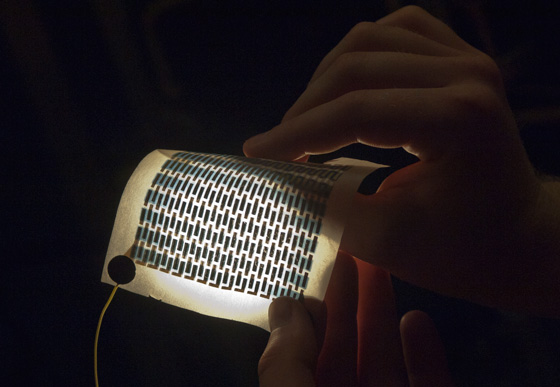
An American- Chinese team of solar developers shows that there is a way that they can develop highly efficient solar cells from cheap wood fiber.

A team of developers from the South China University of Technology teamed up with the University of Nebraska-Lincoln and revealed a report that shows that a new type of paper can be used as a base for the future generation of solar cells. The innovative cells could reach a level of 95% of transparency.

The report underlines the fact that the new wood-based papers has a bigger quality that all the other materials, especially regarding transparency, low-cost, efficiency and eco-friendly performance that can revolutionize the solar PV industry.

As the report shows, the paper constitutes of TEMPO-oxidized wood fibers that dispose of micropores and nanopores instead, so that the transparency values and optical haze reach values above 90%, respectively 60%. The latter is the highest figure among the transparent substrats. Normally, materials that offer a big transparency , a big advantage for the solar transmission, lower the optical haze values to less than 20%.

But the TEMPO treatment undermines the connection between the microfibers that make up generally wood fibers leading them to crash into a structure that dispose of micropores. Usually, the wood fibers in ordinary paper have low transparency because of the microcavities that are a part of the porous structure. The transparency is booted by replacing micropore with nanapores

The representative of the Department of Materials Science and Engineering at the University of Maryland , Liangbing Hu , says that “the papers are made of ribbon-like materials that can stack well without microsize cavities for high transmittance, but with nanopores for high optical haze.”

Apple wants to go green with a solar-powered MacBook

Apple recieved patent solar-powered  laptop

Apple has plans for renewable display for Macbooks

The solar-powered MacBook is to use a PV unit for energy generation, as the patent application reports

Apple looks set to go solar with one of its next lines of Mac Books.

The U.S department of Patent and Trademark authorized the Cupertino company a license for an “electronic device display module and a two-sided display that contains a photovoltaic unit that can be used as the both the screen and lid of the new laptop from Apple.

As the patent abstract states, “the rear plate may be formed from electrochromic glass and may cover photovoltaic cells and touch sensors”.

The Patent and Trademark Office publicized an Apple application in last year’s fall that explained a possibility of gearing electronic devices with internal converters with the purpose of using external solar panels.

Although the rumors that the MacBook company is working on the development of PV technology for its products, Apple did not made any official statements.

Theories about Apple’s investments in the green energy area appeared after the company purchased a module manufacturing facility from First Solar last year in Mesa, Arizona.


Trade war between US and China escalates

Solar trade disputes on anti-dumping duties

Solar trade war between US and China

A trade war begun between US and China as politicians argued and it all that started from a misunderstanding between solar manufacturers in China and Taiwan and U.S. Department of Commerce.

The ministry of Commerce in China responded to anti-dumping measures and counter investigations on Chinese solar products as it follows: “China will closely follow the case, assess the impact on the Chinese solar sector and resolutely safeguard our interests through various mechanisms.”

With delegates from China, Hong Kong, Chinese Taipei and the U.S. that participated in Friday’s pledge, the outcome of the U.S. Department of Commerce to begin anti-dumping (AD) and countervailing duty (CVD) investigations into Chinese and Taiwanese-made modules, including Taiwanese cells, will make sure that negotiations at the WTO, World Trade Organization, will not progress.

The list of goods for which it is hoped all tariffs and other trade barriers will be removed includes solar cells and inverters.

The US department of Commerce announced that an investigation started from a complaint that Chinese manufacturers were using alternative regarding import duties for solar imposed in 2012 to continue and sell at very low prices in the American market.

On the other hand, The Solar Energy Industries Association reported that if the US went forward with a new set of import duties regarding solar panels from China and Taiwan, it could lead to the cut off the supply of low-cost equipment that had a major impact in the industry’s boom in the past few years. A spokesman of SEIA announced that “As the conflict escalates, the threat to the industry grows.”

Researchers found a way to convert solar into fuel

Solar top be converted in fuel for cheaper energy

Solar can be converted into fuel

The Frontier Research Center at UNC-Chapel Hill discovered a way to transform solar into fuel, so that people could have power even when the sun sets.

People could be truly independent with the help of this system and could say goodbye to the pricey solar batteries. U.S solar power researchers say the sun can be used to separate water into hydrogen and oxygen. The Research Center recently published two papers about this whole process, papers published in the Proceedings of the National Academy of Sciences.

Tom Meyer, a chemistry Professor, explains that the system uses solar power until daylight exist, and meanwhile it cheaply separates hydrogen and oxygen from water. The two elements can then be stored separately and burned for power.

Meyer reports that power utilities have already got infrastructure for that: “See, that’s the beauty of it, I think. With this, you can plug into existing engineering, existing technologies. People know how to generate hydrogen. They know how store it. They know how to use it to extract energy in a power plant. So that’s all done. You know, all we want to do is find a way to give it to them in a relatively inexpensive way using the sun.”

Meyer also believes that this method can be used for cheaper power utilities someday:
“This is a basic research project that’s knocking on the door to become a technology. I think the principles are established and it’s really important, but the efficiency of the devices that we have are very low. That is, ‘Here’s all the sun’s energy. How much do you actually use in a useful way?’ And the answer’s about one percent.”

What Mayer says is that right now, only one percent of the solar power that gets to the device is being used to transform water into fuel. He also believes that the procedure won’t be effective for commercial use until that one percent turns into 10. His team also research for a way of separating carbon dioxide into its basic elements for fuel.

Every hour of the first three months of 2014 a PV plant will be installed

PV demand record to be broken in 2014

Solar PV demand to reach 49GW in 2014

The PV market data analyst, NPD Solarbuzz, shows that global solar PV request will get to 49 GW next year.

The forecast shows that 5 MW of phtovoltsics are to be installes evey hour, at least in the first trimester, a record for solar installations. Global solar analysts NPD Solarbuzz have predicted that the PV demand will gow to 49 GW in 2014.

Moreover, starting from the final three months of this year and finishing with the first one in 2014, 22 GW of capacity will be planted, meaning a new 5 MW farm will rise every hour. Though 36 GW of estimated capacity is to be installed by the end of next year, that figure is said to be aced by 30%.

“The solar PV industry has reached a critical tipping point, with end-market demand hitting record levels almost every quarter.” said NPD Solarbuzz vice president Finlay Colville. “This growth is being driven by leading module suppliers and project developers that returned to profitability during 2013, and which have now established highly effective global sales and marketing networks,” he added.

The data analyst also says that the last semester of this year will break even more records for solar capacity since the 12GW barrier is set to be broken for the first time in the history of PV, record to be overcome in the first semester of the next year.
At the top of the list with the higher demand are the Chinese market, the Japanese one and U.S is leading,, and most of the panels installed next year will be located in this areas.

“Manufacturing overcapacity and pricing erosion within the PV industry was previously a key factor in limiting annual growth to between 10-20% between 2011 and 2013.With a more stable pricing environment and the prospect of increased end-market globalization, NPD Solarbuzz forecasts a return to annual growth above 30% for the PV industry in 2014.” announced Colville.

Roxana MORARU