BMW will convert landfill methane in to hydrogen

BMW is one of the most eco-friendly manufacturers in the world and he make green efforts for the environment conservation.

BMW is all set to research on extracting hydrogen from methane gas found in a specified local landfill.

BMW’s North American plant in Spartanburg, South Carolina, currently has a fleet of over 100 material handling vehicles that are powered by hydrogen.

It is one of the very few automobile plants that houses majority of the systems under a single roof.

The automaker hopes to build the infrastructure needed to power the entire fleet from hydrogen.

The plant already has hydrogen storage and a distribution area, which could be integrated into a full-scale version of the new project.

The project will cost a million dollars and will go through multiple phases.

The German automaker had actually saved $5 million per year after the implementation of high efficient technology.

An amazing solar tower in Arizona will power 150.000 homes

EnviroMission has decided to set up a solar tower with huge dimensions in the desert of Arizona.

The tower will instantly become one of the world’s tallest buildings because it measure some 2625 ft in height and 130 meters in diameter.

The structure will produce 200MW electricity, enough to power 150,000 US homes.

This project would also be a good money eater, costing a sensational US$750 million to the participants.

Arizona being a desert has an air temperature as high as 40 degrees Celsius.

As we know that air rises up making space for a cooler gush, the heated air at the bottom of the tower would rise up and the temperature at the ground level can be raised to 80 – 90 degrees.

Turbines would be integrated into the system such that when the hot air makes its upward move, it rotates the turbines and electricity is generated.

The temperature will be greater between the layers of air if the tower is planned tall and more energy would be generated.

No continuous raw feed would be required to keep the system working. Nature would take that responsibility.

This arrangement can be expected to keep working for 80 years without any maintenance need.

A solar-powered superyacht is available for charter in the Mediterranean

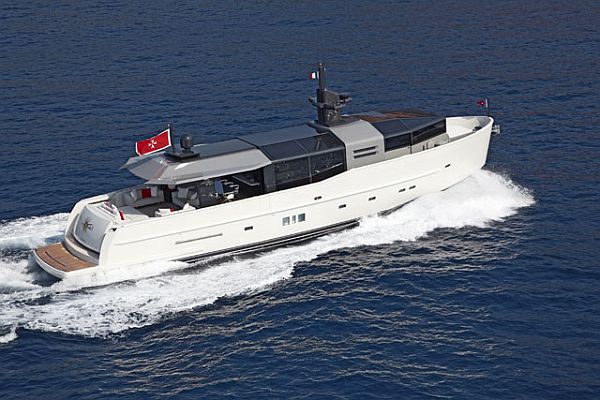
Arcadia 85, the super-yacht built with solar panels is offering charter holidays in the Mediterranean, during the summer of 2011.

The solar-powered yacht was named ‘Solar’ and from €49,000 (about $70,371) per week, up to eight people can feel confident about their carbon footprint, without losing out on luxury.

This yacht has the lowest fuel emission of any yacht in its class because it has an economical speed of 9 knots, when the diesel engines use only 30 liters per hour.

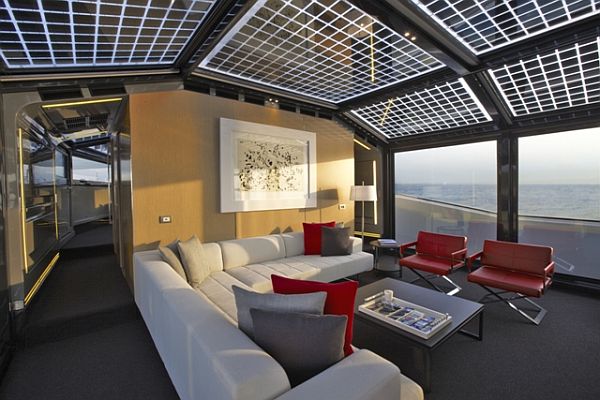
Solar’s panels run the hotel load, which it means everything from air conditioning to lighting, plus pumps and refrigeration.

The Solar yacht was built by  Edmiston & Company, it boasts a deck of 60 square meters and has  four cabins that have all necessary audio visuals, a spacious saloon in the top deck which is the entertainment area and sitting place and a huge saloon.

The super-yacht reaches a top speed of 18 knots propelled by a fuel that is organic in nature.

Also, on the yacht is a delicious cuisine where the chef uses only organic ingredients.

This is the perfect green-way to relax on your holiday.

A solar-powered superyacht is available for charter in the Mediterranean

Arcadia 85, the super-yacht built with solar panels is offering charter holidays in the Mediterranean, during the summer of 2011.

The solar-powered yacht was named ‘Solar’ and from €49,000 (about $70,371) per week, up to eight people can feel confident about their carbon footprint, without losing out on luxury.

This yacht has the lowest fuel emission of any yacht in its class because it has an economical speed of 9 knots, when the diesel engines use only 30 liters per hour.

Solar’s panels run the hotel load, which it means everything from air conditioning to lighting, plus pumps and refrigeration.

The Solar yacht was built by  Edmiston & Company, it boasts a deck of 60 square meters and has  four cabins that have all necessary audio visuals, a spacious saloon in the top deck which is the entertainment area and sitting place and a huge saloon.

The super-yacht reaches a top speed of 18 knots propelled by a fuel that is organic in nature.

Also, on the yacht is a delicious cuisine where the chef uses only organic ingredients.

This is the perfect green-way to relax on your holiday.

The new generation of green rocket

U.S. military researchers have developed a new generation of green rocket fuel.

The new green rocket fuel emits less corrosive and toxic chemicals than the conventional rocket propellants.

Typical rocket fuel is very toxic and creates environmental pollution because the fuel has a structure of propellant which contains high grade kerosene, rubber and chemicals like hydrazine, nitrogen tetroxide and nitrous oxide.

‘One of the important requirements in the development of less hazardous liquid bipropellants for rocket propulsion is reduced vapor toxicity of oxidizer and fuel,’ says propellants expert John Bellerby of Cranfield University, UK.

Also Bellerby adds that hydrogen peroxide is an attractive low-hazard alternative oxidizer and finding a fuel with low vapor toxicity that is hypergolic with this oxidizer and also produces a high performance has proved difficult.

Repeated tests have proved the hypergolicity of the hydrogen rich ionic-liquid fuels with hydrogen peroxide as the oxidizing agent, which can be considered as green bipropellants for the future.

This type of ionic liquids as the pioneer in liquid bi propellants and in the future and will bring out better and green performances.

Rightly placed turbines may increase efficiency

Properly placed wind turbines can generate more energy.

South Australia’s University of Adelaide computer science research succeeded to understand where best these wind turbines may be placed to increase wind power.

Senior lecturer Dr Frank Neumann from the School of Computer Science has developed a step-by-step approach called “evolutionary algorithms”.

Dr Neumann has come to the University of Adelaide this year from Germany where he worked at the Max Planck Institute and now is working on wind turbine placement optimization in collaboration with researchers from the Massachusetts Institute of Technology.

“Renewable energy is playing an increasing role in the supply of energy worldwide and will help mitigate climate change,” says Dr Neumann.

Factors that will influence this development are size of land, wake effects, wind as a whole, wind turbines – their aerodynamics and the resulting complexities of the same.

According to Dr Neumann current approaches to solving this placement optimization can only deal with a small number of turbines.

China’s goal is 50 GW of solar power by 2020

China, the world’s largest polluter will make more investments in renewable energy.

China has some of the globe’s worst air and water quality but has an economy growing.

China doubled its target for solar power capacity to 50 gigawatts for 2020 because his power requirement is one of the highest in the world.

China vast experience in building solar panels will help her in building the necessary infrastructure for its own solar power needs.

Beijing has ordered safety inspections of the country’s nuclear plants and “temporarily” suspended approval of new and proposed projects following the disasters in Japan, but has said it will continue to develop the technology.

China hopes its installed solar power capacity will reach 10 gigawatts by 2015 and 50 gigawatts by the end of the decade.

You can decreases electricity bills and pollutes less by charging EVs at night

How you can do this?

Researchers said that lower electricity rates aren’t the only reason to charge your electric car at night and they come with a theory that finds the fact that using electricity to charge your car at night pollutes a lot less.

Here’s how it happens.

According to this theory less ozone is emitted during nighttime charging. In the chemical reaction between hydrocarbons & nitrogen oxides will result lighter quantities of the byproduct in the air, because of the lack of sunlight.

Sunlight is the the main catalyst behind this reaction.

Yet the night seems to be the best time to recharge electric vehicles, less pollution and lower bills.


Blue Sky Energy Unveils Universal Communication Module

Blue Sky Energy, Inc., a leading manufacturer of photovoltaic (PV) battery charge controllers introduces the Universal Communication Module (UCM) for its Solar BoostTM family of Maximum Power Point Tracking solar charge controllers. Blue Sky Energy’s IPN network based charge controllers coordinate their activities and share resources over the proprietary IPN network. The new UCM provides is a full featured communication bridge or gateway between IPN network based charge controllers and external system, including remote access over the Internet.
According to Melanie Cullen, V.P. of Operations and Marketing, “We are excited to bring the UCM’s web enabled capability to the charge controller market place. The UCM is compatible with all of Blue Sky Energy’s IPN compatible charge controllers and provides multiple standard communication interfaces including RS-485 Modbus, Ethernet based Modbus/IP, FTP data upload, and a built in web site server. Unlike other web enabled products the UCM’s built in web site server allows remote access to all charge controller data and setup parameters over the Internet without a subscription. If an IPN-ProRemote display is present on the IPN network it’s full featured battery system monitoring functionality and associated setup become available as well. The UCM also provides 128 days of data logging of key performance parameters which may be downloaded from the UCM’s web site.”
Source: www.renewableenergyworld.com

Thin film solar technology promises charging phones without need of wires

Electronics users may soon never have to plug their cellphone or e-book reader into a wall again thanks to the latest innovations in thin film solar technology. French company Wysips is planning to launch a transparent solar film that will fit over a device’s screen, charging it without the need for wires.
The company, which has won first place in CTIA’s 2011 Emerging Technology competition, says that the material will be available in flexible or rigid formats, with thicknesses of between 0.1mm and 0.5mm.
The film has an efficiency of 10 per cent, but can scales easily in size, so that it can be used for relatively large areas, the company says.
It also claims that it can be built into screens, fabrics, plastics, and other materials, without affecting their appearance, making it ideal for mobile electronic devices.
The material could be particularly useful for the growing e-book reader category, most of which rely on electronic paper that carries an image with power. These books, which draw power only to change the image on the page, are likely candidates for the material, because their power draw is already so low.
However, Wysips is setting its sights on a wide range of potential markets, envisaging tents with built-in light sources, or garden furniture that can similarly power electrical devices.
Source: www.businessgreen.com/bg/news/2038960/french-solar-innovation-promises-wireless-phone-charging