Sunny Scotland to embrace solar energy

solar panels in Scotland

More solar panels for Scottish homes

Figures showing last month’s sunshine could have powered all the homes in Scotland have sparked calls for more properties to install rooftop panels.

According to Business Green, Scottish homes with solar panels saw more than 100 per cent of their energy needs met by the sun during April, according to data collated by WeatherEnergy, the UK arm of a Europe-wide network of analysts.

The country received enough sunlight to generate 113 per cent of the electricity needs of an average home in Edinburgh, 111 per cent in Aberdeen, 106 per cent in Glasgow, and 104 per cent in Inverness.

Meanwhile, for those homes fitted with solar hot water panels, there was enough sunshine in Edinburgh, Glasgow and Inverness to generate an estimated 100 per cent of an average household’s hot water needs – and 99 per cent for homes in Aberdeen.

“Scotland has long been leading the charge when it comes to wind power,” said Karen Robinson of WeatherEnergy. “However, despite misconceptions, Scotland also has potential for sun-loving renewables too.”

While over 35,000 Scottish homes and 600 business premises currently have solar PV arrays fitted, wind power remains the country’s major renewable electricity source. During April, wind turbines in Scotland generated enough electricity on average to supply the electrical needs of 69 per cent of Scottish households, equivalent to 1.66 million homes.

Prices of solar panels have plunged in the last two years, while efficiency has increased. Tesla’s announcement last week of $3,000 battery to store solar energy could also ensure green electricity on demand for the first time.

“With these sorts of figures, every home or business with a south-facing roof should seriously consider switching on to the full potential of solar power,” said Lang Banks, director of WWF Scotland. “Similarly, there is no reason why Scotland should not be home to commercial-scale solar farms.”

Japan anticipates clean energy will edge out nuclear power

solar energy Japan

Clean energy in Japan. Photo via inventorspot.com

Japan anticipates that by 2030 clean energy such as solar and hydro will generate slightly more of the nation’s electricity than nuclear power plants.

According to renewableenergyworld.com, clean energy sources will supply as much as 24 percent of Japan’s electricity in 15 years, while atomic power will account for as much as 22 percent, according to a draft report from the Ministry of Economy, Trade and Industry on what Japan’s electricity mix should look like by 2030.

Though the eagerly-awaited report — the result of months of study by a ministry panel debating the electricity mix — continues to see a need for nuclear, the draft proposes a diminished role compared with before the Fukushima disaster of March 2011. Nuclear power accounted for more than a quarter of Japan’s electricity generation before the meltdowns at the Fukushima Dai-Ichi reactors.

Even the 22 percent level is doubtful for a nation with one of the world’s oldest nuclear fleets and where the majority of the public has opposed atomic generation since Fukushima, environmental group Greenpeace, which campaigns against nuclear power, said in a statement.

Nuclear’s role has been the central focus of the panel’s discussions. The 2011 disaster triggered strong opposition to atomic power among the public, while the subsequent spike in electricity prices has seen business groups lobby intensively for the nation’s nuclear reactors to resume operations.

Operable Reactors

Nuclear provided about 29 percent of Japan’s electricity in fiscal 2010, while clean energy sources supplied 9.6 percent with most of that coming from hydro. None of Japan’s commercially operable nuclear reactors are working at the moment.

If all 24 nuclear reactors currently under review for a restart by the country’s nuclear watchdog are allowed to switch back on, they would still not be able to generate more than 16 percent of Japan’s power, Greenpeace estimates. At least 10 more reactor units need to resume operations to reach the government’s target for nuclear, the group said.

Such a mass-scale restart is unlikely, according to Shaun Burnie, a nuclear specialist at Greenpeace Germany.

“The scale of the challenges facing the nuclear industry are such that generation from reactors is likely to collapse during the coming decade,” Burnie said in the statement. “Many reactors will never restart, and most reactors over the coming years will be too old to operate.”

Latest Proposal

The latest proposal signals less reliance on nuclear than a previous plan released in 2010. Japan had been envisioning nuclear and renewable sources supplying 53 percent and 21 percent of power, respectively, by 2030, under the government led by the Democratic Party of Japan.

The DPJ’s stance shifted following the Fukushima disaster, with the party eventually calling for all nuclear to be phased out. The DPJ was replaced by a coalition led by the Liberal Democratic Party in December 2012.

The draft foresees hydro power accounting for as much as 9.2 percent of Japan’s total power generation, with solar at 7 percent, wind at 1.7 percent, biomass coming in at as much as 4.6 percent and geothermal as much as 1.1 percent, according to the release.

By 2030, gas will supply 27 percent while coal and oil will provide 26 percent and 3 percent, respectively.

The release came a day after the trade ministry issued draft estimates of power generation costs. Nuclear is estimated to be the cheapest source, as low as 10.1 yen per kilowatt hour, by 2030.

Large-scale solar was estimated to cost 12.7 yen to 15.5 yen, while onshore wind was projected to cost 13.9 yen to 21.9 yen, according to the ministry.

MIT research team is turning salt water into drinking water using solar panels

Solar-powered desalination

Solar-powered desalination. Image via sciencealert.com

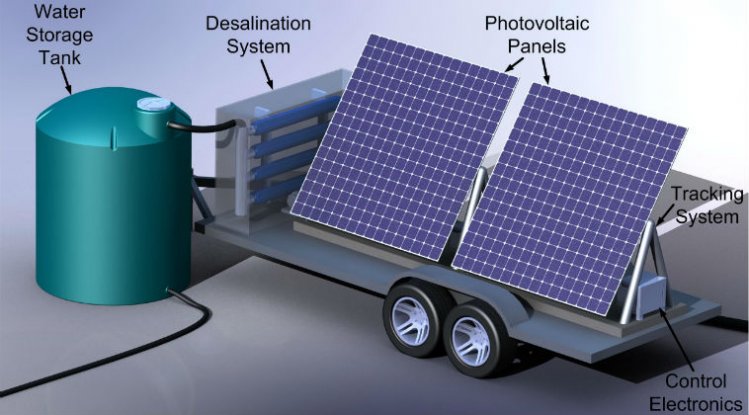
By inexpensively turning salt water into drinking water using sustainable solar power, a team from MIT in the US has not only come up with a portable desalination system for use anywhere in the world that needs it, but it’s just won the 2015 Desal Prize – a competition run by USAID to encourage better solutions to water shortages in developing countries.

In order to win the $140,000 prize, entries had to demonstrate how their invention not only works well, but is cost-effective, environmentally sustainable, and energy efficient. And the MIT researchers teamed up with US-based manufacturing company, Jain Irrigation Systems, to do just that.

According to Science Alert, the team’s invention works by using solar panels to charge a cache of batteries that power an electrodialysis machine that removes salt from the water and makes it perfectly drinkable. David L. Chandler explains for MIT News:

“Electrodialysis works by passing a stream of water between two electrodes with opposite charges. Because the salt dissolved in water consists of positive and negative ions, the electrodes pull the ions out of the water, Winter says, leaving fresher water at the centre of the flow. A series of membranes separate the freshwater stream from increasingly salty ones.”

Solar-powered desalination plants are nothing new, and officials are investigating potential in water-poor areas such as Chile and California right now, but the technology has so far been extremely expensive to both piece together and run. And this obviously makes it difficult for developing countries to adopt. The key to the MIT plant is the electrodialysis process, says Chandler, talking to one of the team, mechanical engineer Amos Winter:

“Both electrodialysis and reverse osmosis require the use of membranes, but those in an electrodialysis system are exposed to lower pressures and can be cleared of salt buildup simply by reversing the electrical polarity. That means the expensive membranes should last much longer and require less maintenance, Winter says.”

Chandler reports that the MIT system can turn 90 percent of the salt water that’s fed into it into drinking water, which is huge, compared to the 40 to 60 percent from reverse-osmosis systems.

The team has been testing their system out in several villages across India since 2014, and have been using the Brackish Groundwater National Desalination Research Facility in the US to run 24-hour tests to analyse its efficiency and cost of maintenance. According to Mary Beth Griggs at Popular Science, in just 24 hours, their system can remove the salt from 2,100 gallons (7,950 litres).

They’re now hoping to expand their field tests to rural communities in developing countries, in the hopes that they can set them up as irrigation systems in small farms. “A solution with the potential to double recoverable water in an environment where water is becoming more precious by the day could have a huge impact,” environmental and civil engineer Susan Amrose from the University of California at Berkeley, who was not involved in the research, told MIT News.

Trina Solar sets new world record for high efficiency solar panels

Trina Solar world record

Trina Solar sets new solar panel efficiency world record. Image via pv-tech.org

Trina Solar’s State Key Laboratory of PV Science and Technology of China has set a new world record for high efficiency p-type multi-crystalline silicon solar panels.

According to Energy Matters, Trina says its test Honey Plus multi-crystalline silicon module attained a new module efficiency record of 19.14% with an aperture area of 1.515 m2.

The results were confirmed by the National Center of Supervision and Inspection on Solar Photovoltaic Product Quality (CPVT) in Wuxi, China.

The 60-cell panel features advanced technologies including back surface passivation, local back surface field and half-cell module technologies. Trina says the half-cell module technology is not currently part of the Honey Plus products, but will be incorporated at a later date.

“To the best of our knowledge, this is the first time that a multi-crystalline Silicon PV module reaches an efficiency higher than 19%. It demonstrates that multi-crystalline Silicon PV modules can reach an efficiency level that was reserved to the most efficient solar cells before, such as mono-crystalline IBC or heterojunction cells,” said Dr. Pierre Verlinden, Vice-President and Chief Scientist of Trina Solar.

”This milestone achievement is the result of a very close collaboration among our silicon crystallization, solar cell and module scientists. We believe that innovation is playing the very essential role to Trina’s sustainable growth and long-term success. Our focus remains on developing innovative and cutting-edge solar power products and technologies to strengthen our leadership in the PV industry.”

In other recent news, the company announced the signing of an agreement with Toyo Engineering Corporation to supply approximately 116 MW of Trina Solar panels for use in Japan’s largest solar power project – a 231-megawatt facility to be built in Setouchi City, Okayama Prefecture.

Approximately 446,000 Trina Solar TSM-260PC05A modules will be used in the project, which will be situated on 1,210 acres of city land on the former Kinkai salt field.

The project is expected to commence commercial operations in the second quarter of 2019.

Trina Solar says Japan is a key market for the company and that solar will play a crucial role in the growing diversification of the country’s energy mix.

Trina Solar panels are also popular choice in Australia, where they are often used in residential solar power system installations.

Tesla’s new home battery to solve one of solar power’s biggest problems

Tesla's new home battery

Tesla’s home battery to be unveiled this month. Photo via gizmodo.com

So far, specific details are thin on the new battery designed for home use that Tesla will unveil this month. But just based on what we do know, it’s a pretty big deal. The quest for a good battery that can store home-generated power is kind of like the holy grail for a renewable energy future. This one product might change everything.

A New York Times article published earlier this week essentially sets up the problem that Tesla’s battery will solve. In Hawaii, 12 percent of homes have some kind of solar energy, by far the highest rate for any place in the US at the moment. In fact, that rate is growing too quickly—solar customers are dumping so much energy back onto the grid that they’re taxing the delicate and often aging infrastructure that was only designed to deliver power to homes. What’s happening in Hawaii is actually indicative of what’s going to be an issue everywhere as many cities start to see an increase in large-scale solar implementation: There’s going to be too much energy generated, and nowhere to put it.

According to Gizmodo, utility companies might spend the money to upgrade the grid, but even then it’s difficult for them to predict how much more capacity they’ll need (and of course those costs will certainly be passed down to consumers). The absolute best idea is for homeowners to start installing batteries that can store the power for later use instead of giving the power back to the utilities, something called peak load shaving. It’s not just solar power that can be stored, of course—it can also come from wind turbines or hydroelectricity or the treadmill you rigged together to juice up your house with kinetic energy.

Enter Tesla. In its quest to design the perfect electric car, Tesla has pretty much engineered the best battery on the market. Now, basically, the company is manufacturing an electric car battery for home use. They’re already out there: Tesla’s installed batteries in about 400 locations, including businesses like Walmart. Supposedly this new battery concept will improve upon what’s available now. But the real game changer here—like almost everything about energy—is price.

Thanks to companies like Tesla, the cost per kilowatt-hour of these batteries is coming down much faster than once predicted. Right now, Tesla’s batteries are about about $300 per kWh, which is comparable to the market rate the industry expected for 2020. This cost is intertwined with the proliferation of renewable energy because cheaper batteries mean that the price of entry for something like solar energy is essentially cheaper. Which means more people will be able to get into the solar game.

The biggest news here—and why utility companies are likely worried—is that with a cheaper, more accessible battery, homeowners will now very easily be able to achieve complete energy independence. You could store your power for off-peak usage, and you might be able to sell your excess energy to a neighbor. In the near future, cord-cutting may mean severing one’s self from the electrical grid.

Now here’s the very interesting twist: Tesla is also announcing a “utility-scale” battery, something we don’t know anything about at all. If this is something that the utility companies can use to help shoulder some of that grid burden, then this, too, will be a game changer for utilities. That’s a win-win for both energy customers and energy companies.

Solar soda bottles to light our streets

Solar soda bottle street lights

Solar soda bottle street lights

The streets of San Luis, Bogota, Colombia are now a little safer thanks to low cost solar-powered soda bottles.

Costing just USD $70 to construct, the street lights use a 3 watt LED lamp, controller and battery pack powered by a couple of small solar panels. The protective casing used for the lamp is just a plastic soda bottle – pretty much unbreakable under most conditions.

According to Energy Matters, 14 locations in Colombia have already been illuminated with these solar street lights and there are plans to install another 2,000 across the country in this year.

Quartz reports the super-cheap solar streetlights are a project of Liter Of Light; an organisation that rose to prominence with its promotion of Moser lamps. A Moser lamp is a plastic bottle filled with water inserted into a roof to refract sunlight into the room below; with a with a brightness equivalent to a 55w electric bulb.

Tens of thousands of households in the Philippines capital Manila alone have so far benefited from Liter Of Light’s Moser lamp inspired revolution, which has now also spread across the world.

2015 is International Year of Light and Light-based Technologies (IYL 2015). IYL 2015 isn’t just about increasing access to light, but the right sort of light. Lighting represents almost 20% of global electricity consumption (International Energy Agency). While this has a significant impact on the environment in relation to coal fired power generation, worse still is lighting fueled by kerosene.

“In developing and third-world countries without access to electricity, 1.3 billion people depend on kerosene for light. The burning of kerosene lamps leads to the death of 1.5 million people every year. Inhaling kerosene smoke is the equivalent of smoking 4 packs of cigarettes a day, and commonly induces respiratory illnesses such as asthma, bronchitis, pneumonia, and cancer in tens of millions of people,” states the IYL 2015 web site.

It’s also very expensive, with some families spend up to half of their income on kerosene.

An important aim of the International Year of Light will be to promote the use of portable solar-powered LED lanterns in regions where there is little or no reliable source of light. Solar lighting is literally changing lives – enabling extended productivity, enhanced security and without the negative health impacts.

Other low-cost solar powered LED lighting designed specifically for developing nations that we’ve covered in the past include LUCI, Luminaid, Solar Pebble, the Solar Schoolbag and the Australian-designed Mandarin Solar Light and Sunking.

Turkish farms will use solar power to cover their own electrical demand

solar farm

Solar power for Turkish agricultural sector

Solar energy is about to power Turkish agricultural sector, which is among the most significant market sectors in the country. In the upcoming period, the most important innovation for the sector will be clean energy produced by solar panels.

According to Daily Sabah Business, the aim is to use solar energy to cover all energy expenses of agricultural lands that are large enough to support it. The devised system is especially advantageous for farmers using well water, since they have to pay high bills for using electrical engines to pump water from the ground.

The cost of this process decreases nearly one-10th and the system also recoups its costs within two years by operating drip irrigation systems.

The Ministry of Energy and Natural Resources, the Ministry of Economy, Ministry of Food, Agriculture and Livestock and the Ministry of Finance are carrying out collaborative work to establish an effective incentive policy on this issue. The fact that the energy surplus obtained from the energy plants will be transferred to the government increases the attractiveness of the project, and the number of Turkish companies specializing in the field is increasing daily.

Abeer Seikaly’s stunning woven refugee tents powered by the sun

Solar-powered tent

Solar-powered shelters for disaster zones

Award-winning architect and designer Abeer Seikaly has created a practical yet beautiful solution to the need for lightweight, mobile, and structurally sound shelters for disaster zones.

According to inhabitat.com, the Canadian-Jordanian’s Weaving a Home project not only provides flexible, transportable shelter, but also incorporates water collection, solar power generation and solar water heating into the design.

Drawing inspiration from traditional basket weaving techniques and the flexibility of snake skin, the designer uses weatherproof fabric drawn between durable, curved plastic tubing. This creates a structurally sound tent that can handle both compression and tension loads.

The double-layered fabric tent skins are also hollow, allowing for weatherproof entrances and for water piping and electrical cables to run between the layers. While the design is scalable, the models shown are five meters in diameter and 2.4 meters high.

Solar-powered tents

Solar-powered woven refugee tents. Image via designboom.com

Each tent has its own water collection system, utilizing the natural channels formed by the skin to direct water to the storage point. By using a fabric with strong thermal properties, the tents can also convert solar radiation into power and heat collected water for showering. The strength of convection can also be used to draw fresh water into the heating system from an external source. The flexible design of the tents allow for openings to be made wherever they are needed to allow hot air out and to catch any cross-breezes. The tents also seal up tight in case of wet weather or cold conditions.

Seikaly states: “‘Weaving a Home’ reexamines the traditional architectural concept of tent shelters by creating a technical, structural fabric that expands to enclose and contracts for mobility while providing the comforts of contemporary life (heat, running water, electricity, storage, etc.)” The honeycomb-like design folds up neatly when not in use to allow for easy transportation to wherever the tents are needed. The project was a winning entry in the 2013 Lexus Design Awards.

Finland’s largest solar power plant under construction in Oulu

Oulu solar plant

Pilot results show that solar systems in Oulu produce as much electricity as those in northern Germany. Photo: Kalevi Rytkölä / Yle

Finland’s largest solar power plant, comprising of 1,600 solar panels producing 420 kilowatts of power, will be built in Oulu on the roof of the local printing plant this spring. The northern city of Oulu is quickly making a name for itself as a pioneer in the use of renewable energy sources.

According to yle.fi, Oulun Energia Group has announced plans to build a solar power unit on the roof of the local Kaleva newspaper’s printing plant in Oulu this spring. The 420-kilowatt unit will have 1,600 solar panels, combining to make a total panel surface area of approximately 2,400 square metres. Along with the support equipment, the setup will cover near to 3,200 square metres, which equals nearly half a football field.

System installation will begin in April, and the objective is for the unit to be operational by June 2015.

“On a clear summer day, we expect to gain up to 90 percent of the electricity required to run the Kaleva printing operations via solar. Annually, the solar energy obtained should cover about 10 percent of the printing house’s electricity costs,” says Kaleva’s CFO Esko Jokelainen.

The manufacture of solar panels in Finland is only in its early stages, so the panels for a project this large must be ordered from Germany. All of the other labour for the installation, from transport to assembly, will be carried out by local employees from the northern Finland region.

“Solar energy and other distributed energy production solutions will proliferate in the next few years and therefore create more jobs in northern Finland as well,” says Oulun Energia Group’s Sales Director Seppo Tuomi.

Oulun Energia Group generates, transmits, distributes and sells electricity and district heating in the Oulu region and is owned by the city of Oulu.

Why Oulu?

Located in North Ostrobothnia, Oulu is the largest city in northern Finland and the sixth largest city in the country, with a population over 200,000. It is one of the northernmost larger cities in the world. Situated this far north, one could wonder how a solar plant could be feasible with so many dark winter months in the year.

But the city of Oulu has taken on the role of a ‘living lab’, where residents experiment with new technologies from ICT to cleantech. Consequently, in per capita R&D spending, it ranks first in Finland and fifth in Europe. Oulu also has Europe’s largest technology park.

Oulun Energia Group conducted a pilot project for solar energy, testing the efficacy of 16 customer solar systems installed on local homes.

The pilot was surprisingly successful, producing results that were comparable to solar energy production conditions elsewhere. If properly situated, a 5-kilowatt system of 20 panels produced up to 4,500 kilowatts of electricity, which directly corresponds to a similar system in northern Germany.

In the Oulun Energia Group’s report on the pilot project, Tuomi is confident that there is significant potential for growth for photovoltaic systems in Finland.

“Solar energy systems are suitable for both businesses and consumers. Using them in the summer time to cool down property is particularly profitable. The cost of the panels is low, the payback period is reasonable and in ideal locations, the costs are clearly cheaper than grid electricity.”

The EU has set a climate target that 38 percent of member countries’ electricity consumption should be obtained from renewable energy sources by the year 2020.

Oil downturn slows progress in bringing solar power to mines

solar panels

Solar power in mines

High oil prices spurred mining companies to look at renewable energy to cut their diesel fuel bills. With crude plunging, it’s a different story today.

According to Bloomberg, an almost 50 percent drop in crude oil in the past year has pushed diesel prices lower, leading mines and other energy users to delay adding solar and wind projects.

“There’s no doubt about it there are a lot of parts of the world that see the drop in price as a reason for them to stall the decision on whether to proceed,” said John Eccles, director of global hybrid generation at First Solar Inc., the largest U.S. solar panel manufacturer.

Global renewable energy investment in mining was forecast last year by Ernst & Young to rise almost twentyfold to $3.9 billion by 2022. Now that target will take longer to reach, according to the consultants.
“While oil prices remain lower, it will slow down the adoption rate of alternative energy,” Mike Elliott, the Sydney-based global mining and metals leader at Ernst & Young, said by phone.

“There will be some of those investment decisions that will still default to a conventional fuel source as opposed to a renewable source,” he said.

As miners expanded into more remote locations during the decade-long commodities boom, they grew more dependent on diesel to generate power at sites that aren’t connected to the electricity grid. Energy accounts for as much as 40 percent of the operating costs at some mines, according to Ernst & Young.

Remote Projects

There are fewer than 12 remote mining projects in the world that get at least half of their power from wind and solar, mostly ones in Chile that have been developed over the past couple of years, Elliott said.
When oil prices surged and renewable energy costs fell, it gave miners in countries from Chile to Australia a strong incentive to increase reliance on wind and solar to offset some of their diesel consumption.

The oil price drop may still benefit renewable energy. At least 27 nations are decreasing or ending the subsidies that hold down costs for fuels used to generate electricity, including coal and natural gas, the International Energy Agency said in November. That’s adding momentum to global efforts to limit greenhouse gases by increasing the use of clean energy.

Efforts globally to reduce carbon emissions will probably continue to lead miners to weigh wind and solar projects when making investment decisions, Elliott said.

Competitive

Even with the drop in oil, total diesel fuel bills remain higher in some regions due to a range of factors from taxes to transportation costs, increasing solar’s appeal as an energy source, said First Solar’s Eccles.
The number of solar-diesel hybrid projects is forecast to increase, according to Tempe, Arizona-based First Solar, which signed a deal last year to bring solar power to a Rio Tinto Group bauxite mine in Queensland state.

Solar photovoltaic technology over time “needs lower and lower fuel prices to be economically competitive,” Eccles said. “There’s a long investment horizon. It needs time to crystallize, and then you’ll see a more rapid uptake.”

About 40 to 50 power projects in remote locations across Australia, the world’s biggest exporter of iron ore, are seeking funding from the Australian Renewable Energy Agency, its chief executive officer, Ivor Frischknecht, said in a phone interview.

“Some projects have slowed down a little bit in terms of how aggressively they are pursuing it” as the price of diesel declines, he said.