World’s first solar-powered cricket stadium

Solar-powered cricker stadium

Bengaluru’s Chinnaswamy stadium. Photo: India Today

This year’s edition of the Indian Premier League in Bengaluru will be played on what the state cricket association claims is the world’s only solar-powered cricket ground.

According to The Economic Times, the Karnataka State Cricket Association (KSCA) has commissioned a 400-KW solar plant to power the entire M Chinnaswamy stadium, except for the high-intensity floodlights, before the IPL season commences next month. The company executing the project has proposed powering the floodlights too using solar energy as the next step in KSCA’s ‘go green’ mission.

“We are aiming to make this a green stadium,” said KSCA honorary secretary Brijesh Patel, a former India cricketer. “It makes economic sense for us to do this, and the additional power we generate will be offloaded to the grid.”

The Rs 4.5 crore project, commissioned in February and inspired by Germany’s fully solar-powered Freiburg football stadium, is expected to reduce KSCA ‘s power consumption drastically . The state cricket body is headquartered in the Chinnaswamy stadium.

At present, KSCA consumes about 18 lakh units per year. After the solar power project is implemented, it is expected to use about 6 lakh units a year through solar and sell any additional power to the Bangalore Electricity Supply Co grid.

“In a matter of four years, the KSCA will get its returns,” said H Nandi, founder of city-based technology solutions firm MRO-TEK that’s implementing the project.”It would also be able to generate Rs 70-80 lakh revenue with the power it generates.”

MRO-TEK’s next target is the floodlights at the stadium. “Each floodlight consumes about 1 MW power, with each bulb carrying 1,000 watts of power. It can be replaced with 200 watt LED bulbs, which we plan to do experimentally without disturbing other floodlights. With this, power consumption would drastically reduce,” Nandi said.

[VIDEO] Scientists use solar film to separate water into hydrogen and oxygen…without exploding

solar-powered membrane

Researcher Ke Sun, an author of the new study holds a sample of the film that he helped develop. Photo: Lance Hayashida/Caltech

Hydrogen powered cars are slowly accelerating in popularity with boosts from infrastructure development and car manufacturers. But getting eco-friendly hydrogen is still a bit of a challenge. Right now, a lot of hydrogen is produced through mixing steam and natural gas. An alternative to using natural gas is electrolysis, using an electric current to pull apart the oxygen and hydrogen in water, but current methods use way too much energy to make it worth it.

Scientists around the country are working on making the process simpler, using AAA batteries, chemical reactions and other methods to make hydrogen a greener choice.

Of course, one of the greenest methods is to act like a leaf, and use the sun for energy.

According to Popular Science, a new study published in the Proceedings of the National Academy of Sciences announces the development of a transparent film that uses energy from the sun to separate water into hydrogen and oxygen, without some of the dangerous side effects inherent in the process.

Author Nate Lewis and his colleagues at Caltech created a thin coating of nickel oxide that can be applied to semi-conductors made of silicon or other materials–a setup that acts like an artificial leaf, using sunlight to power the system. When introduced to water, one side of the ‘leaf’ oxidizes the water, releasing oxygen, while the other side gathers the hydrogen.

A membrane keeps the newly separated hydrogen and oxygen isolated from each other, which helps reduce the risk of explosion. If heat (or electricity) is added to a mixture of hydrogen and oxygen the results can be incredibly explosive, much more so than each gas on its own. Check out the differences in burning oxygen, hydrogen, and a mix of the two in the video below.

“Without a membrane, the photoanode and photocathode are close enough to each other to conduct electricity, and if you also have bubbles of highly reactive hydrogen and oxygen gases being produced in the same place at the same time, that is a recipe for disaster,” Lewis says. “With our film, you can build a safe device that will not explode, and that lasts and is efficient, all at once.”

The film has other benefits too. Other research groups have also developed solar powered water-splitters, but those tend to have a very short shelf life, breaking down quickly. In addition to not exploding (always good) the new coating is transparent, which helps get sunlight to the leaf, and it is also rust-resistant, meaning that the material can work for a long time without degrading.

Solar charge controller to improve efficiency of solar panels

charge controller

New controller for solar panels

The simplest and easiest way to charge a battery with a solar panel is to connect the panel directly to the battery. Assuming the panel has a diode to prevent energy from flowing through it from the battery when there’s no sunlight. This is fairly common but not very efficient. Debasish Dutta has built a charge controller that addresses the inefficiencies of such a system though, and was able to implement maximum power point tracking using an Arduino.

Maximum power point tracking (MPPT) is a method that uses PWM and a special DC-DC converter to match the impedance of the solar panel to the battery. This means that more energy can be harvested from the panel than would otherwise be available. The circuit is placed in between the panel and the battery and regulates the output voltage of the panel so it matches the voltage on the battery more closely. [Debasish] reports that an efficiency gain of 30-40% can be made with this particular design.

According to Hackday, this device has a few bells and whistles as well, including the ability to log data over WiFi, an LCD display to report the status of the panel, battery, and controller, and can charge USB devices. This would be a great addition to any solar installation, especially if you’ve built one into your truck.

This is [Debasish]’s second entry to The Hackaday Prize. We covered his first one a few days ago. That means only one thing: start a project and start documenting it on hackaday.io

Solar Shirt: the phone charger you can wear

solar shirt

The solar shirt. Photo: Holst Centre

Ever had the frustration of your phone, camera or GPS battery going flat when you’re out and about? That could soon be a thing of the past thanks to the Solar Shirt – the follow-up project after Wearable Solar. Created in collaboration by Holst Centre, TNO and renowned fashion designer Pauline van Dongen, the shirt brings the worlds of high tech and high-street fashion together.

It combines solar panels and flexible electronics into an attractive, off-the-peg T-shirt for everyday wear that can charge your smartphone or other portable devices.

According to Printed Electronics World, the Solar Shirt generates power from 120 thin-film solar cells integrated into the fabric itself. In bright sunlight, it produces around 1 W of electricity – enough to charge a typical phone in a few hours. Indoors, the shirt generates enough power to keep a battery charged – so your phone or other device is always ready when you need it.

The shirt can charge smartphones, MP3 players, cameras, GPS systems and other USB-compatible handheld or portable devices. And if all your devices are charged, the electricity can be stored in the shirt’s battery pack for later use.

The solar cells are combined into standardized functional modules using Holst Centre’s vast solar cell know-how developed within the Solliance alliance and its stretchable electronics technology for integrating electronics into fabrics. This technology is part of a research program on wearable applications that integrates functionalities ranging from lighting (LED/OLED), energy harvesting (PV), sensors and displays, in textile or other flexible materials.

The solar cell modules can be mass-manufactured in a cost effective way by Roll to Roll compatible technologies and then incorporated into the fabric using familiar industrial “iron-on” techniques before the garment is stitched. Designers and garment manufacturers can arrange the modules as they like, giving them complete freedom to create their own unique designs,” says Holst Centre’s Managing Director Ton van Mol.

The Solar Shirt design was created by fashion designer Pauline van Dongen, a pioneer in the field of wearable technology garments. “Wearing solar cells lets us harness the sun’s potential energy and become a power source ourselves. As a designer, I’m excited by how solar cells can add to the esthetic of a garment. To date, all attempts to combine solar technology and fashion had focused on one-off haute couture designs.With Holst Centre’s technology, we were able to seamlessly integrate the technology and the design so they mutually inform each other – advancing the concept and value of fashion. We’ve taken solar fashion from the catwalk to the high street, with an attractive yet practical garment that people could wear every day,” she says.

“Our technology enables extremely thin electronics that are stretchable, flexible and washable. It can be integrated into fabrics using standard high-volume techniques that are well known in the textile industry. The maturity of the technology means textile manufactures could bring functional fabrics to market in a matter of months using existing production facilities. Pauline is one of the leading names in wearable technology, and her design shows how technology and fashion can complement each other to create desirable clothing that has a function,” adds Holst Centre’s Margreet de Kok.

The first solar-powered round-the-World journey has begun

Solar Impulse 2

Solar Impulse plane begins epic global flight

An historic attempt to fly around the world in a solar-powered aircraft the weight of a minivan began Monday as the plane took off from Abu Dhabi on the first leg of its record-breaking journey.

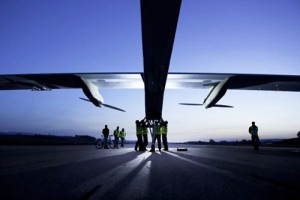
According to The Washington Post, the Swiss-made, single-seat plane left Abu Dhabi’s Al Bateen Executive Airport just as the sun was rising. The plane, incredibly light but with a wing-span longer than that of a 747 jet, runs only on solar power. Its wings carry just over 17,000 solar cells that transfer solar energy to four electrical motors that then power the plane’s propellers.

 Electric bikes followed the plane, the Solar Impulse 2, as it taxied to take off, to prevent the wings from touching the runway, the British Broadcasting Corporation reported.

 Solar Impulse founder Andre Borschberg flew the plane on the first leg of its 21,700-mile journey around the world. He will trade off with fellow Swiss co-founder Bertrand Piccard during layovers.

 “After 16 years of a dream, and 12 years of hard work, we hope it will work,” an excited Bertrand told the BBC after the plane took off.

 Some legs of the 25-day, five-month global journey will mean five full days and nights of flying solo, such as when it crosses both the Pacific and Atlantic oceans. It is due back in Abu Dhabi in late July or August.

 The plane will stop at various locations around the world — for the pilots to rest and do maintenance — but also, more importantly, to spread the message about clean, renewable technologies.

 The cockpit of the plane, about the size of a telephone booth, is so cramped it holds only one person. The pilots will not be able to stand while flying, however, but the single seat reclines for stretching and its cushion can be removed to access a toilet.

“We never feel alone in the cockpit, though,” Bertrand told the BBC. He said millions of people around the world were behind the prototype effort to find a more sustainable and cleaner alternative to fossil fuel-powered aircraft. He pointed out that flight pioneer Charles Lindbergh also flew in a small cockpit, whereas now jets can hold hundreds of passengers.

The plane weighs just over 5,000 pounds, about as much as either a minivan or a mid-sized truck. An empty Boeing 747 jet weighs about 400,000 pounds.The solar cells line the top of the aircraft’s long wings and energy-dense lithium-ion batteries sustain it during night-time flying.

On its first leg, the plane will head to Muscat, Oman, a journey that will take it about 10 hours. A typical passenger jet would take just one hour to make the same journey. The best speed for the plane is about 28 mph, the pilots told the Associated Press news agency. The slow speed of the plane means the journey’s legs will take several days and nights of non-stop flying.

Borschberg has been practicing yoga and Piccard self-hypnosis to get ready for the historic endeavor, the AP reported. They aim to rest a maximum of 20 minutes straight, repeating the naps 12 times over a 24-hour period — similar to how a lone round-the-world yachtsman catches small periods of sleep.

Goggles worn over the pilot’s eyes will flash lights to wake him up, the AP said, and armbands placed underneath their flying suits will buzz if the plane isn’t flying level.

The plane will reach an altitude of around 28,000 feet during daytime hours to catch the sun’s rays. At night, when flying over oceans, it will fall to around 5,000 feet.

After two stops in India, the plane will head to China, where it will stay for a month until the days are longer to catch more of the sun’s energy. It also plans stops in Myanmar, Hawaii, Arizona and New York’s John F. Kennedy International Airport. The path across the Atlantic will depend on the weather and could include stops in southern Europe or Morocco.

Those interested can follow the aircraft on Solar Impulse’s Web site, tracking its battery status, energy consumption, location and flight path, as well as how much the pilot has slept and how much food and water he has left. There is also a live feed of the plane’s Monaco-based control room with occasional footage from the cockpit.

Solar Impulse supporter Prince Albert of Monaco attended the Monday take-off. Other sponsors include Masdar, Abu Dhabi’s clean-energy company, Omega, Google and Moet Hennessey, among others, the AP reported.

“Now the adventure has started,” Piccard told the news agency at take-off.

Cheap solar cells made from shrimp shells

Solar cells from shrimp shells

Solar cells from shrimp shells

Scientists from Queen Mary University of London (QMUL) have created electricity-generating solar cells using chemicals derived from the shells of shrimp and other crustaceans, a development that could have a major impact on the cost of producing solar panels.

According to Energy Matters, the research is focused on nanotechnology, specifically the highly conductive light-absorbing quantum dots used in thin-film and spray-on solar technology.

These tiny crystals can be tuned to specific wavelengths of light, multiplying the energy production of electrons throughout solar devices. They can also trap and convert infrared light to energy, light that would otherwise heat up and degrade photovoltaic processes.

The team discovered that two materials found in the shells of shrimp and crustaceans, chitin and chitosan, could be used to replace expensive metals like ruthenium and platinum, the expensive and rare metals used to make carbon quantum dots (CQDs).

Using a process known as hydrothermal carbonisation, the QMUL scientists incorporated the shrimp-derived chemicals to successfully produce CQDs. They then coated zinc oxide nanorods with the quantum dots to make solar cells.

“This could be a great new way to make these versatile, quick and easy to produce solar cells from readily available, sustainable materials,” said Dr Joe Biscoe, a researcher on the project.

The efficiency of the solar cells is low compared to the silicon-based solar panels used in rooftop PV systems, but the team hopes their discovery of an organic replacement for rare-earth materials in the production of CQDs will result in cheaper solar energy, at least in the field of thin-film technology.

“Once we’ve improved their efficiency they could be used anywhere that solar cells are used now, particularly to charge the kinds of devices people carry with them every day,” Dr Briscoe said.

Professor Magdalena Titirici, Professor of Sustainable Materials Technology at QMUL, added,

“New techniques mean that we can produce exciting new materials from organic by-products that are already easily available. Sustainable materials can be both high-tech and low-cost…We’ve also used biomass, in that case algae, to make the kinds of supercapacitors that can be used to store power in consu

Solar to become cheapest source of energy over next decade

solar panels

Solar energy to become the cheapest source of energy

Solar energy is set to become the cheapest source of electricity in many parts of the world within the next 10 years, according to a new report from German think tank Agora Energiewende.

Solar energy is set to become the cheapest source of electricity in many parts of the world within the next 10 years, according to a new report released by German think tank, Agora Energiewende.

The report was commissioned by the independently funded organisation, designed to steer Germany towards its 80 per cent renewable energy target.

According to Radio Australia, chief executive officer Dr Patrick Graichen said they wanted to see if recent falls in the cost of photovoltaics would continue.

“The finding is there’s no end to the cost decline in photovoltaics,” he said.

“The technology still has further improvements so we expect that within the next 10 years photovoltaics will become, in many regions of the world, the cheapest source of electricity.”

Dr Graichen said in some sun drenched parts of the world, it would be cheaper than burning fossil fuels.

The Current and Future Cost of Photovoltaics report found the price drop is set to occur even in conservative scenarios, and assuming no major technological breakthroughs.

Dr Graichen, former head of the Division for Energy and Climate Policy at the German Federal Environment Ministry, said the falling price was being driven by several factors.

“It’s the technology itself, the modules have become cheaper because China is now producing them on a very large scale,” he said.

“So we have the effect of the mature technology with a global market, where prices decline, and second, we’ve got to know better how to integrate it into the systems during the past five-six years.”

He said it was surprising Australia had not taken up the technology to the extent of countries like Germany.

“We have in Germany an extensive program on photovoltaics in the past years, and that has led to about 40 gigawatts being installed,” he said.

“That is still only 6 per cent of our electricity production, but still it is already 6 per cent, and we’ve seen how that already impacts on our electricity system in the sense that we don’t need peak power of gas-fired power plants in the summer anymore.”

He said given Australia’s sunny climate, solar energy should be thriving.

“If you look at that technology and you ask yourself the question, ‘where in the future will we have cheap and clean energy?’ It’ll be those countries in the world with a lot of sun and with stable investment conditions,” Dr Graichen said.

“You see a lot of solar projects are now coming up in the Gulf, in New Mexico, California, Texas, but Australia is lacking in that concept.”

The study highlighted while the cost of producing hardware for solar will continue to decline irrespective of local conditions, the financial and regulatory environments will be key to ongoing price falls.

It said stable regulatory conditions are needed to keep the cost of finance down.

Dr Graichen said the world needs the cheap and clean energy solar power can provide.

“Obviously this is a threat to all those that are betting on coal, but there has always been structural changes, major structural changes to economies,” he said.

“Those that were building railroads weren’t happy about cars either, but in the end the cars came because the technology was better suited to the needs of the 20th century.”

Solar panels have now a force field that eliminate dust

dirty solar panel

Self-cleaning solar panels

A new electrostatic material could eliminate dust particles of solar panels in the desert, making them way more efficient.

Dry, arid places are obvious locations for large-scale solar plants because there’s plenty of space and plenty of sun. But there’s a problem: Dust and sand that clings to equipment, reducing its efficiency. In places like Saudi Arabia, some solar reflectors—which concentrate heat to produce steam—have to been cleaned twice a week. That seriously increases maintenance costs and raises water issues, because there’s not a lot of water in the desert.

But there might just be an ingenious solution: an electro-static field. According to fastcoexist.com, a team at Boston University is working on a way to charge dust particles and then push them sideways, so they don’t get in the way. Its transparent “electrodynamic system” is printed on a solar panel or reflector, so it has a sort of force-field around it when it’s turned on. Most creatively, the material has three layers that are activated in phases and create a rippling effect.

“Number one, we want to charge the particle. Number two, we want to lift them up and propel them,” says Malay Mazumder, a Boston University professor of electro-physics. “The dynamic field we apply lifts them up one millimeter and the phases produce a traveling wave that propels the particles, so they are removed from the surface.”

The idea first came from Japan, and Mazumder has developed it for several applications. Between 2001 and 2003, he looked at a way to extract dangerous particles from coal before it’s burned in a power plant. Later, he looked at methods to put charges on drug molecules that treat respiratory diseases so they would go deep into lungs, rather than the stomach where they’re less useful.

The solar project could have the biggest impact, as it might reduce costs for solar operators, especially where they are currently high. It could also make some projects more viable. But there’s still some work to do. Mazumder’s team has only got the fields working with 15-by-15-centimeter panels so far. They need to scale up to at least 1.3 meters to be operational. Plus, they also need to find a material that’s both durable and cost-effective.

“The main barrier is to find materials that we can use outdoors in hot and extreme climates but that are less expensive than the operational cost [of conventional cleaning],” Mazumder says.

He’s confident it can be done, though. He’s got funding from the U.S. Department of Energy and others, as well as help from the large solar company, Abengoa. He hopes the first installations could appear within two to three years.

High-Efficiency solar cells move from space to your rooftop

High-Efficiency solar cells

High-Efficiency solar cells from space

High-efficiency solar cells originally designed for space travel are currently used for better efficiency in home solar systems. This advance is made possible by the development of new microscale solar concentration technologies.

Concentrating photovoltaic (CPV) systems utilize inexpensive optics to concentrate sunlight onto collectors, in order to raise efficiency in the panels.

“Current CPV systems are the size of billboards and have to be pointed very accurately to track the sun throughout the day. But, you can’t put a system like this on your roof, which is where the majority of solar panels throughout the world are installed,” Noel Giebink, assistant professor of electrical engineering at Penn State, said.

According to the Tech Times, the costs of installing solar energy systems includes not just the panels, but also installation, wiring and maintenance. However, prices for panels have fallen significantly in recent years, making solar energy more affordable for owners of homes and small businesses.

Gallium arsenide photovoltaic (PV) cells were fitted with a pair of plastic lens arrays, created on a 3D printer. The top layer acts like a magnifying glass, while a bottom layer, under the cell, further focuses light, like a concave mirror. Energy flowing into these new devices can be concentrated up to 200 times by the layers.

A steerable focusing mechanism is also utilized in the system to concentrate sunlight. Previous attempts to focus sunlight with lenses would only function for around two hours, due to the apparent motion of the Sun across the sky. The new system was able to collect energy eight hours a day during laboratory testing, with minimal movement needed for tracking. This new device is smaller, and easier to install and operate, than any previous CPV system, allowing them to be installed on buildings.

The new solar panels are just four-tenths of an inch thick, and are constructed mostly of plastic and Plexiglass, making manufacture inexpensive.

Despite their high efficiency, CPV systems are not able to collect enough energy in cloudy environments to be practical for home use. However, they could represent a new generation of solar collection devices for users in the American southwest and other sunny locations.

“The vision is that such a microtracking CPV panel could be placed on a roof in the same space as a traditional solar panel and generate a lot more power. The simplicity of this solution is really what gives it practical value,” Giebink told the press.

Development of the new technique for delivering more efficient solar energy at home was profiled in the journal Nature Communications.

First autonomous public lighting system that runs on solar and wind energy

solar and wind public light

Solar and wind public lighting system

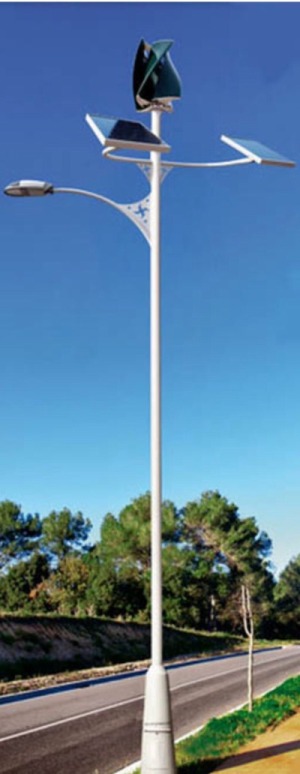
The first autonomous industrialized public lighting system that is running on nothing but solar and wind energy was recently created by researchers at the Universitat Politècnica de Catalunya, in cooperation with Eolgreen.

The system is designed for use along inter-urban roads and motorways, and in urban parks and various public areas and is reported to reduce total costs by as much as 20%, as compared to conventional systems, Clean Technica writes.

According to a recent press release, the prototype is 10-meters high and is fitted with a solar panel, a wind turbine and a battery. The turbine runs at a speed of 10 to 200 revolutions per minute (rpm) and has a maximum output of 400 watts (W). The developers’ aim is to make the lighting system even more environmentally efficient, so work is being done on a second prototype generator that runs at a lower speed (10 to 60 rpm) and has a lower output (100 W). An electronic control system manages the flow of energy between the solar panel, the wind turbine, the battery and the light.

“It takes very little wind to produce energy. The generator that has been developed can start working at a wind speed of only 1.7-meters per second (m/s), whereas current wind turbines need more than 2.5 m/s,” states creator Ramon Bargalló, a researcher in the Department of Electrical Engineering at the Barcelona College of Industrial Engineering of the Universitat Politècnica de Catalunya.

The system can reportedly provide up to 6 nights of electricity with no wind or sun.

As it stands, Eolgreen has already signed agreements with the port of Huelva, the municipal authorities of Sant Boi de Llobregat + Girona, and a number of towns in Andalusia. The company is planning to produce ~700 of these street lights in 2015.