Drastic cuts for Bulgarian green electricity producers

In Bulgaria, the support for the production of electricity from renewable energy sources has been drastically reduced.

Seems that energy regulator DKEVR (english: SEWRC) has retroactively cut feed-in tariffs for electricity from PV and wind generation sources.

SEWRC based its decision from 14 September on requests from network operators to temporarily increase access prices to the transmission grid.

According to the energy regulator, expenditures of the electricity networks have massively increased due to the great number of new renewable energy sources feeding into the grid. In order to cover the costs, remuneration per kWh fed into the grid by renewable power sources had to be reduced.

Renewable electricity producers’ associations characterised the commission’s decision of September 14 as illegal and demanded its withdrawal. The reason would be that the cuts contradicted the renewable energy law, guaranteeing investors fixed prices over long time periods.

According to the Bulgarian Wind Energy Association (BGWEA), “The drastic cuts will push the majority of all existing renewable energy projects into bankruptcy, as with income losses of 10 % to 39 % most projects will not be able to make their loan repayments anymore. This means that several billion Leva worth of domestic and foreign investment along with hundreds of newly created jobs have been destroyed overnight.”

Moreover, due to the retroactive cuts the Bulgarian banking system would run the risk to end up with a massive amount of bad loans on its books.

The branch is appealing against the decision in Brussels. The European Wind Energy Association (EWEA) has expressed its protest in a letter to EU Energy Commissioner Günther Öttinger.

At the same time, renewable energy producers in Bulgaria plan to increase pressure on the government. The Bulgarian PV Association (BPVA) has published an appeal that calls upon the members of the branch to meet for a protest meeting in front of the DKEVR building in Sofia on Monday 24, September at 9.30 local time.

New Air Liquide R&D laboratory for the solar industry inaugurated

Air Liquide inaugurated an R&D laboratory for the solar industry.

The Group is the first player in this market segment to roll out a pilot manufacturing line for solar cells using crystalline silicon technology.

Today, this technology accounts for 88% of total production worldwide.

This crystalline solar cell manufacturing line will be used to fully test and evaluate new molecules and processes adapted to the needs of each client. The research being undertaken seeks to improve the performance of solar cells while lowering the cost production per watt, with the aim of making solar energy more competitive.

A pool of scientists with experience in photovoltaic technologies will run the research effort carried out at the Air Liquide Group R&D center located on Plateau de Saclay, near Paris, France.

Dubai is going to build its first Eco-friendly mosque

People have resorted to minimize the consumption of electricity and maximize the growth of plants and trees around themselves.

Even religious institutions are being designed keeping the hazards of global warming in mind. An example of such an institution is a mosque which is about to be set-up in Dubai.

The project has been set to be completed in 18 months.

The mosque has been aimed to be completed by the closing of 2013 and is decided to be located behind the Al Rowad village near the Deira Clock Tower. It will cover an area of about 4180 square meters with the capacity of 3500 men praying inside it.

Photovoltaic panels are to be used to provide electricity for heating water for ablutions and other work. A highly efficient air-conditioning and a computerized system will be installed mainly to check the efficiency of the electrical equipment.

In the construction of the mosque, asbestos and polystyrene shall be avoided to add to the Eco-friendly environment.

The main front of the building will have a special coating on it to keep it cool in summers. The mosque will be placed in such a direction so as to get the maximum light, thus reducing the consumption of electricity. In addition, there will also be techniques to save water used in ablutions by reusing it for the purpose of flushing toilets and for irrigating the landscape filled with greenery.

The foundation aims at reducing the water consumption by 25% and electricity consumption by 20%.

US photovoltaic market is growing up

In the second quarter of 2012, the PV market in the USA grew by 116% in comparison to the same period of the previous year.

In total, a photovoltaic output of 741.7 MW was newly connected to the grid – this is the second best value overall after 791.3 MW in Q4 2011 and 45% more than in the first quarter of this year (512 MW).

Solar power plants accounted for 477 MW of the new installations in the second quarter. Until the end of the year, 1.1 GW of new PV capacity could be installed, in total 3,400 MW are under development according to the study.

Also a strong growth is predicted in this market for 2013.

In the home photovoltaic sector, the prices were 5.84 $/W for privately financed facilities, while facilities installed by third parties on rented roofs were available for 5.64 $/W.

Solar ORC systems providing hot water and electricity in Africa seted up by STG International

Electricity isn’t really an energy source that can be yet be taken for granted in certain isolated parts of Africa where more often than not, a regular supply is considered a luxury.

STG International, an MIT non-profit has come up with a feasible way to power up clinics and schools in such parts of Africa using alternative energy sources instead of complete grid reliance.

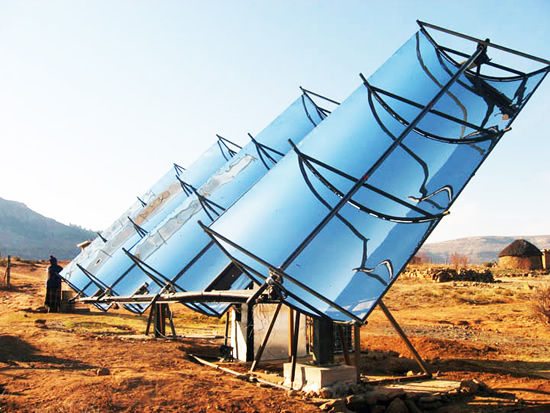
Using a new hybrid power and heat solar system that’s capable of providing electricity, hot water and space heating, STG International is currently drawing plans to set up five such units in Africa.

With MIT graduate PHDs Matthew Orosz and Amy Mueller leading the way, these units will be tested for viability and will use ORC Engine instead of solar electric panels.

Capable of providing up to 18-24kW-hr of energy and 200-300 gallons of hot water daily, this system could prove to be a boon for rural development, not just in Africa but also other far-flung areas disconnected from the grid around the globe.

The largest biaxial photovoltaic system in Italy realized by REGRAN

With over 1.17 MW, 74 dual-axis, high efficiency solar trackers  each with 168 Concentrix ™ photovoltaic modules, together with two central inverters of 500 kW each to  guarantee a reliable power grid; these will produce enough electricity for 300 houses and should compensate the emission of more than 125 tonnes of carbon dioxide per year.

These are the numbers of the photovoltaic system of Santa Lucia, Belpasso, in the province of Catania, installed by REGRAN, the Sicilian company and a leader in both engineering services for large PV systems and the construction of (all inclusive) systems to generate energy from renewable sources.

The realization of the Belpasso plant is, as a matter of fact, the largest biaxial photovoltaic system in Italy, and its installment was carried out by REGRAN. The plant was built using the system of the French company Soitec, who also owns the utility.

“With the installation in Belpasso, REGRAN has confirmed its achievement of important development objectives and partnerships with leading European businesses,” said Marco Anfuso, CEO of the Sicilian company,confirming that the choice of  Soitec for REGRAN represents a starting point.

“The technology in the renewable energy field is evolving rapidly. For this reason, in order to maintain our leadership
position in southern Italy, we must continue to invest in research and development and strengthen partnerships with key players in the market.

Endesa Pavilion is adapted to maximum renewable energy potential

Solar House 2.0, is a rare structure that adopts to maximize the renewable energy potential of its location.

Made by the Institute of Advanced Architecture for Catalonia (Iaac), it has a modular facade covered with protrusions that support additional solar panels.

Protrusions are designed to creatively maximize the use of energy, also they absorb the sun’s energy independent of the seasons.

The building is capable of generating almost 100kWh of electricity and its average daily consumption stands at 20kWh.The roof alone features 150sq m of photo voltics.

During summers, the protrusions form a barrier when the sun tracks higher across the sky, whereas during winters it allows the sun’s rays to directly penetrate.

The house has been constructed from wood due to the fact that wood is an inexhaustible material that is soft and easy to work with and also it can be molded and adapted to provide warmth and insulation.This building looks more like a huge log cabin, suitable to belong to the Scandinavian woodland.

Solar energy project in Arizona

Kyocera,a Japanese multinational company is going to shipp solar panels for the 127MW Arlington Valley Solar energy II power project.

Till the year 2013, the company will continue to manufacture PV panels at its San Diego plant.

It isn’t for sure if Kyocera will be the only one supplier of PVs because no details of the deal have been released as yet.

The Arlington solar energy project, located in Maricopa County, sits on an area of 1,160 acres and will supplement the energy needs of residents and businesses alike.

With Europe deeply involved in renewables, countries across the globe are gearing up to establish wind farms and solar parks to meet power requirements.

Kyocera has begun shipping 34MW of modules and will continue to provide more in future.Earlier, the corporation had announced that it wanted to increase  multicrystalline PV production to 1,000MW every year by March 2013.

The solar project received funding to construct the $550 million plant. The energy power that’s generated from the project will be sold off to San Diego Gas & Electric.

Chinese solar panel dumping is now in

The verdict is now in. And it’s not good for Chinese solar manufacturers.

Although the official pronouncement has not been made, we’ve learned from sources close to the case that the Commerce Departments’s preliminary decision on SolarWorld’s solar dumping petition against China has been handed down in a case that had the potential to rock the U.S. solar market’s status as an emerging growth market.

China solar manufacturers have been accused of unfair trade practices in subsidizing solar panel manufacture and selling panels in the U.S. below their cost.

Cheaper  Chinese solar panel pricing has been a boon for consumers and solar installers, but a competitive challenge for the few crystalline solar manufacturers in the U.S.

SolarWorld accuses Chinese firms of dumping. Others suggest that China has a legitimate cost advantage.On March 20 of this year, The Department of Commerce’s preliminary verdict on unfair subsidies for Chinese solar panels was handed down, along with what amounted to low tariffs for the Countervailing Duties (CVD).

The preliminary determination indicated the DOC’s intention to impose a duty of 4.73 percent on U.S. imports from Trina Solar, 2.9 percent from Suntech, and 3.59 percent from all other remaining Chinese manufacturers.

Homes can have access to solar power in Mid Atlantic

In the area of Mid Atlantic sun’s power is available in abundance and this was the reasons for switching over to solar power.

The government is willing to extend all possible support and policy makers are also devising methods to encourage large scale production of the same.

The capacity to generate solar energy has almost doubled in this region.Presently it stands at one gigawatt capacity, equivalent to power one million homes.

Along with the expansion of government tax breaks and extension of incentives, the factors that encourage the use of solar power include, better financing options and lower technology cost.

This power serves thirteen states of the Mid Atlantic, including Washington D.C. Both Virginia and D.C. are currently dependent on oil burning for electricity production, and this is one of the major pollutants that taint the quality of air.

Solar power will benefit the environment, the health of the people and also safer for the wildlife of the region.