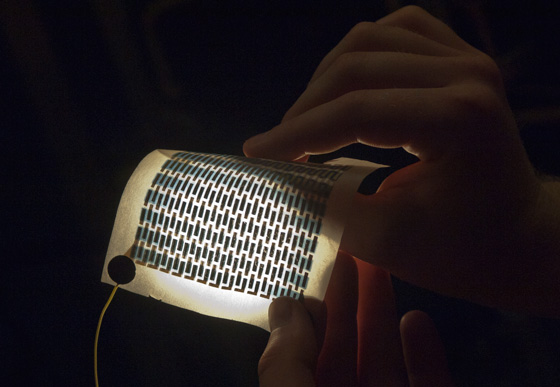
A new way of using solar energy is developing- solar skyscraper windows

Scientists discovered a way to capture solar energy from the sun

Semi-transparent cells to be used in skyscrapers for solar energy

Solar technology is taking a step forward and could make use of giant building’s windows and build them to be solar-power generating glass.

The newly developing type of solar cells merges semi-transparency with better productivity is going to transform the global Building Integrated Photovoltaic (BIPV) market.

As it’s founders announce, the transparent strengthened PV panels could be produced starting from 2015.

The researches were done by the Oxford University physicists and Oxford Photovoltaics co-founder Professor Henry Snaith. The revealed that the new inventions was possible with the help of the oxide mineral perovskite.

The new developed cells have proved their performance by achieving 15% in the past year, outdistancing all other newly developed green technologies that didn’t break the 14% barrier even if their discovery took years.

The most important answer the scientists got has something to do with the glow associated with the use of prerokative. So, they managed to create semi-transparent cells that allow owners to clearly view outside.

The licence to the technology belongs to Oxford Photovoltaics, awarded with the British Renewable Energy Association’s Innovation Award, the UK Business Angels’ Best Early Stage Investment in a Disruptive Technology Business Award and the Solar Award for Excellence: BIPV Innovation at the 2013 Solar UK Industry Awards.

The past December, professor Snaith was nominated by Nature magazine as being one of the ten people that mattered from science’s point of view.

“The pace of development, of this new solar technology, alongside ongoing research into storage solutions, means that photovoltaics will play an increasingly important role in meeting future energy demand globally,” the professor said.

Kevin Arthur, Oxford PV Chief Executive’s words are: “We’re making great progress towards commercialisation of this ground-breaking technology and expect to sign our first licensing deals early next year. This research also emphasises the importance of nurturing links between business and academic institutions. Our sponsorship of PhD students delivers extra capacity to push our work through faster and builds a pipeline of great talent for our company. All of this will help the UK become a world leader in the multi-trillion pound electricity generation industry. ”

New power station will be installed at Dwarka by Delhi Metro

Delhi Metro will install Pv

Delhi metro to install PV at it’s stations

Delhi Metro, which became the country’s first public transportation system, is willing to install pv power plants on the roofs of its stations, in order to attempt preservation of the enviroment in New Delhi.

At Dwarka Sector 21 metro station will be the first 500 kwp solar power plant and it is predicted to become functional within six months.

This remains the largest roof top station with the aforementioned capacity in the Delhi-NCR region. This wiil be set after a PPA (Power Purchase Agreement) has been signed between Delhi Metro Rail Corporation and a multinational company engaged in the installation and management of solar power worldwide, in the presence of DMRC’s officials.

The central financing shall be provided by the developer and DMRC will afterwards pay for the units generated by the plant. This power will be offered to the DMRC at the presented station.

Anuj Daval, Executive Director at Corporate Communications mentioned: “After the installation of this roof top plant, Delhi Metro will also explore the possibility of installing more such plants at its stations, depots, parking lots as well as residential complexes.”
For the preservation of the surrounding environment, Delhi Metro has already got involved with a number of measures of providing sustainable means of energy.

DMRC was confirmed in 2011 by the United Nations to be the no. 1 Rail and Metro Rail based organization in the world to get Carbon Credits for downsizing Green House Gas Emissions, this aided in lowering pollution levels in the city by by 6.3 lakh tons yearly discharges and so reducing global warming.

A military base from Arizona is going to have the biggest solar power plant of this kind

Solar power plant in a Arizona military base

solar power plant to be used in Arizona

35 percent of the electricity needs in Arizona’s military base will be fulfilled by the new installation. The U.S. Air Force is planning to use 25% more renewable electricity by 2025.

California’s SunEdison and MIC Solar Energy Holdings are the companies responsible for completing the 16.4 MW PV plant situated in the Davis-Monthan Air Force Base outside Tucson in Arizona.

The project represents the largest solar power plant in the U.S. Department of Defense installation and is said to diminish the Air Force’s utility costs by $500,000 per year in the upcoming 25 years.

“This project was very rewarding for our team because we are helping save our fellow taxpayers’ money. The Air Force, like other branches of the armed forces, is a perfect candidate for solar power because they have high electricity demands and often have large plots of underutilized land,” is the opinion of Bob Powell, SunEdison president of North America.”

SunEdison views the project as doable because of a public-private alliance between Davis-Monthan AFB, SunEdison, the North American Development Bank (NADB), MIC Solar Energy, Chevron Energy Solutions and local officials.

A subsidiary of Macquarie Infrastructure Company, MIC Solar Energy , specializes in framework contributions and took over the project. The SunEdison Renewable Operation Center (ROC), that supplies asset management, monitoring and reporting services, all day every day will administer plant operations with the help of a contract with MIC Solar Energy.

The plant is made to supply 35 percent of the base’s electricity needs and can provide the necessary electricity for 5,173 houses. As the biggest consumer of energy in the federal government, the Air Force is planning to bring up the use of green energy.

U.K. and Bulgaria, the two EU countries who adhered to WEEE PV Directive in time

Two E.U. countries submitted to Waste Electrical and Electronic Equipment Directive

U.K and Bulgaria intro directives in their national lows

Just two E.U. countries submitted to the most recent Waste Electrical and Electronic Equipment Directive (WEEE) on PV modules and introduced them in their national laws until de 14th of February deadline.

Last Friday was the last chance for E.U. countries to comply with the most recent WEEE directives, a set of rules for the disposal of old solar PV modules and just the governments of the U.K. and Bulgaria brought the latest text into their national law.

This directive was primary introduced in August 2012 and was meant to incorporate rules and advices on the proper disposal of solar PV modules for the first time. 18 months was the changeover period in which the solar PV industry and every nation’s governments could make the necessary improvements to the standard removal and waste management, and the law that implies them.

The end of that period was on February 14, and even if the governments in key PV markets all over the E.U. didn’t officially transferred the guidelines into their own national versions of the European directive, WEEE will be a significant to the PV sector during 2014 and more, as the pan-European PV recycling and take-back organization, PV Cycle reports .

“Under WEEE, PV companies in the European Union will not only have to ensure the collection and recycling of their discarded end-of-life products, but are required to also guarantee the financial future of PV waste management,” announced PV Cycle’s managing director, Jan Clyncke.

Even if only Bulgaria and the U.K. subscribe to the necessary changes until now, other European countries showed their bids for compliance.

ITC finished investigations regarding third party manufactured cells and discovered some in the U.S.

Chinese products with third party components are harming the solar industry

Products based on Taiwan cells harm U.S. manufactureres

The International Trade Commission taking care of anti-dumping duties investigated chineese products and found third-party produced cells.

The investigation on Chinese third party manufactured cells revealed the fact that the asian’s country’s products bring damages to the U.S solar investors. The research was possible with the help of the U.S. International Trade Commission

The decision made public on ITC’s website says that the accusation that third-party produced cells are prejudicing the U.S is just and is hurting the U.S. corporations by being drained in the U.S solar market and by taking advantage from the country’s diminish.

The commission started the investigation as a follow-up to the charges brought by the German manufacturer Solar World. The company claims that Chinese module manufacturers were bypassing the AD and anti-subsidy offsetting duties practiced for Chinese-manufactured solar products by seting up panels with cells made in Taiwan or other third-party states. SolarWorld’s U.S. business says that Chinese manufacturers brought calls manufactured in Taiwn in other countries as an escape from U.S. duty regime.

The ITC’s verdict came after a day in which the Chinese solar giant Trina Solar acquired a cell producing operation back in mainland China. The verdict is seen as a prior decision to the duties to be applied to every Chinese produced modules despite the origins of the cells. This is to happen in the following weeks and a final decision will be made in June with the duties backdated three months.


Pro-nuclear governor has been elected in Tokyo


Japan's new governor is pro-nucleaar

Japan has a new pro-nuclear governor

In the Japanese pv-module business, it remains unsettled what the election means. A pro-nuclear appeal could be a backsliding of considerate solar FITs, yet it could also be an approval of the system that proposed them.

It stands a subject of controversy regarding what this election of Yoichi Masuzoe as governor represents for the solar business in Japan. Despite the fact that Masuzoe was the only candidate with a pro-nuclear policy, BBC News reports show us that political analysts consider it to be an essential plan for economic and social benefit.

The governor of the capital has more power over expenses by virtue of Tokyo’s position, its dividends are free from the government allowance that takes place over the rest of other Japanese cities, and its governor is viewed as the second most important political man in Japan, given the city’s 2014 budget of around JPY13 trillion (US$127 billion).

The report from BBC, that alleged amounts from the AP news agency, Masuzoe, with 2.1 million polls, hat more votes than both his nearest – anti-nuclear – competitors Kenji Utsunomiya and Morihiro Hosokawa. The Liberal Democrat party and its main member, prime minister Shinzo Abe, backed up Masuzoe and his call to turn the reactors back on, decision that was suitable for the PM.

Although there is a dread for the Japan to go back nuclear, and the dissolving of the world’s most hospitable FIT regime, the grand surplus of victory for the newly established governor could equally strike as a confirmation of the ‘Abenomics’ package of public spending measures – which includes renewable allowances – that were brought in by Abe as a well calculated remedy for the latest Japanese recession.


Taiwanese solar exporters asked for help from the government to deal with U.S anti-dumping duties

Taiwan suspectd to beinvolved in dumping process with China

COmpanies from Taiwan need help in the U.S dumping investigations

Retailers from Taiwan’s solar energy product exporters required help from their government in order to cope with the U.S government researches on dumping pleas against them.

The firm from the Asian country is concerned about financial penalties that can come from claims that they have been covering for Chinese exporters in order to avoid tariffs in the U.S by providing the solar cells.

A subsidiary of a German company, Solar World Industries America Inc. won a ruling for imposing duties on Chinese solar products imported in U.S.A in 2012.

It later claimed that Chinese companies have found a way to dismiss tariffs by exporting panels using solar cells made in different countries, basically, Taiwan. These tariffs were not implied in the main ruling. But in January, the U.S. Commerce Department and International Trade Commission (ITC) had begun an investigation into Taiwanese solar energy product enterprises that were part of the pleas.

The International Trade Commission is aiming for a ruling by the middle of the month, a ruling that can ensure that there are certain evidences that China or Taiwan are bringing prejudice to the U.S. solar industry. And if so, the Commerce Department will try and resolve this conflict on subsides until March and until June on dumping.

Until then, two Chinese solar energy product makers, Yingli Solar and Hanwha SolarOne, that purchase cells from Taiwanese companies, made a petition at U.S. Commerce Department to represent the Taiwanese firms that are part of the investigation. This decision is to be made by the 21st of February.

Still, the Taiwanese companies are concerned that they cannot defend themselves if the two Chinese enterprises are allowed to represent them as Sam Hung, head of the Taiwan Photovoltaic Industry Association declared.

The TPVIA, therefore, has asked Taiwan’s Bureau of Foreign Trade come up with an approach for the situation. Solar market sources say that Taiwan-made cells were not involved in dumping as the cells produced in the country are 8% more expensive than the rest.

PV world comes with another surprise: paper-based solar cells

High transparecy paper based solar cells introduced by researchers

Chinese-AMerica developers prooduce new paper based cells

An American- Chinese team of solar developers shows that there is a way that they can develop highly efficient solar cells from cheap wood fiber.

A team of developers from the South China University of Technology teamed up with the University of Nebraska-Lincoln and revealed a report that shows that a new type of paper can be used as a base for the future generation of solar cells. The innovative cells could reach a level of 95% of transparency.

The report underlines the fact that the new wood-based papers has a bigger quality that all the other materials, especially regarding transparency, low-cost, efficiency and eco-friendly performance that can revolutionize the solar PV industry.

As the report shows, the paper constitutes of TEMPO-oxidized wood fibers that dispose of micropores and nanopores instead, so that the transparency values and optical haze reach values above 90%, respectively 60%. The latter is the highest figure among the transparent substrats. Normally, materials that offer a big transparency , a big advantage for the solar transmission, lower the optical haze values to less than 20%.

But the TEMPO treatment undermines the connection between the microfibers that make up generally wood fibers leading them to crash into a structure that dispose of micropores. Usually, the wood fibers in ordinary paper have low transparency because of the microcavities that are a part of the porous structure. The transparency is booted by replacing micropore with nanapores

The representative of the Department of Materials Science and Engineering at the University of Maryland , Liangbing Hu , says that “the papers are made of ribbon-like materials that can stack well without microsize cavities for high transmittance, but with nanopores for high optical haze.”

Apple wants to go green with a solar-powered MacBook

Apple recieved patent solar-powered  laptop

Apple has plans for renewable display for Macbooks

The solar-powered MacBook is to use a PV unit for energy generation, as the patent application reports

Apple looks set to go solar with one of its next lines of Mac Books.

The U.S department of Patent and Trademark authorized the Cupertino company a license for an “electronic device display module and a two-sided display that contains a photovoltaic unit that can be used as the both the screen and lid of the new laptop from Apple.

As the patent abstract states, “the rear plate may be formed from electrochromic glass and may cover photovoltaic cells and touch sensors”.

The Patent and Trademark Office publicized an Apple application in last year’s fall that explained a possibility of gearing electronic devices with internal converters with the purpose of using external solar panels.

Although the rumors that the MacBook company is working on the development of PV technology for its products, Apple did not made any official statements.

Theories about Apple’s investments in the green energy area appeared after the company purchased a module manufacturing facility from First Solar last year in Mesa, Arizona.


Chinese modules with Taiwanese cells are considered Chinese

European commission sets new rules for Chinese modules

Chinese modules with cells from Taiwan considered Chinese

The European Commission forced to set another set of rules regarding the provenance of the Chinese modules in order to block goods selling from third countries.

Industry allegations regarding the fact that a recent resolution about he sources of solar modules manufactured in China, using Taiwanese cells spared the panels from minimal module pricing and export cap neccesities were rejected by the European Commission. Karel De Gucht, EU Trade Commissioner arranged in July a minimum module cost for these modules made in China, along with an annual cao on the quantity of panels that could be exported to Europe, it is said to be 7 GW of the predicted 10 GW of solar EU imports from China.

PV magazine pointed out on Jan. 27 an industrial source who declared that a choice made by the EU inDecember by which it was clarified the rules of origin excused these panels made in China, with use of Taiwanese cells from the deal agreement and it became very improbable that the quantity of panels produced with Chinese cells to reach the 7 GW amount.

The European Commission’s press officer for EU Trade Policy, Helene Banner, announced that the set of rules of origin apply to “goods originating in China” but also to “goods consigned from China, irrespective of their origin.”

This means that modules that are put together in China and Taiwanese cells are part of the second statement, , since they are accredited from China, as the press officer explained.

The Commission wanted to spell out the rules of origin because they wanted to prevent avoid situations like Chinese manufacturers sending unfinished modules to third countries and after that to sell them as if they were produced in those countries, by that refrain from the measures. But if the origin of the goods is stated the products will be looked at as made in China.