Pro-nuclear governor has been elected in Tokyo


Japan's new governor is pro-nucleaar

Japan has a new pro-nuclear governor

In the Japanese pv-module business, it remains unsettled what the election means. A pro-nuclear appeal could be a backsliding of considerate solar FITs, yet it could also be an approval of the system that proposed them.

It stands a subject of controversy regarding what this election of Yoichi Masuzoe as governor represents for the solar business in Japan. Despite the fact that Masuzoe was the only candidate with a pro-nuclear policy, BBC News reports show us that political analysts consider it to be an essential plan for economic and social benefit.

The governor of the capital has more power over expenses by virtue of Tokyo’s position, its dividends are free from the government allowance that takes place over the rest of other Japanese cities, and its governor is viewed as the second most important political man in Japan, given the city’s 2014 budget of around JPY13 trillion (US$127 billion).

The report from BBC, that alleged amounts from the AP news agency, Masuzoe, with 2.1 million polls, hat more votes than both his nearest – anti-nuclear – competitors Kenji Utsunomiya and Morihiro Hosokawa. The Liberal Democrat party and its main member, prime minister Shinzo Abe, backed up Masuzoe and his call to turn the reactors back on, decision that was suitable for the PM.

Although there is a dread for the Japan to go back nuclear, and the dissolving of the world’s most hospitable FIT regime, the grand surplus of victory for the newly established governor could equally strike as a confirmation of the ‘Abenomics’ package of public spending measures – which includes renewable allowances – that were brought in by Abe as a well calculated remedy for the latest Japanese recession.

 

Taiwanese solar exporters asked for help from the government to deal with U.S anti-dumping duties

Taiwan suspectd to beinvolved in dumping process with China

COmpanies from Taiwan need help in the U.S dumping investigations

Retailers from Taiwan’s solar energy product exporters required help from their government in order to cope with the U.S government researches on dumping pleas against them.

The firm from the Asian country is concerned about financial penalties that can come from claims that they have been covering for Chinese exporters in order to avoid tariffs in the U.S by providing the solar cells.

A subsidiary of a German company, Solar World Industries America Inc. won a ruling for imposing duties on Chinese solar products imported in U.S.A in 2012.

It later claimed that Chinese companies have found a way to dismiss tariffs by exporting panels using solar cells made in different countries, basically, Taiwan. These tariffs were not implied in the main ruling. But in January, the U.S. Commerce Department and International Trade Commission (ITC) had begun an investigation into Taiwanese solar energy product enterprises that were part of the pleas.

The International Trade Commission is aiming for a ruling by the middle of the month, a ruling that can ensure that there are certain evidences that China or Taiwan are bringing prejudice to the U.S. solar industry. And if so, the Commerce Department will try and resolve this conflict on subsides until March and until June on dumping.

Until then, two Chinese solar energy product makers, Yingli Solar and Hanwha SolarOne, that purchase cells from Taiwanese companies, made a petition at U.S. Commerce Department to represent the Taiwanese firms that are part of the investigation. This decision is to be made by the 21st of February.

Still, the Taiwanese companies are concerned that they cannot defend themselves if the two Chinese enterprises are allowed to represent them as Sam Hung, head of the Taiwan Photovoltaic Industry Association declared.

The TPVIA, therefore, has asked Taiwan’s Bureau of Foreign Trade come up with an approach for the situation. Solar market sources say that Taiwan-made cells were not involved in dumping as the cells produced in the country are 8% more expensive than the rest.

PV world comes with another surprise: paper-based solar cells

High transparecy paper based solar cells introduced by researchers

Chinese-AMerica developers prooduce new paper based cells

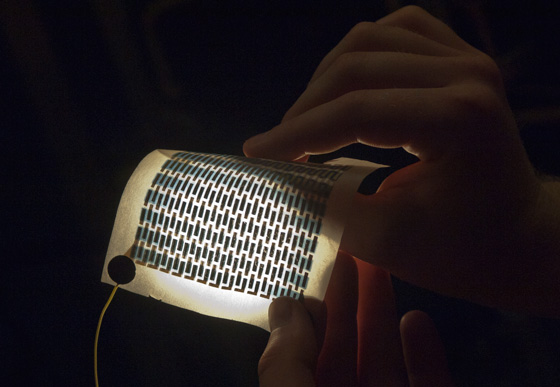
An American- Chinese team of solar developers shows that there is a way that they can develop highly efficient solar cells from cheap wood fiber.

A team of developers from the South China University of Technology teamed up with the University of Nebraska-Lincoln and revealed a report that shows that a new type of paper can be used as a base for the future generation of solar cells. The innovative cells could reach a level of 95% of transparency.

The report underlines the fact that the new wood-based papers has a bigger quality that all the other materials, especially regarding transparency, low-cost, efficiency and eco-friendly performance that can revolutionize the solar PV industry.

As the report shows, the paper constitutes of TEMPO-oxidized wood fibers that dispose of micropores and nanopores instead, so that the transparency values and optical haze reach values above 90%, respectively 60%. The latter is the highest figure among the transparent substrats. Normally, materials that offer a big transparency , a big advantage for the solar transmission, lower the optical haze values to less than 20%.

But the TEMPO treatment undermines the connection between the microfibers that make up generally wood fibers leading them to crash into a structure that dispose of micropores. Usually, the wood fibers in ordinary paper have low transparency because of the microcavities that are a part of the porous structure. The transparency is booted by replacing micropore with nanapores

The representative of the Department of Materials Science and Engineering at the University of Maryland , Liangbing Hu , says that “the papers are made of ribbon-like materials that can stack well without microsize cavities for high transmittance, but with nanopores for high optical haze.”

Apple wants to go green with a solar-powered MacBook

Apple recieved patent solar-powered  laptop

Apple has plans for renewable display for Macbooks

The solar-powered MacBook is to use a PV unit for energy generation, as the patent application reports

Apple looks set to go solar with one of its next lines of Mac Books.

The U.S department of Patent and Trademark authorized the Cupertino company a license for an “electronic device display module and a two-sided display that contains a photovoltaic unit that can be used as the both the screen and lid of the new laptop from Apple.

As the patent abstract states, “the rear plate may be formed from electrochromic glass and may cover photovoltaic cells and touch sensors”.

The Patent and Trademark Office publicized an Apple application in last year’s fall that explained a possibility of gearing electronic devices with internal converters with the purpose of using external solar panels.

Although the rumors that the MacBook company is working on the development of PV technology for its products, Apple did not made any official statements.

Theories about Apple’s investments in the green energy area appeared after the company purchased a module manufacturing facility from First Solar last year in Mesa, Arizona.


Chinese modules with Taiwanese cells are considered Chinese

European commission sets new rules for Chinese modules

Chinese modules with cells from Taiwan considered Chinese

The European Commission forced to set another set of rules regarding the provenance of the Chinese modules in order to block goods selling from third countries.

Industry allegations regarding the fact that a recent resolution about he sources of solar modules manufactured in China, using Taiwanese cells spared the panels from minimal module pricing and export cap neccesities were rejected by the European Commission. Karel De Gucht, EU Trade Commissioner arranged in July a minimum module cost for these modules made in China, along with an annual cao on the quantity of panels that could be exported to Europe, it is said to be 7 GW of the predicted 10 GW of solar EU imports from China.

PV magazine pointed out on Jan. 27 an industrial source who declared that a choice made by the EU inDecember by which it was clarified the rules of origin excused these panels made in China, with use of Taiwanese cells from the deal agreement and it became very improbable that the quantity of panels produced with Chinese cells to reach the 7 GW amount.

The European Commission’s press officer for EU Trade Policy, Helene Banner, announced that the set of rules of origin apply to “goods originating in China” but also to “goods consigned from China, irrespective of their origin.”

This means that modules that are put together in China and Taiwanese cells are part of the second statement, , since they are accredited from China, as the press officer explained.

The Commission wanted to spell out the rules of origin because they wanted to prevent avoid situations like Chinese manufacturers sending unfinished modules to third countries and after that to sell them as if they were produced in those countries, by that refrain from the measures. But if the origin of the goods is stated the products will be looked at as made in China.

Trade war between US and China escalates

Solar trade disputes on anti-dumping duties

Solar trade war between US and China

A trade war begun between US and China as politicians argued and it all that started from a misunderstanding between solar manufacturers in China and Taiwan and U.S. Department of Commerce.

The ministry of Commerce in China responded to anti-dumping measures and counter investigations on Chinese solar products as it follows: “China will closely follow the case, assess the impact on the Chinese solar sector and resolutely safeguard our interests through various mechanisms.”

With delegates from China, Hong Kong, Chinese Taipei and the U.S. that participated in Friday’s pledge, the outcome of the U.S. Department of Commerce to begin anti-dumping (AD) and countervailing duty (CVD) investigations into Chinese and Taiwanese-made modules, including Taiwanese cells, will make sure that negotiations at the WTO, World Trade Organization, will not progress.

The list of goods for which it is hoped all tariffs and other trade barriers will be removed includes solar cells and inverters.

The US department of Commerce announced that an investigation started from a complaint that Chinese manufacturers were using alternative regarding import duties for solar imposed in 2012 to continue and sell at very low prices in the American market.

On the other hand, The Solar Energy Industries Association reported that if the US went forward with a new set of import duties regarding solar panels from China and Taiwan, it could lead to the cut off the supply of low-cost equipment that had a major impact in the industry’s boom in the past few years. A spokesman of SEIA announced that “As the conflict escalates, the threat to the industry grows.”

China sets new record in the PV world

China sets new installations record

China installed 12 GW of solar last year

Chinese PV developers reached a new milestone with 12 gigawatts of solar panels installed last year, almost doubling the total amount of solar plants in the U.S, this year they could exceed that as Bloomberg New Energy Finance announced.

The solar PV panels were made in the Chinese provinces of Gansu, Xinjiang and Qinghai and bring China’s state-owned power companies the world’s biggest owners of solar valuables, as the London-based research company reported.

China was the largest solar market in 2013, outweighing the old leader Germany. Chinese solar installations are three times higher than they were two years ago, with a total of 3.6 gigawatts. This year it is said the Asian country will have 14 gigawatts of solar installed, as figures predict.

“The 2013 figures show the astonishing scale of the Chinese market. PV is becoming ever cheaper and simpler to install, and China’s government has been as surprised as European governments by how quickly it can be deployed in response to incentives.” said the lead solar analyst at New Energy Finance Jenny Chase.

Chinese investors completed the projects before the end of the year, until the1-yuan (17 U.S. cents) a kilowatt-hour incentive expired. This may bring maybe 2 gigawatts of late-year additions that are not part of the 12-gigawatt total.

China brought a 28 per cent raise in global solar installations in 2013. All installation may bring another 20 per cent this year, according to announcement. Until last year, no country execeded8 gigawatts of solar power installations in a year.

The SMA Fuel Save Solution authorized in APAC

Diesel gensets and photovoltaics finished in Vava'u islands

The SMA Fuel Save Solution in APAC

Diesel gensets and photovoltaics combined in a hybrid system under the umbrella of SMA Fuel Save Solution , has been commissioned in the APAC region. The infinit benefits of reduced energy costs, and a minimal reliance on fossil fuel are finally available the Tongan island of Vava’u. The hybrid contains the SMA Fuel Save Controller, which enables a smart integration of photovoltaics and leaves diesel gensets unmoved. Moreover, another unit that stores energy makes sure that rainy days are not a problem. The system is able to compensate up to 70 percent of Vava’u’s electricity demand during the day and nearly 13 percent of the total demand of the Island in a year.

The latest solar farm consists of ground-mounted PV and battery storage technology that is mixed in with the island’s diesel power station. The 500kW hybrid can generate 873MWh of energy in a year and it can coutercount approximately 225,000 litres of diesel every year. The system consists of 21 SMA Sunny Tripower 20000TL inverters, 15 SMA Sunny Backup 5000 inverters and the SMA Fuel Save Controller.

The brain of a large-scale power plant, more precisely central solar inverters, have long a primary choice among large-scale solar developers. They can provide all the needs and has a low cost per watt installation rate. Central solar inverters are destined to be a popular technology for utility-scale and large commercial solar power conversion because they bring more and more innovative features.

This type of inverters they recognize the field-proven history of the technology. The best central inverters have been set up in all kind of conditions around the world from the California desert to the Austrian Alps. Such inverters can work extreme heat and cold, sandstorms, maritime air and more. The most reliable central have an output rat of 110% in continuous operation at ambient temperatures up to 25° C.

Mark Twidell, Managing Director of SMA Australia says that “SMA is proud to be an integral part of the system at Vava’u, helping the Tongan government to reduce its fossil fuel dependency. This project benefits from the SMA Fuel Save Solution which stabilises the grid and prevents system failures.”

“The SMA Fuel Save Solution enables state of the art integration of PV into diesel genset systems without compromising operational readiness, reliability or fuel efficiency,” in Rodger Whitby’s words who is General Manager Generation of the Australian solar power company Ingenero that installed the solar farm.

Vava’u is the name of a chain made of one large island and 40 smaller ones in Tonga, in the South Pacific Ocean. The main island of Vava’u hast 90 square kilometres. Until now Vava’u used diesel generators for its electricity needs until but a hybrid energy system was developed for a cleaner energy. The Tonga Energy Road Map (TERM) aims to supply 50 percent of the Kingdom’s power demand from green energy sources until 2020. The project was possible due to Abu Dhabi based renewable energy company Masdar and is financed through a grant provided by the Abu Dhabi Fund for Development.

The SMA Group is the global market leader for solar inverters, presents new key technologies for future power supply structures. It is has main offices in Germany, and is represented internationally in 21 countries.

London is hosting the biggest solar-powered bridge in the world

London hosts the biggest solar bridge in thw world

World lagest solar bridge is in London

After almost half a decade the bridge was opened ceremonially yesterday at at Blackfriars Bridge across the River Thames.

The bridge is part of Solarcentury’s project and the top of the the roof of the bridge was covered with 4,400 photovoltaic panels, and it provides up to half of the energy for London Blackfriars station.

The platform is said to reduce the stations carbon emissions by an estimated 511 tonnes a year, and above all to further reducing the carbon of its train routes to the south east of England.

David Statham, managing director of First Capital Connect stations, reported “Electric trains are already the greenest form of public transport – this roof gives our passengers an even more sustainable journey.The distinctive roof has also turned our station into an iconic landmark visible for miles along the River Thames.”

The solar bridge bridge also fulfills London’s purpose to become a more sustainable city. The advertisement for this is the bridge itself as it is viewable from the entrance of the city.

The project itself made by Solarcentury was one of the most complicated project even for them, as company installed the panels in a series of phases over the past two years, and took a break only to minimise the impact on the station during the 2012 Olympic Games.

“We had different sections of roof available at different times to fit in with this complicated jigsaw of getting everything up and going,” says Gavin Roberts, Solarcentury’s senior project manager. He also said that the company even considered to bring some of the components in via the Thames.

Researchers found a way to convert solar into fuel

Solar top be converted in fuel for cheaper energy

Solar can be converted into fuel

The Frontier Research Center at UNC-Chapel Hill discovered a way to transform solar into fuel, so that people could have power even when the sun sets.

People could be truly independent with the help of this system and could say goodbye to the pricey solar batteries. U.S solar power researchers say the sun can be used to separate water into hydrogen and oxygen. The Research Center recently published two papers about this whole process, papers published in the Proceedings of the National Academy of Sciences.

Tom Meyer, a chemistry Professor, explains that the system uses solar power until daylight exist, and meanwhile it cheaply separates hydrogen and oxygen from water. The two elements can then be stored separately and burned for power.

Meyer reports that power utilities have already got infrastructure for that: “See, that’s the beauty of it, I think. With this, you can plug into existing engineering, existing technologies. People know how to generate hydrogen. They know how store it. They know how to use it to extract energy in a power plant. So that’s all done. You know, all we want to do is find a way to give it to them in a relatively inexpensive way using the sun.”

Meyer also believes that this method can be used for cheaper power utilities someday:
“This is a basic research project that’s knocking on the door to become a technology. I think the principles are established and it’s really important, but the efficiency of the devices that we have are very low. That is, ‘Here’s all the sun’s energy. How much do you actually use in a useful way?’ And the answer’s about one percent.”

What Mayer says is that right now, only one percent of the solar power that gets to the device is being used to transform water into fuel. He also believes that the procedure won’t be effective for commercial use until that one percent turns into 10. His team also research for a way of separating carbon dioxide into its basic elements for fuel.