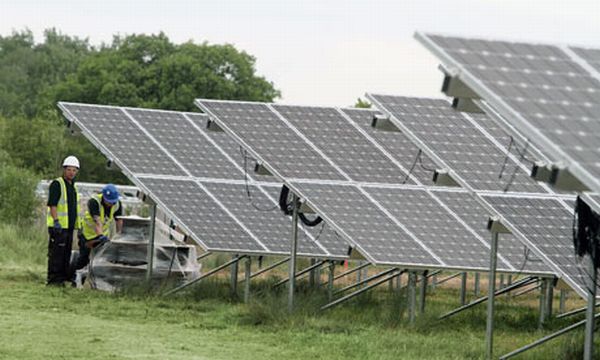
Toyota UK car plant will use solar energy

In addition to manufacturing a number of striking eco friendly cars like Prius and Highlander, Toyota has now geared up to power entire operations of its Derbyshire production plant in the U.K. with solar panels.

The Japanese automobile giant has announced that it is going to implement the ambitious project, which will cost more than $14 million to the company.

Toyota looks set to install a £10m solar array to power operations at its Derbyshire plant.

The company has already started work to fit around 17,000 panels on 90,000 square metres of industrial land – an area slightly smaller than four and a half football pitches – within the plant’s boundaries.

The array will be capable of supplying enough energy to build around 7,000 cars a year at the plant, which produces Auris hybrid, Auris and Avensis cars, as well as saving the company 2,000 tonnes of CO2 emissions a year.

Toyota project is expected to begin producing power in July 2011.

World’s first solar powered town in Japan

Japan will have the fist solar powered town in Fujisawa City.

Japan has learned its lessons from relying too much on nuclear energy after all the dark hours the nation has spent since the

Fukushima plant disaster and is now turning to solar energy instead to power up the lives of the people there.

Japan will built a smart town which will work with nine private sector firms to build a sustainable urban town which will see solar systems and battery storage technology installed in all homes and town facilities.

The project can become a model town that can be replicated in Japan’s earthquake-damaged areas.

This will be the first completely solar powered town in the world and it will have a thousand homes, playing residence to a population of about 3,000 people.

The project, which costs US$742 million and spans 19 hectares, will be completed in 2014.

A new record efficiency for solar cells

Always scientists around the world have been trying to create a low cost solar cell that is both efficient and easy to manufacture.

The purpose is to make solar energy affordable for the common people.

Swiss researchers from Swiss Federal Laboratories for Materials Science and Technology’s (EMPA) Laboratory for Thin Film and Photovoltaics have established a new world record efficiency of 18.7% for flexible copper indium gallium (di)selenide (CIGGS) solar cells on plastics.

This new discovery has the potential to lower the cost of solar energy drastically because they are cheaper to produce and this latest breakthrough brings them closer to the highest efficiency levels achieved by crystalline silicon and rigid CIGS cells.

These highly efficient solar cells will drop the cost of solar energy and make them ideal for use in demanding applications such as solar facades and portable electronic devices.

Google invest $55 million in Mojave Desert

The wind power industry of California received a boost when Google Inc. announced its decision to invest $55 million in a large Mojave Desert wind farm.

By this investment the state made an important step to regain its number one position in the world in field of wind power energy production.

Google is involved in many projects related to renewable energy because it needs huge amount of electricity to run its vast datacenters.

The internet search giant has taken up the above mentioned project in partnership with Citibank which is also investing an equal amount, i.e. $55 million.

The wind farm will produce 1.5 gigawatts which will power 450.000 homes.

This initiative will create green jobs in Kern County which is struggling with 17.5 percent unemployment.

Japan wants a solar powered nation

After all the disasters, Japan is still optimistic to achieve a nuclear free eco-system.

Japan has a new plan for a solar powered nation by 2030.

Japan is soon going to begin a universal solar panel initiative for all their structures in the time frame of 20 years.

There are plans to make solar panels for all residential and commercial buildings in the country.

We hope that Japan’s ambition to become reality.

Wind power could be stored in water under Germany’s mountains

Germany hopes to meet the country’s electricity demands only with renewable sources by 2050.

This ambitious dream reflects on their green investment particularly in the fields of solar and wind energy.

Germany plans to store energy generated by wind turbines in water pump storage facilities under the mountains.

This first project in the world is made after a Marko Schmidt study.

The study was to build a plant in the abandoned Wiemannsbucht mine shaft in Bad Grund, a town in the western Harz Mountains.

Pumped-storage hydroelectricity plants work by using power from solar or wind turbine sources to pump water from one tank to another above it.

When the sun goes in or the wind stops blowing and electricity is needed, the water from the top is released to the bottom tank – pushing through turbines as it goes and generating power.

Six of such large scale projects have been proposed for the West Harz region.

The first one will be in Bad Grund and will have the storage capacity of 400 megawatt hours, which is sufficient to allocate power to over 40,000 households per day.

This project has a lot of advantages because such plants can be constructed in abandoned mine-shafts and also the provision of additional green jobs.

The new generation of green rocket

U.S. military researchers have developed a new generation of green rocket fuel.

The new green rocket fuel emits less corrosive and toxic chemicals than the conventional rocket propellants.

Typical rocket fuel is very toxic and creates environmental pollution because the fuel has a structure of propellant which contains high grade kerosene, rubber and chemicals like hydrazine, nitrogen tetroxide and nitrous oxide.

‘One of the important requirements in the development of less hazardous liquid bipropellants for rocket propulsion is reduced vapor toxicity of oxidizer and fuel,’ says propellants expert John Bellerby of Cranfield University, UK.

Also Bellerby adds that hydrogen peroxide is an attractive low-hazard alternative oxidizer and finding a fuel with low vapor toxicity that is hypergolic with this oxidizer and also produces a high performance has proved difficult.

Repeated tests have proved the hypergolicity of the hydrogen rich ionic-liquid fuels with hydrogen peroxide as the oxidizing agent, which can be considered as green bipropellants for the future.

This type of ionic liquids as the pioneer in liquid bi propellants and in the future and will bring out better and green performances.

Top 10 clean energy states in U.S.

Promoting green technology is on the rise.

An extensive study released Wednesday by consulting firm Clean Edge offers some results.

The survey used more than 3,500 data points to evaluate all 50 states in the U.S.

Factors for evaluating each state included: the amount of green-tech related patent activity; the amount of green-tech venture capital being invested; the number of alternative fuel, electric, and hybrid vehicles registered in the state; and the percentage of electricity produced from clean sources.

The following states are ranked in the Top 10 for leading in green tech:

1.     California
2.    Oregon
3.    Massachusetts
4.    New York
5.    Colorado
6.    Washington
7.    New Mexico
8.    Minnesota
9.    Connecticut
10.  Vermont

California has the most money for backing up all those green-tech projects and has some of the most progressive environmental policies.

The state attracts more green-tech venture capital than all the other states in the U.S. combined.
California is also leading in clean-energy:

1.    California
2.    Massachusetts
3.    Oregon
4.    Colorado
5.    New Jersey
6.    Connecticut
7.    New York
8.    Maryland
9.    Washington
10.  Minnesota

All you need to know about eco-houses

Today, everyone wants go green to save the world.

The eco-houses are designed in such a way that the energy consumption per house will be 20-30% lesser than a regular home.

Also, an eco-house meets certain guidelines for energy effectiveness standard.

On the market the eco-house demands are increasingly.

The eco-houses not only save energy but also help in the improvement of the environment by avoiding the excess usage of the non-renewable energy and the burning of fossil fuels.

If you choose an ecological house you’ll use less energy and avoid causing excess air pollution.

In U.S. the green homes for sale have a blue Energy Star mark, which is the government-backed symbol for energy efficiency, to ensure that a new home is energy efficient.

Eco-homes are effectively insulating with advanced insulating systems installed in various parts of the house.

These houses maintain the same level of temperature throughout the house while using less energy than regular houses.

The windows need to have protective coatings and newly improved frames that help to keep the house warm during cold days and dissipate it out during the summer time and fluorescent bulbs.

If you are lucky maybe the house will have solar thermal panels for hot water and heat.

These homes really do consume 20-30 % less energy than regular homes.

All you need to know about geothermal energy

Geothermal energy can be defined as a sort of renewable energy derived from the heat generated deep in the earth’s crust.

The temperature of the earth crust rises one degree Celsius for every 30-50 meters and the heat is brought to the surface by thermal conduction.

This clean renewable energy is used in some countries for cooking and heating for thousands of years.

Geothermal resources can be harnessed into electricity, for hot water and for heating your homes.

Electricity generation technology consist of three methods: dry steam method that uses steam as it comes from the underground source to drive the turbines, flash steam method which makes use of the underground hot water (360 degrees F) is pumped to the surface where it flashes to steam and drives the turbines and binary method that makes use of heated underground water and runs it through a heat exchanger where it heats a fluid with a lower boiling point that flashes to steam and drive the turbine.

In the top producers of electricity from geothermal energy are United States, Philippines and Indonesia.

Currently only 24 countries have geothermal power stations.

Finding a suitable build location is a major drawback to geothermal energy because to trap geothermal energy must provide hot rocks in the layer of the Earth’s crust that would heat the water pumped into the well at suitable level and not all the locations are completely reliable.

Investment costs in geothermal energy are very high.
Drilling is more than half the cost.

The other ugly part of geothermal energy is the hazardous gasses and minerals such as mercury, hydrogen sulphide, ammonia and arsenic come upon the surface along with hot water.

In conclusion geothermal power in the long run is seen to be very cheap, but the initial cost of installing the power will definitely be high and has some risks.