Great River Energy offers free wind-power upgrade for electric vehicles

windenergy promotion

Co-op upgrades EV users to wind power, at no extra cost. Image via windpowerengineering.com

Great River Energy and its participating member cooperatives launched Revolt, a first-of-its kind program that allows members to upgrade the electricity used to fuel their vehicles to wind energy at no additional cost.

According to Windpower Engineering, renewable sources are already part of Great River Energy’s power mix, but the Revolt program provides a more direct connection between wind energy and the electric vehicle driver.

“Our Revolt program allows consumers to further support the use of renewable energy. We are dedicating wind energy to completely cover the electricity that a consumer uses to fuel an electric vehicle for the vehicle’s lifetime,” said David Ranallo, Great River Energy Revolt program manager. “We’re thrilled to offer this innovative program and hope it acts as a spark to ignite awareness around electric vehicles in Minnesota.”

To be eligible for participation in Revolt, a cooperative member must currently own, purchase or lease a plug-in electric vehicle or plug-in hybrid electric vehicle by December 31, 2016. A household can enroll up to four electric vehicles in the program. Standard or off-peak rates still apply for electricity used to fuel the vehicles.

“Electric vehicle owners are already some of the happiest drivers on the planet because they know they’re making a positive impact on the environment,” said Jukka Kukkonen, a plug-in vehicle owner who is a principal in PlugInConnect, a Minnesota consulting firm. “The Revolt program adds an innovative element by powering the vehicles completely from wind energy, which I see only bolstering the satisfaction of owning an electric vehicle.”

In addition to electric vehicle enthusiasts, Revolt is being lauded by leaders of organizations across Minnesota that promote the use of renewable energy.

“There has never been so much innovation going in to producing vehicles that are faster, safer, cleaner, and cheaper and easier to maintain,” said Michael Noble, executive director of Fresh Energy, a nonprofit organization that advocates for acceleration of Minnesota’s transition to a clean energy economy.

“Refueling with renewable electricity is a great vision for Great River Energy to advance and is ready to become more common than fueling with gasoline within the next 20 years.”

“We applaud Great River Energy for giving customers 100 percent renewable wind energy to recharge their electric vehicles. Making sure renewables are generating the ‘juice’ for an electric vehicle is the right way to go and provides a win-win product for their members,” said Beth Soholt, executive director of Wind on the Wires, a nonprofit organization which works to bring wind energy to market.

Wind turbines in Germany generated 32.5 TWh of electricity in January

Germany wind energy

Germany’s record wind turbine growth boosts output. Photo via investindk.com

Germany’s wind power output in January-May rose 34% year on year and the country is on track for a third successive record year for new turbine installations, with the first wave of offshore wind farms finally coming online, a Platts analysis of the latest available data show.

According to Platts, wind turbines in Germany generated 32.5 TWh of electricity in January- May, up more than 8 TWh from a year earlier, grid operator data compiled by Platts Powervision show.

On average, wind generated 7.5 GW each hour in the first five months of 2015, the data shows. That is the equivalent output of seven modern nuclear reactors. Compared with the first five months 2013, wind output so far this year was even 71% higher, the data show. The main reason for the rise is record growth in Germany’s wind-power industry with Germany on track to install over 14 GW of new wind turbines between 2013 and 2015, averaging over 12 MW a day.

That compares with 13 GW added in the seven previous years between 2006 and 2012, or averaging just 5 MW/day, data from Platts Powervision show.

According to industry experts, the pending reform of Germany’s renewable energy law (EEG) and the introduction of an annual cap on solar in 2012 are one reason that triggered the latest boom in wind with onshore developers rushing to get projects implemented ahead of the launch of an annual cap on onshore wind this year.

Another reason for the current wind boom is delays in offshore grid links, which put back the planned start date of many offshore wind farms.

However, with the offshore grid link bottlenecks now easing, the first wave of some 3 GW of German offshore wind farms is on track to be online by the end of 2015. Offshore wind power capacity registered for direct marketing was 2.225 GW in May, a fourfold increase from a year earlier, according to the latest data from the TSOs. Last year, German offshore wind developers brought 529 MW online, doubling total installed capacity to 1.049 GW, according to the annual statistics.

Total onshore capacity was 38.116 GW as of end 2014 after a record 4.75 GW of new onshore wind capacity was installed last year.

For 2015, wind lobby group BWE still expects another significant increase of 3.5-4.0 GW, it said earlier this year.

However, the reform of the EEG, in place since August 2014, will cap future annual wind power installations at 2.5 GW for onshore wind.

Repowering of existing sites with more powerful turbines is exempt from the annual cap and more than 1 GW was added last year in a growing market, the BWE said.

The next update for new wind installations in the first half of 2015 is due in July.

The boom in additional wind capacity from 2013 to 2015 is in stark contrast to a sharp slowdown in new solar capacity, which boomed between 2010 and 2012 adding some 22 GW in those three years alone, Platts Powervision data show.

Germany’s new solar capacity fell 2014 for a second year in a row, down 42% year on year to 1.9 GW, its lowest annual level since 2007, as deeper cuts to solar subsidies have sharply reduced growth in the sector.

So far this year, Germany has added only 419 MW of new solar installations, still bringing total installed solar PV capacity to 38.7 GW.

Germany’s combined wind and solar portfolio is now estimated above 80 GW.

Combined output from wind and solar in January-May was 46 TWh with full-year estimates above 100 TWh, which would be the first time ever that wind and solar generated more electricity than nuclear in Germany.

Germany’s nuclear phase-out will start this June with the Grafenrheinfeld reactor coming offline for economic reasons six months ahead of its final decommissioning date, leaving just eight reactors with a combined capacity of 10 GW online until the end of 2017.

German day-ahead prices in April averaged Eur25.30/MWh, the lowest monthly average in more than 12 years as the seasonal drop in demand combined with strong supply from renewables as well as conventional sources.

May was the third month so far this year with average spot prices settling below Eur30/MWh with June, July and August also trading below Eur30/MWh.

By contrast, day-ahead prices in Great Britain in May averaged at GBP40.82/MWh (Eur56.17/MWh), more than double the average wholesale power price in Germany with the strong pound and the additional carbon levy boosting wholesale prices in the UK.

Solar-powered LED lighting for Northern regions

solar-powered LED lighting

Danish research collaboration results in solar-powered LED lighting that operates in Northern regions. Image via ledsmagazine.com

At first glance, the best approach to make a solar powered outdoor lighting product work at winter in the far North is to go for state-of-the-art components: photovoltaic panels, batteries and super effective LEDs. However, the heart of the systems is actually what binds these components together: the power supply and the battery management system.

With a very limited amount of PV power input during the short winter days, the energy conversion efficiency and the stand-by power consumption of the management system are crucial factors. In this project, a prototype channeled the power generated in the PV panel to the battery with an extreme efficiency of 98-99%.

According to ledsmagazine.com, most commercial LED power supplies consume 8-15% of the load. Nevertheless, the same prototype discharged a 10-25W output from the battery to the LED with an impressive conversion efficiency of 97.5%.

A much smaller 10W version was prototyped as well. In this case, high efficiencies are even harder to obtain, but even this model produced similar impressive conversion efficiencies for the solar-powered LED lighting.

The results have great potential in actual solutions that are ready for the market. Both prototypes were specified in close cooperation with private companies to enable direct use in real products. Hence, the prototypes were tested in five different outdoor products with LED.

And who says it will stop here? The project generated an advanced design and dimensioning tool that can manage all of the limiting conditions. All parts are highly dependent on temperature conditions in the environment and the PV panels obviously depend on latitude and shading conditions. Hence, all local conditions as well as the dynamical and technical performance figures of potential components can be loaded into the design tool, and an optimized solution can be designed.

This design tool is valuable not only in stand-alone solar-powered LED lighting systems in the Nordic region but essentially all over the world. Furthermore, the prototyped power managements system can be applied to many other PV systems, as for instance stand-alone outdoor surveillance and intelligent parking meters.

The project was sponsored by the Danish Energy Agency (EUDP) and was managed by the DTU Fotonik (Technical University of Denmark) in close collaboration with DTU Energy and DTU Elektro. Three different private companies participated (Out-sider, AKJ Inventions and Morten Lyhne).

Efficiency record for black silicon solar cells jumps to 22.1%

black silicon solar cell

Aalto University researchers have developed black silicon solar cells that achieve a record 22.1 percent efficiency when turning the Sun’s rays into usable energy. Photo credits: Aalto University

Aalto University’s researchers have obtained the record-breaking efficiency of 22.1% on nanostructured silicon solar cells as certified by Fraunhofer ISE CalLab. An almost 4% absolute increase to their previous record is achieved by applying a thin passivating film on the nanostructures by Atomic Layer Deposition, and by integrating all metal contacts on the back side of the cell.

According to a press release, the surface recombination has long been the bottleneck of black silicon solar cells and has so far limited the cell efficiencies to only modest values.

The new record cells consists of a thick back-contacted structure that is known to be highly sensitive to the front surface recombination. The certified external quantum efficiency of 96% at 300nm wavelength demonstrates that the increased surface recombination problem no longer exists and for the first time the black silicon is not limiting the final energy conversion efficiency.

The results were published online in Nature Nanotechnology.

For Nordic conditions

“The energy conversion efficiency is not the only parameter that we should look at”, explains Professor Hele Savin from Aalto University, who coordinated the study. Due to the ability of black cells to capture solar radiation from low angles, they generate more electricity already over the duration of one day as compared to the traditional cells.

“We have demonstrated that in winter Helsinki, black cells generate considerably more electricity than traditional cells.”

This is an advantage particularly in the north, where the sun shines from a low angle for a large part of the year. “We have demonstrated that in winter Helsinki, black cells generate considerably more electricity than traditional cells even though both cells have identical efficiency values”, she adds.

In the near future, the goal of the team is to apply the technology to other cell structures – in particular, thin and multi-crystalline cells.

“Our record cells were fabricated using p-type silicon, which is known to suffer from impurity-related degradation. There is no reason why even higher efficiencies could not be reached using n-type silicon or more advanced cell structures”, Hele Savin predicts.

The development of the cells fabricated last year will continue in the upcoming “BLACK” project, supported by the European Union, in which Professor Savin together with her team will develop the technology further in cooperation with industry.

The surface area of the best cells in the study was already 9 cm2. This is a good starting point for upscaling the results to full wafers and all the way to the industrial scale.

This solar-powered floating farm will produce 20 tons of vegetables every day

solar-powered floating farm

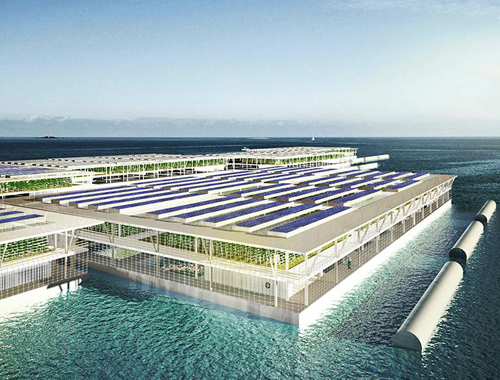
Solar-powered floating farms to provide food for world. Image via inquisitr.com

Given the fact that a community that supports green technology also supports organic growing, it is evident that its members would design clean ways to produce healthy, organic food with as little impact on the environment possible. One such farm exists in Japan. Not only is it the world’s largest indoor farm, it produces 100 times more food than conventional farming methods.

Now, an architecture company known as Forward Thinking Architecture has designed a solar-powered floating farm. What is unique about it is the fact that through its green technology, it produces 20 tons of vegetables every day.

According to inquisitr.com, there has been a concern that the world’s food supply wouldn’t be able to keep up with the world’s population growing at an exponential rate for many years. Forward Thinking Architecture provided an innovative and viable solution with their farms. The fact that it is built on water addresses the issue of decreasing supply of arable land. However, it must be noted the floating farms are, at this moment, made to supplement traditional farming, not replace it.

A follow-up by Minds provides more details to the floating farm. The farms — which were inspired by Chinese floating fish farms — are modules that measure 200 meters by 350 meters and consist of three floors. The bottom floor focuses on aquaculture and water desalination. The next floor up focuses on hydroponics crop cultivation. Finally, the roof is fitted with numerous solar panels, skylights, and rainwater collectors.

As mentioned earlier, each floating farm module can produce 20 tons of food everyday. Over the course of a year, the anticipated estimate is 8,152 tons of vegetables! Apparently, the solar farms are also fisheries as they can bring in 1,703 tons of fish a year too! Finally, the fact that the floating farm modules can be connected to form a grid (or any design allowable by its architecture as shown in the above picture), entire cities can be fed if they are scaled up to be huge farms, kind of like a floating farm metropolis.

Solartab: the premium solar charger

Solartab, solar charger

Clean power for your gadgets with Solartab. Image credit: mysolartab.com

The Solartab is unlike any other power bank or solar charger. A truly unique product featuring great design, a high-capacity internal battery and a built-in cover that ensures maximum sun exposure at all times. And a solar panel large and powerful enough to charge even your tablet.

Acccording to its Kickstarter Campaign, the Solartab was born out of the idea of creating a high quality solar charger with attractive design and a truly efficient solar panel.

“Solar power should never be a mere gimmick – on the contrary, we believe it’s the future of power consumption! A tablet-sized solar charger makes for a powerful and essential asset that truly liberates you from the power outlets of your home. Every day.”

Thanks to the Solartab’s large solar panel you can always charge your device directly from the sun. Even while listening to your favorite summer tune or phoning your friends at the same time!

With two USB ports and a micro USB port, the Solartab is ready to keep any of your mobile devices going at all times. An environmentally friendly, portable and never-ending source of energy, always ready for use.

Solar-powered spacecraft is ready for its first test launch

Solar-powered sailing space ship

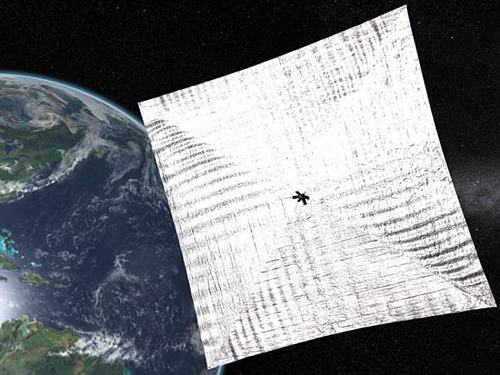
The LightSail uses sunlight for propulsion. Picture: Josh Spradling / The Planetary Society Source: Supplied

The LightSail, a spaceship with sails that relies on just sunlight for fuel is set for its first test in space when it launches on Wednesday.

According to news.com, the so-called LightSail is a privately-funded project by The Planetary Society, the world’s largest non-profit space advocacy group.

It is sending two small spacecraft into Earth orbit carrying large, reflective sails measuring 32 square metres. CEO Bill Nye says Wednesday’s test flight will pave the way for a second, full-fledged solar sailing demonstration in 2016.

Solar sails use the sun’s energy as a method of propulsion — flight by light. Light is made of packets of energy called photons. While photons have no mass, a photon travelling as a packet of light has energy and momentum.

Solar sail spacecraft capture light momentum with large, lightweight mirrored surfaces — sails. As light reflects off a sail, most of its momentum is transferred, pushing on the sail. The resulting acceleration is small, but continuous. Unlike chemical rockets that provide short bursts of thrust, solar sails thrust continuously and can reach higher speeds over time.

The LightSail is hitching a ride on a Atlas V rocket which will also carry a top-secret mini military space plane on another long orbital test flight.

The US Air Force is tight-lipped about the unmanned mission.

What is known is that this will be the fourth flight of the X-37B space plane, a secretive, experimental program run by the Air Force. The three previous missions also began with rocket launches from Cape Canaveral Air Force Station.

The mystery test vehicle — essentially a technology test bed — is designed to orbit the Earth and then land like one of NASA’s old shuttles. It is operated robotically, without anyone on board, and is reusable. It is 8.8m long — about one-quarter the size of a NASA shuttle.

The longest X-37B flight lasted about 675 days; touchdown was last October. There’s no official word on how long this one will stay up. All three previous missions ended in California.

NASA has a materials experiment aboard, while the Planetary Society is tagging along with a solar-sail demo.

Although largely mum about this X-37B flight, the Air Force has acknowledged a thruster experiment involving electric propulsion. Air Force researchers want to check design modifications to ion thrusters already flying on some advanced military communication satellites.

GE uses holograms and the industrial internet to make wind farms more efficient

wind farm

GE plans to make generating wind energy 2o percent better. Photo via clevescene.com

Two new products that rely on data and the industrial internet will help GE make wind farms more efficient.

The secret to generating more electricity from wind turbines may not rest in better blade designs but in better communication between those turbines and holograms, according to Steve Bolze, the president & CEO of GE’s Power & Water division. At the American Wind Energy Association Windpower event, GE is expected to announce two products that will make wind farms 20% more efficient through the use of GE’s industrial internet software and sensors.

According to Fortune, the overall idea is to look at wind farms as a whole, instead of focusing on the turbines individually. GE has optimized turbines in the last decade using its PowerUp program that saw a 5% increase in efficiency thanks to better designed blades. That’s all well and good for boosting a renewable energy source that met 4.5% of the U.S. energy demands in 2013, but GE is aware that it needs to do more. So it turned to holograms.

In what it calls its Digital Twin product, GE takes data from a future wind farm site and starts simulating the future farm, modeling what turbines should go where, how high they should sit, and how fast they should turn. The resulting data is turned into a hologram of the future site so engineers can visualize other problems to see what computers might not.

The second product is another mess of data, only this time, it’s generated by the actual turbines in the wind farm. But instead of sharing the data about wind speed solely back to GE so it could optimize the blade design, as happened in the PowerUp project, now the turbines talk to each other. This means the sensors on turbines in the wind farm can communicate with turbines far back in formation to share data about the wind. Instead of each turbine working alone, it now works as part of a team. This Digital Wind Farm technology works with turbines made by GE, and with turbines made by GE’s competitors.

There is a huge benefit to including all of the turbines. Depending on the algorithms that GE writes, it’s possible that techniques such as having turbines at the outer edge operate at 70% capacity and having those further back operate at 80% generates the optimal amount of electricity when accounting for wear and tear on the turbines. Such communication can also help account for turbines that might be out of commission.

It’s through this better forecasting in the planning stages and then, better communication once operating, that GE hopes to keep wringing the efficiency out of the wind generation business. Bolze says that since the products are just being announced, there are no customers yet, but he expects them before the end of the year.

Solar power for the world’s largest tram network

solar-powered tram

Digital impression of a Melbourne tram as part of a pitch before the state government to power the network with solar energy. Photo: Australian Solar Group

Melbourne’s entire tram network could be powered by solar if the state government gave a bold renewable energy proposal the green light.

While the pitch may conjure up images of trams with rooftop panels on them like the family home, the power would instead be generated at two new solar farms the project proponents plan to build near Swan Hill and Mildura.

According to smh.com.au, the company behind the bid, the Australian Solar Group, have held quiet talks over four years with different arms of the government to try get the project off the ground, but has so far not got final backing.

The two solar farms would generate 80 gigawatt-hours of electricity a year, about the same amount used by Melbourne’s tram network, which is the world’s largest.

Under the proposal the government would back the project by signing Public Transport Victoria (PTV) up to a power purchase agreement with the solar farms, creating a reliable revenue source alongside the renewable energy target.

The proponents say the project has been designed to ensure the cost of tram tickets would not rise, nor would it add to PTV’s power bill. It would cut 100,000 tonnes of greenhouse gas emissions a year from running trams and give the city an obvious global selling point, according to the pitch.

The Australia Solar Group was founded by businessmen Adrian Critchlow and Dave Holland. Mr Crtichlow previously helped start companies Booking.com and AlertMe, before successful sales of both. Mr Holland was formerly the head of Solar Systems, a company that was building a large solar project in Mildura before financial collapse in 2009.

Mr Holland said Australia Solar had tried to get almost all elements of the tram project ready to go before it sought final financial backing.

“This project is virtually ready to go. We can’t see any barriers that would stop it from here,” he said.

The tram project has been supported behind the scenes by members of the Melbourne City Council, including Lord Mayor Robert Doyle. Councillor Arron Wood said it ticked many boxes, from contributing significantly towards the city’s renewable energy target to creating employment and training opportunities in rural Victoria.

“Ultimately, whether this project proceeds rests firmly with the Victorian Government. I just hope they take the action necessary to get it done,” Cr Wood said.

A spokeswoman for the Andrews government said: “We are interested in how the project progresses and will continue discussions with the group.”

Australian Solar says the solar farms would span across 80 hectares and use 130,000 panels to track the sun throughout the day. It has planning and grid connection approvals for its Swan Hill site, with permit processes underway for the second site at Red Cliffs.

Greenpeace: Renewable energy is vital for internet lifestyles

Renewable energy is vital for internet lifestyles

A Greenpeace report charges utilities with hampering efforts to use renewable energy to power data centers needed for services hosted in the cloud. Photo: AFP

A Greenpeace report released on Tuesday accused utilities of hampering efforts to use renewable energy to power data centres needed for services hosted in the cloud.

According to euractiv.com, Greenpeace praised moves made by Apple, Google and other internet titans to fill a skyrocketing demand for electricity with solar, wind or other environmentally-friendly sources but lamented expansion of data centre capacity in places where utilities reliant on carbon-spewing coal fuel dominate markets.

“A growing number of companies have begun to create a corner of the internet that is renewably powered and coal free,” Greenpeace said in its 2015 click clean report.

Internet companies that have committed to being completely powered by renewable energy sources include Apple, Facebook, and Google, according to Greenpeace.

Those commitments have driven growth of renewable power in several key markets, and caused some utilities to invest more heavily in that kind of electricity generation to meet demand, the report stated.

However, some locations that have attracted data centre investments are in markets ruled by utilities with generation powered mostly by coal, gases from which are a culprit in climate change.

Examples listed included Duke Energy in North Carolina, Dominion Resources in Virginia, and Taiwan Power Company in Taiwan.

“These utilities represent the biggest obstacles to building a green internet, and will require collaborative pressure from data centre operators and other electricity customers to secure the policy changes needed to open the market up to competitors that offer meaningful options for renewable energy,” Greenpeace said.

Apple leads the charge

Apple continued to “lead the charge” in using clean energy to power internet operations even as the California-based company rapidly expanded, according to the report.

Apple on Sunday announced broadened renewable energy and environmental protection initiatives in China, including a project with the World Wildlife Fund to promote responsible forest management.

The forestland project aims to protect up to a million acres of working forests used for fiber for paper and wood products, according to Apple.

The project is expected to generate as much as 80 million kilowatt hours annually of clean electricity, enough to power about 61,000 Chinese homes.

About 87% of Apple’s global operations run on renewable energy, and the Sichuan Province solar farms will move the company closer to 100%, according to the maker of iPhones, iPads, iPods, Macintosh Computers, and Apple Watch.

Google is also pushing to rely on renewable energy, but its progress is under threat by monopolies held by coal-using utilities in some data centre locations such as Georgia, Singapore, Taiwan, and the Carolinas, according to Greenpeace.

Amazon, Microsoft, eBay, and Oracle were among technology giants who scored low grades from Greenpeace when it came to green energy deployment and advocacy.

“The magic of the internet seems almost limitless,” Greenpeace said. “But each new internet enabled magic trick means more and more data.”

Increasing demand for data, particularly streaming video, and processing power in the cloud means ramped up demand for power by data centres doing the online work.

“While there may be significant energy efficiency gains from moving our lives online, the explosive growth of our digital lives is outstripping those gains,” Greenpeace said.