America Navy wants solar energy directly from space

U.S navy to capture solar from space

Navy space solar panels

For many years the Pentagon has been the number 1 oil consumer in the world. The continuous rise of prices has determined the military to research other ways to get energy. These researches expanded till space.

A new technology that will give the military the possibility to collect solar energy in orbit and take it to earth is being developed by the U.S. Naval Research Laboratory (NRL). Space solar energy will save the Pentagon a great deal of money, and could also simplify military arrangements. Fuel tankers wouldn’t need to reach remote or volatile areas, and missions couild be lnger.

Until now, NRL tried a couple of prototypes for the “sandwich” module, a design innovation that combines the electrical components in the two square panels. The top is made of a photovoltaic panel that takes in the light. In the middle there is an electronics system that transforms the energy to a radio frequency, and at the bottom there is an antenna that takes the power to a target on the ground.

The final project is to group the modules in space by robots and form a one kilometer satellite.

Another design, a “step” module, opens the sandwich design so it can receive more energy without the risk of overheating.

“Launching mass into space is very expensive,” said Paul Jaffe, a spacecraft engineer leading the Navy’s project.

 It is said that space solar could produce a bigger quantity of energy than ground-based collectors because of the fact that the weather wouldn’t be an impediment.

“People might not associate radio waves with carrying energy, because they think of them for communications, like radio, TV, or cell phones. They don’t think about them as carrying usable amounts of power.” added Jaffe.

Researchers from the UK are working on solar panels that are more efficient during cloudy days

ould friendly solar cells were discovered

British researchers discovered cells that work in cloudy regions

British scientists from a famous Laboratory have been working on the next generation of solar panels that work better when it’s clouded.

The material they are using very thin and can have any color. It can also be printed in sheets on a 3D printer.

Even if the necessary procedures is only beginning to develop, scientists are being optimistic about it and say that very soon they will make the solar PV market and we will see them on coats or bags and we will be able to charge our phones or laptops with them.

Another big advantage of this type of solar PV panels is that they are easier to install on houses because they don’t require fortifying of the roofs and they would be invisible so they world’t bother homeowners.

The concept raised the curiosity of car manufacturers such as Fiat and Ford, which are interested if they could install such panels on the roofs of their cars and replace flat batteries.

The solar cells we know contain semi-conductors like crystalline silicon. So when the lights gets to them a part of the energy is taken in and kicks electrons loose in the silicon that can be lead into a current and withdrawn for external use. This new technology has small organic molecules as semi conductors that can be mixed in and printed in any shape with a 3D printer.

What’s more intriguing about this new type of material is the fact that as opposed to traditional panels that work better in direct sunlight, they function extremely well when the sunlight is not direct or strong.

Researchers tested the new organic photovoltaic material in desert conditions and it reached a 10% efficiency and in cloudy conditions it went up to 13%.

The main research scientist at the National Physical Laboratory Dr. Fernando Castro, believes that “Organic photovoltaics work much better in low and diffused light conditions. Even if it’s cloudy they still work. It’s not that they are going to produce more power but they are more efficient at generating power from the light that is available. So they would work better than normal soar cells do in cloud.”

The new material is going to be less expensive and more environmentally friendly than the old solar cells.

Next generation of Photovoltaics to boom this year

PV market is growing with a new wave of PV

New wave of PV to be used this year

The new generation of photovoltaics are said to enter the clean energy market in 2014 as analysts predict and since investments are coming back.

Analysts at IHS Technology believe that the new wave of PV technologies like n-type substrates and diamond wire will be more available this year since solar companies boost the capital expenditure.

Resilience and trust in global solar markets, combined with new spending cycles, will do much for solar’s transition from nowadays technologies to next-generation PV, as analysts say. They also announce that people will spend $3.4 billion in 2014 on PV this year.

“Innovative technologies will be atop the agendas of major solar manufacturers globally now that supply and demand has come to closer alignment,” reports IHS solar demand analyst, Jon Campos.

“While most experts thought that overcapacity issues would remain significantly longer, the fundamental assumptions made by IHS were that the industry would move toward market equilibrium behind increasing demand in the emerging markets, and that PV manufacturers would turn to advanced technologies to compete with traditional forms of energy production – assumptions that are now coming to fruition,” he added.

Diamond wire, n-type and CdTe are going up. A report IHS made this year says that solar producers that have made it through the past year and a half is are searching for more profitable ways to get slicing tools. Taking this into account, diamond wire is going to take the place of steel wire. Moreover, industry norms will also move in the monocrystalline market, where N-type cells will start to substitute p-type substrates because of the bigger tolerance to common impurities and high minority carrier diffusion lengths.


Switzerland will adopt PV self-consumption rules

Homeowners that want green electricity helped by the gorverment

Switzerland has new rules regarding small-PV systems

The new ruling will be adopted starting from the beginning of the next month. Residential PV customers can choose to reimburse 30% of the bills or a FIT.

Swiss homeowners that want to use green energy and decide to purchase solar panel systems can’t consume the resulted electricity right way, but they have to wait until Switzerland’s law will be amended, on the 1st of April.

At the moment, all Swiss photovoltaic systems that work have to turn over to the electricity grid all energy they produce. Even though owners are qualified to take in a feed-in tariff FIT, self-consumption is banned.

But the newly adopted rule accepted by the Swiss Federal Council also, says that the ones involved in using small-scale PV systems could enjoy the energy it generates. The remaining power will be delivered to other members of the community that need electric power, as the authorities announce.

The government of Switzerland wants to help homeowners even more and help them to make the installation process a little bit more affordable. This means they are giving them the right to choose between a 30% reimbursement of the installation price, or qualification to the FIT scheme.

Switzerland’s leading solar association, Swissolar, agrees with the new regulations and announced that they want to be a part of the process by making the FIT acceptance easier to reach.

In 2013, Swissolar disagreed with the Swiss government’s plan to lower the country’s fit rate by between 35-40%. That‘s because they didn’t want the huge tariffs to be an impediment for the solar sector’s development.

New storage solution developed

Solar energy storage is now more efficient and cost-effective

Bionic leaf for solar energy storage

Researchers from a well-known laboratory in the United States have found a new method of storing solar energy. The solution is called bionic leaf that can transform the energy from the sun into a fuel obtained in a similar way that plants convert light into energy. This leads to much more efficient way of obtaining energy.

The idea is based on an easy process. So the process of using photovoltaic cells to get electric power you cause a chemical reaction that can stock energy the form of hydrogen that can be used in a hydrogen fuel cell to produce electricity.

This method allows you to stock the energy on a long term and in any quantities. The biggest advantage is the fact that this new type of storage is not affected by the unstable nature of solar energy. The concept is simple, you just have to drop a photoelectrochemical cell in a bucket of water and let it go to work stripping out the hydrogen.

This means that there is more way of sustainable way of obtaining hydrogen than the standard that is used at the moment. And if big brands like Toyota and GM set to bring hydrogen fuel cell cars into the light, there is a competition to develop solar powered hydrogen production at scale.

The only thing about this cell is that you have to figure out the perfect combinations of materials that can bring a cost-effective energy.

The general cost of the process is more important than the cell efficiency since in the solar energy market the electricity consumption is very little. The researchers are also taking into account the fact that the performance of the photocathode

Solar energy can also be fun with color solar cells

Harvard scientist discovered

Colorful solar cells

Researchers from the University of Michigan brought solar industry to a new level as they invented colorful transparent cells with decorations and shades.

The first see-trough colored cells can easily be used to harvest energy from the sun and beautifuly decorate the buildings where they are installed, and boost the solar energy installations.

An electrical engineering and computer science professor, mechanical engineering, and macromolecular science and engineering at U-M, Jay Guo says that “this offers a very different way of utilizing solar technology rather than concentrating it in a small area. Today, solar panels are black and the only place you can put them on a building is the rooftop. And the rooftop of a typical high-rise is so tiny. We think we can make solar panels more beautiful—any color a designer wants. And we can vastly deploy these panels, even indoors.”

Guo, the lead author of a paper about the work newly published, says that solar panels like this could be installed in a large variety of places, such as: side of building, bilboards or windows.

The new technology was demonstrated on an American flag model. “All the red stripes, the blue background and so on—they are all working solar cells,” Guo said. The model has a 2% efficiency. A normal-sized solar panel can produce sufficient energy for lightning and small devices.

The only drawback of this model is the fact that even if the researchers are struggling to improve the figures, the fact that colored panels reflect the light from the sun and not converting it into electricity will never change. So the beautifuly design has its costs. Still, as opposed to other colored cells, these ones don’t use microstructures that can harm the process as they are built to transmit certain light wavelengths


Solar energy at night. Harvard physicists believe it’s possible

sollar cells to wrok at night

Harvard physicists found a way to make solar work at night

Federico Capasso and Steven Byrnes, Harvard physicists, believe a new type of renewable energy can be a solar cell-like device that could collect energy during the night. The idea that could change the solar industry is based on a principle: clean energy can be collected anytime a body transfers its hot energy to a cool body.

So, heated by the sun, our planet emits infrared radiations into the cool space. The solar cells we all know and appreciate can capture the energy from the sun during the day, but if connected to a emissive energy harvester, they could also do this at night.

“It’s not at all obvious, at first, how you would generate DC power by emitting infrared light in free space toward the cold. To generate power by emitting, not by absorbing light, that’s weird. It makes sense physically once you think about it, but it’s highly counter-intuitive,” as Capasso reports.

The two physicists discovered two types of models suitable. One could use modified cells to catch the infrared radiation. The process is named thermal EEH and it means the Earth would be a hot plate, and a cooler one would be above the ground. The accumulated energy would rapidly go into the air.

The idea is just in the concept phase tough. The scientist still don’t know if enough energy could be gathered from the process.

“It is possible to harvest energy from Earth’s thermal infrared emission into outer space. We calculate the thermodynamic limit for the amount of power available, and as a case study, we plot how this limit varies daily and seasonally in a location in Oklahoma,” said the team.

Expensive public illumination was put to an end on a street in Nepal’s capital city, Kathmandu

Nepal's capital city has solar street lamps

Nepal has solar street lamps

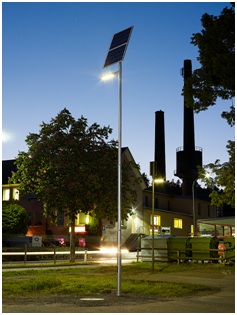
A central street from the Nepal’s capital city, Kathmandu, has a new way of facing the dark: solar powered street lamps.

This big step for the Asian solar industry couldn’t have been possible without the collaboration between Kathmandu Metropolitan City and Durbarmarg Development Board (DDB). The chief of the Urban Development Committee from KMC announced that most of the construction is finished, meaning that poles with twin lights have already been installed.

KMC gave permission to DDB to put into action the project that will bring to the street of Durbarmarg not less than 30 solar street lamps, installed on both sides of the street.

 “Right now we have planted the lamps just as dividers. We will also equip the foot lanes with additional lamps,” announced Rijal, chief at KMC.

To project is predicted to reach Rs 11.79 million and is possible due to a public-private partnership of KMC and the DDB. If this project reaches its goals, KMC is willing to bring a clean light to all main roads in the city.

 “This is just a pilot project, and we are sure it will attract more local communities to solar powered lamps, considering the growing power crunch. This will be proposed in most of the four lanes within the Capital,” said Rijal.

The project was no easy to implement as in 2013 KMC asked for help from public and consumers committees for about 30% of the installation price but they got no support at all. Still,  KMC got Rs 380 million from the Asian Development Bank (ADB).

The bank is going to supply with 600 light, and half of them will be under the jurisdiction of KMC.

 Roxana Moraru

Solar power has reached Indian ATMs

ATMs in rural India to work on green energy

Solar ATMs installed in Indian rural areas

Telecom towers, bank branches, data centers and ATMs in power deficient rural India can now benefit from solar power energy. This applies to the pour in energy area of the Asian country.

Not only is the government showing its support, but companies are also helping with supplies for power back-up and solar power producers. This direction is getting popular as many companies are in need of green power.

Sunil Khanna, president and Managing Director, Emerson Network Powe r “We are providing solar inverters of smaller ratings to ATMs. More than ATMs, our concentration is bank branches. At present, the adoption of solar power in the banking sector is at a nascent stage, but it is aggressively picking up.”

Still, he said that it is not easy to keep a record of the ATMs using solar energy but he is optimistic about Tier-3 and Tier-4 cities adopting this movement and believes it is a domain that can be explored. Moreover, he says that banks can change the old-fashioned way of data centers with ones in a box , with many advantages and financial benefits.

Telecom companies are also using solar power for telecom towers. The Chairman at Omnigrid Micropower Co. Pvt. Ltd, Sushil Jiwarajka says that “at present, we are powering more than 20 telecom towers and by April1 2014, the number will go up to 40. From one micro solar power plant site, we are powering three towers of different companies.”

He also said that thay “are providing surplus power to banks, schools, petrol pumps and even households in the locality to make our project viable.”

A big boost for the trend has something to do with Telecom Regulatory Authority of India’s (TRAI’s) request for companies to introduce the use of clean energy for at least half of their towers in villages.

A new way of using solar energy is developing- solar skyscraper windows

Scientists discovered a way to capture solar energy from the sun

Semi-transparent cells to be used in skyscrapers for solar energy

Solar technology is taking a step forward and could make use of giant building’s windows and build them to be solar-power generating glass.

The newly developing type of solar cells merges semi-transparency with better productivity is going to transform the global Building Integrated Photovoltaic (BIPV) market.

As it’s founders announce, the transparent strengthened PV panels could be produced starting from 2015.

The researches were done by the Oxford University physicists and Oxford Photovoltaics co-founder Professor Henry Snaith. The revealed that the new inventions was possible with the help of the oxide mineral perovskite.

The new developed cells have proved their performance by achieving 15% in the past year, outdistancing all other newly developed green technologies that didn’t break the 14% barrier even if their discovery took years.

The most important answer the scientists got has something to do with the glow associated with the use of prerokative. So, they managed to create semi-transparent cells that allow owners to clearly view outside.

The licence to the technology belongs to Oxford Photovoltaics, awarded with the British Renewable Energy Association’s Innovation Award, the UK Business Angels’ Best Early Stage Investment in a Disruptive Technology Business Award and the Solar Award for Excellence: BIPV Innovation at the 2013 Solar UK Industry Awards.

The past December, professor Snaith was nominated by Nature magazine as being one of the ten people that mattered from science’s point of view.

“The pace of development, of this new solar technology, alongside ongoing research into storage solutions, means that photovoltaics will play an increasingly important role in meeting future energy demand globally,” the professor said.

Kevin Arthur, Oxford PV Chief Executive’s words are: “We’re making great progress towards commercialisation of this ground-breaking technology and expect to sign our first licensing deals early next year. This research also emphasises the importance of nurturing links between business and academic institutions. Our sponsorship of PhD students delivers extra capacity to push our work through faster and builds a pipeline of great talent for our company. All of this will help the UK become a world leader in the multi-trillion pound electricity generation industry. ”