Mirrors can make solar power cheaper

Thermata has engineered a high-tech mirror.

Thermata is a new breed green technology that works on cutting down costs of sun tracking mirrors by supplementing it with digital technologies.

Thermata’s sun-tracking heliostat uses a high-definition camera and a wireless network to correct the angle in real time.

Its system uses a camera to detect the angle of heliostats and a mesh network of microprocessors to position each mirror with the ideal tilt.

Thermata’s system is designed to be smaller, lighter, and operate wirelessly.Each mirror is equipped with four small square mirrors raised above the
surface of the heliostat. A camera placed at a distance and out of the glare made by the heliostat takes pictures of the small square mirrors.

Having a smaller heliostat means lower costs.Mounting them will cost lesser, gears made from plastic and employing only two people per heliostat along
with simpler installation represent a plus for customers.

Thermata plans to start beta testing the heliostats this year with potential customers, which are concentrating solar power technology companies.

Black solar cells can absorb 99.7 percent of all incident light

It is known that solar energy is the most popular form of energy compared to many other forms of alternate energy sources.

One of the most important step that will help in spreading this green energy source far more rapidly among the consumer world will represent an improved ability to convert sunlight into energy.

Scientists at Natcore Tech are well on their way to achieving this step with the first black solar cell that has a reflectance of 0.3  percent.

The black solar cells absorb light more effectively than any other solar cell model. The Black Solar Cell, it can pretty much absorb 99.7 percent of incident light  and only reflects away 0.3 percent of it.

This cells are special because of their ability to produce significantly higher energy on even cloudy days. It is not known the exact efficiency figures of these new  black solar cells but due to the new technology these cell will be for sure more efficient than old ones.

World of Chlorophyll: A green building project inspired by nature

We have always taught that impressive designes are inspired by nature.

Of  course, science and technology can come up with new and advanced things, but but it is still hard to match 5 million years of evolution with a few hundred years of research and development.The design of ‘World of Chlorophyll’ is an amazing example of biomimicry.

The project is inspired by the way trees capture sunlight and turn it into energy. The idea of the design is to create individual units that seems more like the leaves of a plant in one giant structure with each unit getting the proper sunlight along with green rooftops.

Each unit has its own unique view and is not blocked by any other when it comes to natural ventilation. The green building will be largely a residential complex and  with its access to sunlight, it can embrace solar rooftops.

This project is an proposal and if all goes in a good way,then, this amazing new architectural delight could take shape in the heart of New York City.It will be among  the skyscrapers of New York that will be worth paying a visit to.

Brooklyn has the world’s largest rooftop greenhouse

It is not usual that people in big cities get to grow their own fresh vegetables and fruits.

But due to hydroponics and some innovative designs people can cultivate fruits and vegetables on rooftops.This represents one of the latest that helps both financial system and local produce.

This farm will be constructed on Brooklyn’s industrial waterfront. The greenhouse crops are not grown in the soil as is usually done in other farms,it is about  a new technology, according to which nutrients are taken up by the crops exactly from the water in which the plants are grown.

With this new technology new employment avenues will open up for people in Brooklyn and this will give a plus for the local economy.

This farm will provide the right amount of produce for the needs of  a number of people living in New York. The new development encourages a healthy living throughout the city.

This greenhouse farm by Bright Farms will be one of the biggest farms of the world and will provide up to a million pounds of local produce every year. The greenfarm will contribute to improve New York City’s food system. This means that the farm will bring a remarkable increase in the local food production and also a positive effect concerning a healthy life.

The largest rooftop solar power in North America officially completed

It is known that New Jersey likes setting rooftop solar power records.

It started in 2009 when it opened the largest solar rooftop in North America (2.4 MW of capacity).After that in 2011 when Toys”R”Us got a 5.38-MW solar roof and again later in 2011 when a 9-MW solar roof was installed on a large Holt Logistics refrigerated warehouse, the Gloucester Marine Terminal.

This solar rooftop was finally completed this week.The solar rooftop project is called Riverside Renewable Energy and its costs were about $42 million, includes  27,526 photovoltaic rooftop solar panels and covers 1.1 million square feet.

Its construction started in June 2011 and was completed on budget and ahead of schedule.Riverside will give the equivalent of up to 80 percent of the Terminal’s power  demand.The system is expected to to balance out more than 8,100 tons of carbon dioxide,    around the same amount that would be balanced out by planting 400,000 trees or removing 1,200 cars from the road.

U.S. Rep. Robert Andrews affirmed that “The Riverside project is an outstanding example of how we can create jobs that move us towards cleaner, more efficient and cost-saving energy that doesn’t come from overseas” and “By partnering with the federal government, private industry is able to make strides that are good  for job creation and the economy right now, and also for a cleaner, healthier and more energy efficient future here in South Jersey and the country.”

New on the market: the T-Series Panels

Centrosolar Canada announced the release of the new photovoltaic modules: T-Series photovoltaic

Engineered in Europe and manufactured in Ontario it is designed for residential and also for commercial applications.It is designed for optimum capture of available sun to generate very high efficiency of power.

Centrosolar Canada’s T-Series is available in two versions: 60 cell and 72 cell. They are designed to rezist when it comes for harsh weather as snow, storm, ice, hail, high humidity and the intense thermal fluctuation associated with Canadian weather patterns.

T-Series Panels are made with high-quality materials, including top-branded EVA and high-transmittance glass for maximum durability and performance over the life of the installation. The modules are powered by monocrystalline and polycrystalline high-efficiency silicon cells, providing higher power output per module: up to 255Wp and 300Wp.

One of the benefits of the Centrosolar T-Series is its certification to withstand hail impact. wind and snow loads up to 5.4n/m.The Centrosolar T-series provides a tolerance rating of 0/+4.99W, which translates into more power out of the 255W and 300W module per DC wattage than other comparably rated modules.

The T-Series is also offered as part of Centrosolar Canada’s CentroPack System that provides installers with a turnkey system, pre-packaged with all the components  needed to install an approved residential or commercial roof-top PV system.

The CentroPack contains the T-Series panels, mounting systems, inverters and all the electrical and other hardware needed. Site plans, wiring diagrams and mechanical and structural details are also available as required.

Recreational Vehicles: A new step for comfortable trips

RV (Recreational Vehicles) are the best inventions for a perfect trip.

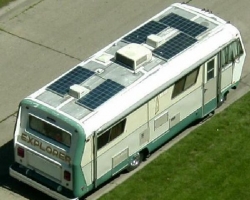
RV requires energy to provide you all comforts of a home while you are on the road. Solar installations  will allow more independence in creating home comforts and also save fuel.

The solar instalations consist of solar panels and also the mount on which the panels will rest.Your camper and batteries will get charged directly from the sun.A problem with RV’s is that for their power needs they may not get access to a power outlet so you need to install a generator.

Specially designed for smaller quarters a Solar Power Ventilator can further enhance the efficiency of renewable energy. Solar installations represent a green solution for saving the fuel, but they will also be a rescuer through times when power supply gets cut off.

New developement:solar cells thinner than spider silk

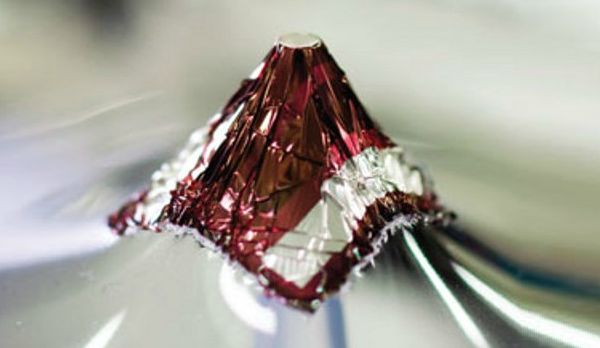
A team of Austrian and Japanese researchers created micro thin solar cells that are thiner than the strand of  spider silk.

It consists of electrodes on plastic foil and measures a mere 1.9 micro meters thick, 10 times thinner than  all available solar cells.
It could change the development of electronic textiles, synthetic skin and advanced robotics.

The device can be attached to a person’s clothes to collect  solar electricity and help elderly individuals wearing sensors to monitor their health.People will not feel the weight of these cells and the elasticity helps using it in many other applications .

The researchers aims to increase the overall rate of the device’s sunlight electricity conversion.The power generated by solar cells increases with size and specialist said that the cells could be made larger to increase their efficiency.
Now, the cells aren’t powerful enough for any gadget but the research team work to be ready for the market in another five years.

IKEA uses 100% renewable energy

IKEA is a 100% green company, its 2011 Sustainability Report affirms its green status.

From September 2010 to August 2011 IKEA set aside approximately $670 million to invest in renewable energy which includes installations that have both been brought into operation or will be completed in the next 1.5 years.

The company’s current renewable energy portfolio will increase. Now it boasts 69 wind turbines and 124 photovoltaic (PV) projects (40 operational and 84 approved).

The company declared its future plans to add 11 new PV solar projects to its current portfolio. The aim is to aid rooftops of each of the brand’s stores with solar PV panels and generate approximately 7000KW of clean energy. The base of this future planning is strengthened by IKEA’s success at the completion of its geothermal project at Denver, Colorado.

In a separate announcement, released just hours before the Sustainability Report, IKEA said it has plugged in its 15th solar energy project in the United States. REC Solar installed 4,984 solar panels atop IKEA’s 148,200 square foot store located in College Park, Maryland. The solar panels will combine to generate 1,196 KW of renewable energy.

IKEA is one of the most lucrative businesses on the planet, is not using this model — the retailing juggernaut owns and operates each of the systems installed on its buildings.

IKEA says it has 22 solar projects underway in the US which, when complete, will hoist the company’s solar energy portfolio to 30.8 MW.

Google – investments in green energy

Web companies like Google are also investing in renewable energy with handsome profits. Google has invested over $915 million in this sector. The company has also taken it upon itself to make use of green and sustainable energy. Some of their corporate campuses utilize photovoltaic systems for solar energy and cogeneration units that make use of landfill gas to generate electricity. Google has also completed two PPAs with a commitment to purchase renewable energy from certain sources.

Google projects:

1. The project: Large scale solar PV in California

Google has invested $94 million in Recurrent Energy, a Sacramento-based company, for solar projects. The investment wil cover four solar projects that is hoped will significantly benefit California’s energy needs.
88MW of power being produced, enough to sustain 13,000 homes.

2. The project: Clean Power Finance – providing financing for rooftop solar panels.

Startup company, Clean Power Finance, is being financed by Google to help third party installers place solar panels on rooftops as part of solar rooftop projects. The investment of $75 million will see about 10,000 homes being benefited by solar power.

3. The project: SolarCity – solar for thousands of residential rooftops. In one of the biggest investments by Google, $280million has gone into funding SolarCity for its residential solar market.

4. The project: Atlantic Wind Connection – a superhighway for clean energy transmission

Google’s 37.5 equity stake in the Atlantic Wind Connection project by Trans-Elect Development Company will be able to generate a substantial 6000MW of power to large population centers in the Mid-Atlantic region.

5. The project: Shepherd’s Flat – the world’s largest wind farm. The investment: $100 million