The world’s first country powered completely by the sun

Nestled in the South Pacific lies a paradise-on-earth, called Tokelau. In essence a group of islands, this beautiful country has now been crowned as the world’s first nation to go 100% solar-powered!

Using a one megawatt array spread across three atolls, Tokelau is capable of powering 1,400 residents’ lives with renewable energy, generating enough power to satisfy 150% of their electricity needs!

Using 4,032 solar panels and 1,344 batteries, the system was installed by New Zealand-based PowerSmart for a price of £4.7 million. The country also generates energy by burning coconut oil in case of cloudy days or emergencies.

The system has helped the country reduce its carbon emissions by nearly 950 tonnes a year, turning Tokelau into an ideal example for the rest of the world.

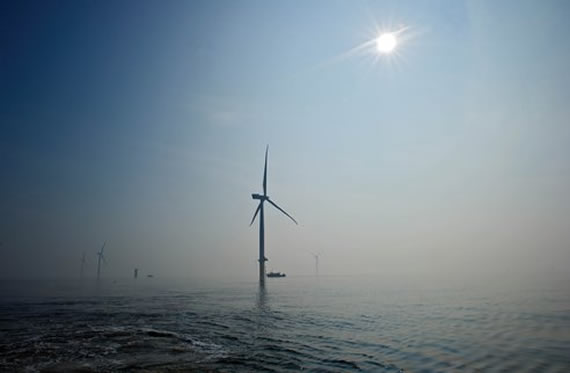
Samsung opens Korea’s first offshore wind farm

Samsung has been leading the world of technology and has turned into one of the world’s largest consumer electronics giants lately.

The Samsung Heavy Industries has now moved towards the greener horizon and has announced plans for an 84-megawatt offshore wind farm. This will be Korea’s first and will be built jointly with Korea Southern Power Co in Jeju Island.

To be built with a depth of about 30 meters and 2 kilometers away from the coast of Daejeong-eup in Seoguipo in Jeju Island, Samsung plans to have this one up and running by 2015. The wind farm will generate enough energy to power up 100,000 households with clean and green juice.

The world’s largest wind farm, London Array

The world’s largest wind-farm, the London Array has finally begun generating energy.

Located in the Thames Estuary, the project will be worth 630 MW when completed. Currently, just 15 of the total 175 turbines have been installed, with the rest being set up.

The remaining turbines are expected to be constructed by the end of this year.

Once completed entirely, the London Array will generate enough juice to power nearly 470,000 UK homes. And this is just the first phase.

The second phase of the project will increase the capacity to 870 MW, slightly off the previously planned 1 GW capacity.

Warrant Buffet’s MidAmerican purchases two wind-farms

Warrant Buffet’s MidAmerican purchases two wind-farms capable of generating 300 megawatts.

American business magnate, investor, and philanthropist better known as the “Wizard of Omaha”, Warren Buffet has now shown his greener side. The billionaire’s Berkshire Hathaway’s subsidiary, MidAmerican, has recently purchased to massive wind farms in California.

Generating a total of 300 megawatts of electricity, these wind farms will be part of the Wind Energy Center located in Tehachapi. The energy generated will be sold to Southern California Edison as part of a long-term power purchase agreement.

That apart, the project is expected to generate just about enough energy to power up nearly 80,000 American homes.

Also, the move could help Warren Buffet offset the pollution his coal trains have been spewing in the environment!

Solar Cell Made of a Single Molecule

A method to measure the photocurrents of a ‘single functionalized photosynthetic protein system’ has now been developed by researchers.

The researchers are confident that they can show that such a system could be integrated and “selectively addressed” inside of an artificial photovoltaic device’s architecture while still being able to retain its “biomolecular functional properties.”

The researchers were investigating the photosystem-I reaction center — that’s a chlorophyll protein complex that is located in the membranes of chloroplasts from cyanobacteria. Photosynthesis is used by algae, plants, and some bacteria in order to convert the Sun’s energy into usable and storable chemical energy.

The primary challenge to the physicists was that they had to develop and master “a method to electrically contact single molecules in strong optical fields.

The research was the result of interdisciplinary cooperation between researchers, led by Joachim Reichert, Johannes Barth, and Alexander Holleitner (Technische Universitaet Muenchen, Clusters of Excellence MAP, and NIM), and Itai Carmeli (Tel Aviv University).

V3Solar Spin Cell vs conventional solar panels

As technology progresses, solar power harvesting systems are quickly receiving long-awaited upgrades.

Recently, we stumbled across this revolutionary new solar energy harvester called the V3Solar Spin Cell. Developed by V3Solar, this cone-shaped apparatus is capable of generating roughly about 20 times more energy than the traditional flat solar panel.

Using concentrating lenses, dynamic spin, a conical shape and advanced electronics, the V3Solar Spin Cell sports two cones, one of which uses hundreds of triangular PV cells. The outer cone works as a static hermetically-sealed outer lens concentrator.

V3Solar Spin Cell is capable of generating more energy from the rays of the sun than its peers, making it the next best way to power up the world today.

The European Union has passed the milestone of 100 GW

EU reaches 100 GW wind power milestone.

It took the European wind energy sector some twenty years to get the first 10 GW grid connected. It needed 13 years to add an additional 90 GW. And half of the actual total European wind power capacity has been installed over the past six years.

100 GW of wind power can generate electricity over a year to meet the total consumption of 57 million households, equivalent to the power production of 39 nuclear power plants, 52 gas power plants or 62 coal power plants. Or: “It would require burning 72 million tons of coal annually in coal fired power plants to match Europe’s annual wind energy production. Loading that amount of coal on trains would require 750,000 wagons with a combined length of 11,500 kilometres – the distance from Brussels to Buenos Aires, Argentina,” said Christian Kjaer, CEO of EWEA.

“Despite only utilising a tiny fraction of Europe’s vast domestic wind energy resources, wind power is having a substantial impact on Europe’s energy security and environment, and benefits us hugely in creating green jobs and technology exports”, he added.

Sharp unveils new semi-transparent solar panels

Sharp unveils new semi-transparent solar panels with 6.8% conversion efficiency.

See-through solar panels have been a long standing dream of many, and Sharp has just given the world its first taste of the revolutionary technology.

Designed specifically for use as balcony railings and skyscraper windows, these solar panels have a semi-transparent black finish with a solar power conversion efficiency of about 6.8%.

These panels pack a maximum output of 95 watts and measure in at 4.5-feet wide by 3.2-feet tall. Now the efficiency of these panels might not match up to those conventionally used, but replacing windows with these is bound to turn just about any building greener!

Also, Sharp has not revealed the pricing details and we hope as technology progresses, these transparent panels will turn a little more efficient!

Google Purchases 48 MW of Wind Power

Google Purchases 48 MW of Wind Power for Its Oklahoma Data Center.

That’s a very large amount of electricity, enough to power a small city.The recent announcement shows that with a forward-thinking approach, large companies can make significant contributions to the transition to a renewable energy economy.

“To power its Oklahoma data centre – one of the facilities responsible for bringing you your Gmail, Docs, and Google search results – Google faced a local electricity mix of over 50% coal power,” Greenpeace writes. “But as one of the major electricity customers in the state, Google worked with the local utility to secure a new supply of renewable wind energy.”

Google’s decision to source the electricity for its data center entirely from renewable energy should send a message to other large “internet companies and electric utilities around the world that renewable energy is not only possible, but is simply smart business in the 21st-century economy,” Greenpeace adds.

Eco Homes in South Korea

Environment friendly homes are getting popular with time. Known as Eco homes or green homes, they are best suited for protecting the environment in the best possible manner.

Solar energy is being generated for building these homes in South Korea. Natives of South Korea are mounting solar panels on their roofs so that they can cut on their electricity bills with ease. Along with this, solar power energy is considered the best source, which can help you on sustaining energy in the best possible manner.

Homeowners in South Korea are incorporating these methods so that they can renovate their homes in an environment friendly manner.

A group of architects from South Korea is the one who conceptualize this dream project of having green or eco homes.The architects of South Korea have shown their potential by designing and making a home, which is truly considered as eco home. More than 95 green technology aspects are taken into use for building the eco homes for perfect results.

The architects are stating that, in the near future, energy sources would be costly and at that point, of time, eco homes would be the best choice for all.

The technology plays a major role in having eco homes in South Korea. With time, use of eco homes will grow at a rapid pace, as the benefits, which are associated with it, are beneficial in the end.