Japan looks to ocean for renewable energy

clean power Japan

Marine power generation plan

As an island nation, Japan controls large swaths of ocean territory, about the sixth-greatest expanse of any country in the world, according to government data. That is stark contrast to its relatively meagre land area, which ranks near the middle of list, in 60th place. So it makes sense for Japan to look to the seas for renewable energy — something it hasn’t done so far.

That is about to change, as the government is teaming up with two major industrial conglomerates, IHI Corp. and Toshiba Corp., to start field testing marine power generation in the near future.

“Our goal is to enable large-scale marine energy farms,” said a Toshiba spokeswoman, noting that the nearest site for testing is the area off Japan’s southern Pacific coast, where the Kuroshio current flows northward.

According to The Wall Street Journal, the initiative is an effort to develop new technologies to harness renewable energy and nurture future businesses opportunities as the need for renewable energy grows world-wide amid stricter regulations on coal in the U.S. and Western Europe. The Japanese government’s energy plan put forward in April 2014 called for an increase in use of renewable energy “to the greatest extent possible.”

IHI and Toshiba will spend about two years collecting data on currents at various locations to select the most promising ones. They will then conduct field tests by setting up a power generation system similar to an underwater kite anchored to the ocean floor that “flies” in the current.

The budget for the program is ¥2.75 billion ($23 million) for the current fiscal year through March. The government will subsidize part of the costs, but doesn’t disclose how much.

Marine current power generation technologies have already been developed and used in Europe, although they aren’t widespread. Japan wants to create its own technologies, say officials with the government-financed New Energy and Industrial Technology Development Organization, or NEDO, which works with the private sector on new energy technologies, and chose the two companies for financial support.

“Our marine environment is not the same as Europe’s,” said Yoshinari Takayanagi, an offshore wind and ocean energy project coordinator at NEDO. “There can be more suitable technologies.”

Students help small businesses to save energy

 Green Impact Campaign

Green Impact Campaign rezults

One way for small businesses to green up their operations can be through choosing a renewable energy source, whether it’s a rooftop solar installation or the purchase of clean energy through their local utility. However, a much lower hanging fruit for small business sustainability initiatives, and one that can have a big positive effect on the bottom line as well, is reducing the energy demand of the business.

Of course, improved energy efficiency doesn’t sound nearly as exciting as getting solar power does, but it should be an essential element of any business sustainability plan, whether renewable energy is part of the mix or not, and and having an energy audit done is an important first step.

By training students to conduct free energy audits for small businesses, the Green Impact Campaign is helping both parties, by helping students gain important green business skills while also identifying big energy savings for businesses.

According to Planet Save, students are trained to use a cloud-based energy audit tool, called GEMS (Green Energy Management System), which they use to answer prompts about the business as they do a walk-through of the building. Once all of the data about the business’ energy and water use has been entered, said to take about 20 minutes, the GEMS tool generates a report about energy efficiency recommendations, with both the estimated costs and estimated savings for those suggestions.

According to the Green Impact Campaign website, small businesses in the US incur about $60 billion per year in energy costs (along with generating carbon emissions from that energy), yet most of them could cut their energy consumption by an average of 20% with an appropriate energy efficiency plan. By participating and having students conduct the free energy audits for them, small business owners can have a very good idea of what they need to do to increase the energy efficiency of their business, how much it will cost, and how much they will save by doing so.

Since its inception in 2011, Green Impact Campaign has helped students at more than 70 universities to conduct energy audits at more than 300 small businesses, identifying a cumulative annual energy savings of 2 million kWh, the equivalent of about $250,000 in savings.

According to an article by one of the founders of the program on New Global Citizen, the students also gain from it, by being able to get real-world experience in sustainability and energy efficiency practices:

“Through their involvement with Green Impact Campaign, students have an opportunity to deepen their knowledge on energy-efficiency and sustainable business practices by being able to touch, see, and interact with sustainability concepts in a real-world setting. Many student volunteers have gone on to internships and jobs with firms that specialize in energy audits or sustainability consulting. Others have gone on to take their sustainability knowledge further by sitting for and passing the LEED Green Associate exam, enabling them to work in the green buildings industry.”

Dutch company uses plants to power streetlights and mobile devices

Plant-e

How Plant-e works

A Dutch company found a way to harvest electricity coming from the most unlikely of sources: plants.

According to Yes Magazine and followed-up by Inquisitr, the Dutch company known as Plant-e initially introduced their new energy project, known as “Starry Sky,” at a demonstration in Hembrug, Netherlands. In it, they were able to power 300 LED lights, a truly marvelous show for anyone in attendance.

The unique part of this project is that the harvested electricity didn’t come from conventional or even traditional green energy sources — it was harvested from living plants.

Marjolein Helder, the co-founder and CEO of Plant-e, believes that the aforementioned method of harvesting electricity can be revolutionary. Using plants to generate clean energy provides an option on the table that has little to no impact on the environment, and may save consumers up to millions as a whole if implemented correctly into society.

Yet, Helder understands to achieve such big dreams, one must take initial steps. For Plant-e, that is done not only through providing light, but by selling Wi-Fi hotspots, mobile chargers, and rooftop electricity modules, all fueled by living plants.

Apparently, the idea for using plants and photosynthesis to extract energy is an old one. Until now, such endeavors have been delegated to middle school projects, mostly in the form of clocks being powered by potatoes. Jim McGowan provided a graphic that gives a general summary of how this is done.

Though such an endeavor is novel, at this moment, it isn’t reliable as a commercial product. Ramaraja Ramasamy, an adjunct professor at the University of Georgia College of Engineering, explains that Plant-e utilizes sediment microbial fuel cells, a method that isn’t advanced enough to compete with more established green technology like solar panels and wind turbines. Also, it is fairly new, thus the research is quite limited.

In conclusion, Plant-e’s way of providing power through plants is interesting but not practical to use, especially in the United States and Japan, countries that use a monumental amount of electricity. Presently, Plant-e and other green technology companies like them are researching if it is possible to get around this situation.

Harvard researchers have discovered how to convert solar energy into liquid fuel

artificial leaf

Bacteria used to convert solar energy into liquid fuel

Biologists from Harvard University have developed a way to make burnable liquid fuel out of sunlight, using an artificial leaf and a bucket of bacteria-infested water.

According to the Capital OTC, the research team developed an artificial leaf which can make sunlight divide water into oxygen and hydrogen. This process uses bacteria specially engineered to convert carbon dioxide and hydrogen into isopropanol, which is a type of liquid fuel.

Professor Pamela Silver, one of the researchers involved in the study and scientist specialized in biochemistry and systems biology at Harvard Medical School, explained that the new discovery proves that it’s possible to have liquid fuel by harvesting solar energy.

Professor Silver said that they are trying to develop an easy way of obtaining fuel using natural methods.

The artificial leaf was invented by Daniel Nocera, professor of energy at Harvard. According to him, this special leaf requires inexpensive materials to act as catalysts and convert solar energy into fuel.

Professor Nocera explained that the catalysts he’s invented are very adaptable and have a high level of compatibility with the conditions needed for the bacteria to thrive.

In this new system, Nocera says, once the artificial leaf succeeded in producing oxygen and hydrogen, the hydrogen is then used to feed a bacterium called Ralstonia eutropha.

After this process, the hydrogen is taken back to protons and electrons by an enzyme, combining them with carbon dioxide in order for them to replicate, which leads to the formation of more cells.

The next step is based on the discoveries made previously by Anthony Sinskey, professor of microbiology, health sciences and technology at The Massachusetts Institute of Technology.

This next step involves the bacterium being metabolically engineered in order to make isopropanol.

Professor Silver said that these principles could also be used to produce vitamins in a small amount.

The team of scientists wanted to increase the ability of the artificial leaf to convert solar energy into biomass by optimizing the bacteria and the catalyst.

The scientists’ goal is to achieve an efficiency of 5%, while nature’s rate of efficiency for turning sunlight into biomass via photosynthesis is of 1%.

The new study was published in the journal PNAS.

World’s largest solar plant opens in California desert

Desert Sunlight power plant

Desert Sunlight power plant

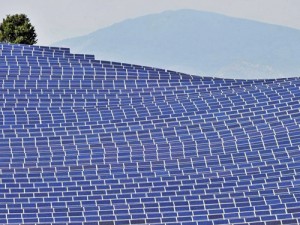
The Southern California desert is now home to the world’s largest solar power plant.

According to the USA Today, U.S. Interior Secretary Sally Jewell joined state officials on Monday to open the 550-megawatt Desert Sunlight solar project in the town of Desert Center, Calif., near Joshua Tree National Park. Built by First Solar, the project generates enough electricity to power 160,000 average California homes.

Desert Sunlight received a federal loan of nearly $1.5 billion, and Jewell called its completion an example of the loan guarantee program’s tremendous importance.

“When you are stepping out with new technology, when you are trying something that has been untested before, a loan guarantee program from an organization like the Department of Energy is what provides you, as a lender, that certainty that you can step up and support the project,” Jewell told The Desert Sun.

Conservative lawmakers have derided the loan guarantee program, arguing that it’s wasted billions of taxpayer dollars. Critics have pointed to the program’s $535 million loan guarantee for Solyndra, a Fremont-based solar panel manufacturer that filed for bankruptcy in 2011.

But the Department of Energy reported last year that it expects to make a profit of $5 billion to $6 billion from the program. The department funded five traditional, large-scale solar farms, and Desert Sunlight marks the last of those projects to go online.

“They’re all rock-solid, money is good, living up to every kind of condition we put in the loan documents in terms of performance, in terms of commercial operation,” Peter Davidson, executive director of the Department of Energy’s loan programs office, said in an interview last week.

The loan guarantee program did more than fund five solar photovoltaic projects, Davidson added: It helped launch the large-scale solar industry. In 2009, there were no traditional solar farms in the United States larger than 100 megawatts. Now, 17 such projects have been financed, according to a Department of Energy report released Monday.

Solar panels “existed before as a technology, but that technology hadn’t been deployed at a large scale,” Davidson said. “Once we’ve done that, the government steps aside to let the private markets take over.”

Desert Sunlight employed an average of 440 people during more than three years of construction, and it now has about 15 full-time employees. Money provided by the project’s owners — as part of an agreement negotiated with Riverside County — is also being used to fund $400,000 in improvements to the community center in nearby Desert Center.

“The debate’s over — we’re going to be moving to more renewable energy,” Riverside County Supervisor John Benoit said.

Power from the plant will go to Southern California Edison and Pacific Gas & Electric Co.

Desert Sunlight is the world’s largest solar power plant, although only by a hair.

The Topaz solar project in San Luis Obispo County, Calif. — which, like Desert Sunlight, was built by Arizona-based First Solar — also has a capacity of 550 megawatts. But the desert has more abundant sunlight than San Luis Obispo County, so Desert Sunlight will actually generate more electricity than Topaz, said Georges Antoun, First Solar’s chief operating officer.

“It’s a beautiful sun here, year-round,” he said.

California as a whole has installed more renewable energy than any other state, noted David Hochschild, a member of the California Energy Commission.

“There were a lot of skeptics who actually didn’t believe that renewables could scale, that this cost reduction could happen, that we could introduce it to the grid,” Hochschild said. “They’ve been proven wrong.”

There’s little doubt that California will get more electricity from clean energy in the coming years. The state’s three major utilities are on track to meet or exceed a 33% renewable energy mandate by 2020, and Gov. Jerry Brown is calling for policymakers to increase that target to 50% by 2030.

It’s an open question, though, whether future solar projects will be anywhere near as big as Desert Sunlight.

Developers have been gravitating toward smaller solar farms, which are easier to build and usually have a smaller impact on species and ecosystems in California’s deserts. Desert Sunlight spans 3,800 acres near Joshua Tree National Park, and it faced vehement opposition from environmental activists during its permitting process.

If legislators adopt a 50% renewable energy mandate, it could incentivize massive projects like Desert Sunlight. But Antoun said he’d be surprised to see many more projects 550 megawatts or larger, in California or elsewhere.

“Can we create a bigger project? Of course,” he said. “But it all has to do with how much appetite (states) have for how much land to utilize, and to be committed for 20-25 years.”

Utilities faced with renewable energy mandates, Antoun said, will more likely turn to projects in the 100-megawatt range, located closer to energy consumers. Projects built near cities require far less transmission infrastructure, which is expensive to build and poses a host of environmental concerns.

Solar panels have now a force field that eliminate dust

dirty solar panel

Self-cleaning solar panels

A new electrostatic material could eliminate dust particles of solar panels in the desert, making them way more efficient.

Dry, arid places are obvious locations for large-scale solar plants because there’s plenty of space and plenty of sun. But there’s a problem: Dust and sand that clings to equipment, reducing its efficiency. In places like Saudi Arabia, some solar reflectors—which concentrate heat to produce steam—have to been cleaned twice a week. That seriously increases maintenance costs and raises water issues, because there’s not a lot of water in the desert.

But there might just be an ingenious solution: an electro-static field. According to fastcoexist.com, a team at Boston University is working on a way to charge dust particles and then push them sideways, so they don’t get in the way. Its transparent “electrodynamic system” is printed on a solar panel or reflector, so it has a sort of force-field around it when it’s turned on. Most creatively, the material has three layers that are activated in phases and create a rippling effect.

“Number one, we want to charge the particle. Number two, we want to lift them up and propel them,” says Malay Mazumder, a Boston University professor of electro-physics. “The dynamic field we apply lifts them up one millimeter and the phases produce a traveling wave that propels the particles, so they are removed from the surface.”

The idea first came from Japan, and Mazumder has developed it for several applications. Between 2001 and 2003, he looked at a way to extract dangerous particles from coal before it’s burned in a power plant. Later, he looked at methods to put charges on drug molecules that treat respiratory diseases so they would go deep into lungs, rather than the stomach where they’re less useful.

The solar project could have the biggest impact, as it might reduce costs for solar operators, especially where they are currently high. It could also make some projects more viable. But there’s still some work to do. Mazumder’s team has only got the fields working with 15-by-15-centimeter panels so far. They need to scale up to at least 1.3 meters to be operational. Plus, they also need to find a material that’s both durable and cost-effective.

“The main barrier is to find materials that we can use outdoors in hot and extreme climates but that are less expensive than the operational cost [of conventional cleaning],” Mazumder says.

He’s confident it can be done, though. He’s got funding from the U.S. Department of Energy and others, as well as help from the large solar company, Abengoa. He hopes the first installations could appear within two to three years.

Recent developments in European solar energy sector

European solar market

What’s new on European solar sector

Many EU member states have passed laws in recent years to encourage solar energy investment. However, solar energy may have become a victim of its own success. According to industry experts, certain subsidies and tariffs may have been overly generous, particularly given the decrease over the past few years in the cost of producing photovoltaic panels. As a result, several European countries – including Bulgaria, the Czech Republic, Greece, Italy, Romania and Spain – are backtracking and modifying their solar energy laws. On the other hand, these changes may contravene applicable bilateral investment treaties or the Energy Charter Treaty, giving rise to claims by investors.

In 2009 the European Union issued a directive setting the goal that by 2020, at least 20% of energy consumed in the European Union shall be from renewable sources.

In conjunction with this directive and the drive towards renewable energy, many EU member states have passed laws to encourage sector investment, including in the solar energy sector.

In particular, many countries offered subsidies or proposed a feed-in tariff system, whereby solar energy investors could sign long-term contracts under which the market operator would commit to purchasing all of the energy that the investor produced at an above-market rate.

As a result of such measures, investment flowed in and many countries witnessed a significant increase in their photovoltaic capacity. For instance, Greece’s photovoltaic capacity increased from 620 megawatts (MW) in 2011 to 2,600MW in September 2013.

According to Intenational Law Office, Italy’s solar energy regulations resulted in an increase in subsidies from €750 million in 2010 to €6.7 billion in 2013. Conversely, investors have invested over €50 billion in the Italian renewable energy sector in the past five years.

Solar energy – a victim of its own success

According to some industry experts, certain subsidies and tariffs may have been overly generous, particularly given the recent decrease in production costs of photovoltaic panels.

In early October 2014 the European Commission noted that certain countries faced high electricity tariff deficits. As a result, several European countries have modified or are modifying their solar energy laws. According to one press report, the Italian government indicated that the changes were “necessary to combat the ‘excessive investments’ into the solar and wind energy sectors”.

Recent changes

The recent changes to solar energy laws have often involved fiscal changes and tariff and subsidy cuts. Often, the only alternative to such cuts is to drastically increase the electricity end price for consumers, which governments are reluctant or unable to do.

In Italy, under Law 116 (which came into effect in August 2014), owners of photovoltaic plants with a capacity of over 200 kilowatt-peak were required by November 2014 to choose between partial deferral of the payment of subsidies or a cut in subsidies (the amount of which would depend in part on the capacity of the plant), with a possible extension of their subsidies from 20 to 24 years.
Plant owners will also be required to pay a 5% general system charge to cover the administrative costs of the solar energy measures. The cuts and additional charges took effect in January 2015.

Bulgaria amended its Renewable Energy Act in December 2013 by imposing a 20% fee on income from wind and solar power installations, effective as of January 2014. It also limited the volume of electricity purchased at feed-in tariff rates. Whereas the national electricity company was previously required to purchase the entire volume of electricity produced via renewable energy technology at applicable feed-in tariff rates, it is now required to purchase only an amount specified by the State Energy and Water Regulatory Commission.

Any additional renewable energy produced must be purchased at the price at which the national electric company sells electricity to end suppliers or distribution companies. These measures led to a decrease in investment in the solar energy sector in 2014.

While Bulgaria’s Constitutional Court invalidated the 20% fee in August 2014, the ruling has not had retroactive effect and solar (and wind) energy producers will not be reimbursed payments made since January 2014. The other part of the law that limits the volume that the national electricity company is required to purchase at feed-in tariff rates, remains in force.

On March 30 2014 Greece enacted a law that retroactively cut solar feed-in tariffs by approximately 30%. Under the new measures, solar energy producers were required to contribute approximately 35% of their 2013 income (by issuing a credit invoice) to the market operator within two months of the law’s entry into force. Unless and until the solar energy producer does so, the market operator is not required to compensate that producer for energy produced following the entry into force of the new law.

Further, under the new law renewable energy providers are required to pay a solidarity tax on their now reduced 2013 income. After the expiration of the extended term of the power purchase agreements, any energy will be sold at market conditions and prices.

Finally, Romania enacted a measure in December 2013 which reduced the number of green certificates awarded to renewable energy producers for projects completed after January 1 2014.

In Romania, renewable energy providers traditionally receive a certain number of green certificates per MW of energy produced for a 15-year period following the commissioning of the plant. Under the amended system, photovoltaic projects completed after January 1 2014 will receive only three green certificates per MW, instead of six.

These recent legislative changes come on the heels of earlier significant changes to the solar energy laws in other European countries (eg, Spain and the Czech Republic). Since 2008, Spain has passed a series of measures resulting primarily in tariff and subsidy cuts and a 7% tax on the sale of electricity, applying to both existing and future projects. Similarly, in 2011 the Czech Republic imposed a levy on electricity generated from solar power plants.

Legal repercussions

Changes to the legal and regulatory frameworks of certain states may not only discourage future investment, but also give rise to legal proceedings by foreign investors. These changes could contravene domestic law, EU law (including EU Directive 2009/28/EC), any applicable bilateral investment treaties (BITs) and the Energy Charter Treaty. Investors may have BIT or Energy Charter Treaty claims for, for instance: expropriation; breach of contract and failure to grant their investments fair and equitable treatment.

They may thus be able to claim specific performance of original contractual agreements or obtain monetary damages.

Certain states are already facing legal action by foreign investors as a result of changes to their solar energy laws. In 2013 foreign investors from Cyprus, Germany, the Netherlands and the United Kingdom initiated at least seven arbitration proceedings against the Czech Republic. The cuts in tariffs and subsidies and the imposition of a 7% tax also led to the initiation of a litany of arbitration proceedings against Spain in 2013 and 2014. It has also been reported that arbitration proceedings were initiated in 2014 against Romania and Italy in connection with the changes to their solar energy laws.

International arbitration proceedings

The European Commission has sought leave to intervene as amicus curiae (an interested party) in arbitrations relating to the renewable energy sector. In July 2014 the commission sought leave to intervene in six of the arbitrations against the Czech Republic. The commission also sought, but was denied, leave to intervene in two of the arbitrations against Spain.

In one such recent amicus curiae submission, the commission contended that the exemptions from the payment of certain charges on the consumption of electricity that were in turn used to support the production of renewable energy amounted to a form of state aid that violated Article 107(1) of the Treaty on the Functioning of the European Union. It has also been reported that the commission has argued in at least two arbitrators that EU investors cannot rely on the Energy Charter Treaty to bring claims against EU member states, one of which has nevertheless resulted in an award in favour of the claimant.

Investors in EU countries suffering from the effects of these recent legislative changes should consider carefully whether they have recourse under the relevant legislative framework.

Parties seeking to invest in European solar energy should equally study the legal and regulatory framework of the country in question, including whether the Energy Charter Treaty or any BIT would govern their envisaged investment project and what protections it would afford.

Given the commission’s efforts to discourage reliance on intra-EU BITs (and possibly the Energy Charter Treaty, as applied to an investment by an EU investor in a different member state), potential EU investors wishing to invest in other EU countries should consider investing through a non-EU structure.

Conversely, states envisaging changes to their solar energy laws should study carefully the possible legal repercussions, including the risk of violating international treaty obligations and of thereby triggering legal proceedings as a result of such changes.

High-Efficiency solar cells move from space to your rooftop

High-Efficiency solar cells

High-Efficiency solar cells from space

High-efficiency solar cells originally designed for space travel are currently used for better efficiency in home solar systems. This advance is made possible by the development of new microscale solar concentration technologies.

Concentrating photovoltaic (CPV) systems utilize inexpensive optics to concentrate sunlight onto collectors, in order to raise efficiency in the panels.

“Current CPV systems are the size of billboards and have to be pointed very accurately to track the sun throughout the day. But, you can’t put a system like this on your roof, which is where the majority of solar panels throughout the world are installed,” Noel Giebink, assistant professor of electrical engineering at Penn State, said.

According to the Tech Times, the costs of installing solar energy systems includes not just the panels, but also installation, wiring and maintenance. However, prices for panels have fallen significantly in recent years, making solar energy more affordable for owners of homes and small businesses.

Gallium arsenide photovoltaic (PV) cells were fitted with a pair of plastic lens arrays, created on a 3D printer. The top layer acts like a magnifying glass, while a bottom layer, under the cell, further focuses light, like a concave mirror. Energy flowing into these new devices can be concentrated up to 200 times by the layers.

A steerable focusing mechanism is also utilized in the system to concentrate sunlight. Previous attempts to focus sunlight with lenses would only function for around two hours, due to the apparent motion of the Sun across the sky. The new system was able to collect energy eight hours a day during laboratory testing, with minimal movement needed for tracking. This new device is smaller, and easier to install and operate, than any previous CPV system, allowing them to be installed on buildings.

The new solar panels are just four-tenths of an inch thick, and are constructed mostly of plastic and Plexiglass, making manufacture inexpensive.

Despite their high efficiency, CPV systems are not able to collect enough energy in cloudy environments to be practical for home use. However, they could represent a new generation of solar collection devices for users in the American southwest and other sunny locations.

“The vision is that such a microtracking CPV panel could be placed on a roof in the same space as a traditional solar panel and generate a lot more power. The simplicity of this solution is really what gives it practical value,” Giebink told the press.

Development of the new technique for delivering more efficient solar energy at home was profiled in the journal Nature Communications.

Solar power stealing sea slug can be first plant-animal hybrid ever descovered

Elysia chlorotica

Elysia chlorotica

Scientists discovered an animal that rely on sunshine for its nutrition. A new study published in The Biological Bulletin belive that Elysia chlorotica might be the first plant-animal hybrid ever discovered, as the emerald green slug steals its solar power by feeding on algae and storing the algae’s photosynthesis performing plastids in its large transparent digestive glands.

According to the Immortal News, the emerald green elysia acquires its solar power by feeding on algae. In the process of feeding on the submerged vegetation, the slug consumes green organelles which capture energy from the sun, combine it with carbon dioxide and water, and produce food. As the chloroplasts are stored in the slug’s digestive glands, it’s able to adopt the plant-like ability of photosynthesis.

Chloroplasts are tiny capsules inside green leaves which use sunlight to power chemical reactions plants require to survive.

Scientific American’s Ferris Jabr wrote that most slugs digest chloroplasts right away, but some species like the emerald green slugs, store the algal chloroplasts for weeks to months.

This storage turns the sea slugs brilliant shades of green. Jabr goes on to say that the chloroplasts inside an alga depend on a lot of genes in the alga’s own nuclear and the proteins for which they code.

“In order to photosynthesize, the chloroplasts inside an alga depend on many genes in the alga’s own nucleus and the proteins for which they code. Tearing chloroplasts out of algal cells and asking them to make food inside a slug’s gut is like expecting the bottom half of a blender to puree some carrots sans the blade and glass jar.”

The research team used fluorescent DNA markers to illuminate the algal genes in the genetic material of adult and larva slugs, the researchers reported in the Biological Bulletin.

Professor Sidney K. Pierce, the study’s co-author and a biologist at the University of South Florida as well as the University of Maryland, indicated that there’s no way the genes from alga should work inside of an animal cell, yet they do.

” There is no way on earth that genes from an alga should work inside an animal cell […] And yet here, they do. They allow the animal to rely on sunshine for its nutrition. So if something happens to their food source, they have a way of not starving to death until they find more algae to eat.”

If the findings in the study are confirmed, this would be the first case of gene transfer from one multicellular organism to another. The report also notes that bacteria do this all the time, however, the sea slug would be the first plant-animal hybrid ever discovered.

Functional gene transfer between multicullular species is the goal of gene therapy which aims to correct genetically-based human diseases.

According to the Daily Mail, Elysia chlorotica is found in salt marshes and shallow pools along the east of the U.S., particularly in New York, Maryland, Florida, Texas, Connecticut, and Massachusetts.

The solar-powered sea slugs can produce carbohydrates and lipids for itself for up to nine months.

Nanogenerator that uses skin as a source of electricity

energy from movements

This tiny patch harvests electricity from your muscle movements

National University of Singapore developed a tiny nanogenerator that uses your skin as a source of static electricity, and converts it to electrical energy — reportedly enough to power a small electronic device.

The invention, presented at the MEMS 2015 conference recently, can generate 90 volts of open-circuit voltage when tapped by a finger. The researchers presented the patch as a self-powered device that can track the wearer’s motion.

According to Extreme Tech, the power generates thanks to the triboelectric effect, which is when certain types of materials can become electrically charged through contact and friction with another material — in this case, the patch gains the charge through fiction with human skin.

When the two materials are pulled apart, they generate a current that can be harvested. An electrode is needed in order to harvest the current, so the research team installed a 50nm-thick gold film to get the job done. The gold film sits below a silicone rubber layer composed of thousands of tiny pillars that help create more surface area for skin contact, which in turn creates more friction.

Thanks to the triboelectric effect, creating the device is easier as well — the skin is one of the triboelectric layers that helps produce the effect, so that layer doesn’t need to be built into the device itself, saving time, money, and materials. It also removes something that can go wrong with the device — having one less layer built in means that’s one less part that can break.

In the researchers’ test, a finger-tap on the device was able to generate enough current to power 12 commercial LEDs.

Aside from the obvious benefit of being able to, in theory, indefinitely power a device so long as you keep moving, this type of generator could remove the need for batteries in certain mobile devices — your smartwatch or fitness tracker could be made even thinner and lighter.

Who knows — one day this type of generator could even generate enough energy to power your smartphone, perhaps even removing the battery entirely, which is one of the biggest constraints to smartphone development and design.