A simple glass sphere could change the future of Solar Power

glass sphere

A new type of glass sphere can revolutionise the solar energy field.

It is not a secret anymore that the sun in one of the biggest sources of energy available on our planet. Still, we haven’t reached a point where we are using it to its maximum power. Most of the photovolataic panels around the world can only perform as high as 15% or less, and if they don’t use a tracking device, their efficiency is even lower. So, we learn that the energy from the sun is not as productive as it could be.

Andre Broessel, a German architect living in Barcelona, can solve the problem. He purpose is to “squeeze more juice out of the sun.” And that is how he designed Rawlemon.

If you put together spherical geometry principles with their dual axis tracking system, Rawlemon can produce twice as much energy as a normal solar panel, if both are located on a vertical set-up. Moreover, the sphere can minimize the cell surface to 1%, as a lot more cells could fit into a specific area and also concentrate its power to make a lot more sustainable, cheap power.

As opposed to conventional solar panels, this new invented device, can benefit from a fully rotational weather-proof natural optical tracking system that can be used on inclined areas, walls, and any other location with sunlight. The unit can use a modular collector system that is able to charge and store power day and night, both from the sun and the moon.

3D printing solar panels are finally here

solar panels

Shawn Freyne and Alex Hornstein from the Philippines can print solar panels within 15 seconds

Open Source technology has seen a huge progress lately. Moreover, a lot of persons are familiar with the source movement and this leads to a lot more creative ideas in the domain. The newest idea of the kind is delivered by Shawn Freyne and Alex Hornstein from the Philippines, that discovered a way to print solar panels within 15 seconds.

The “Open Source Solar Factory”, conceived by the two developers, consists of a small kit that could easily fit on a desktop and its efficiency high enough to make 300 thousand solar panels a year, meaning a solar panel could be printed every 15 seconds.This is not at all complicated, as the materials involved in the process are simple: glue, silicon cells, glass and plastic.

With this way of printing, the solar panel prices can be very low. If time and effort are invested, they can produce sufficient solar panels for important items such as cars and homes. And because the project is DIY, the producers have succeeded in reducing the price by almost 50%, as there is no labor work necessary.

The two scientists that made this possible have a big passion for inventions and they support green, free energy. So that is why they put a lot of effort into making this as economical as they could. In addition to this, they uploaded tutorials on Instructables.com for the kit, so that everybody can make their own solar panel.

At the moment, the duo have completed an entire round of successful funding on Kickstarter, a major crowd-funding site. They managed to raise $70,000 and are now aiming for $100,000 for their continued research on the topic.

Solar energy clears the view

solar panels

A new kind of solar concentrator

Some scientist at Michigan State Univ. (MSU) have been working on a new kind of solar concentrator that if situated on top of a window makes solar energy and, at the same time, is letting people truly see through that window.

The name for this device is transparent luminescent solar concentrator and can be useful for buildings, mobile phones and other utilities that need a clear surface.

And as Richard Lunt of MSU’s College of Engineering says, the key word for this is “transparent.”

The process of creating solar power from cells located around luminescent plastic-like material is not recent. Still, the progress made in the past lead to few good results as the power production was not efficient and the materials were more colored than transparent.

“No one wants to sit behind colored glass,” reports Lunt, an assistant professor of chemical engineering and materials science. “It makes for a very colorful environment, like working in a disco. We take an approach where we actually make the luminescent active layer itself transparent.”

The solar capturing system needs small organic molecules produced by Lund and his colleagues to absorb specific invisible wavelengths of sunlight.

“We can tune these materials to pick up just the ultraviolet and the near infrared wavelengths that then ‘glow’ at another wavelength in the infrared,” he added.

The “glowing” infrared light is lead to the edges of the plastic and then transformed into electric power with the help of thin strips of PV solar cells.

“Because the materials do not absorb or emit light in the visible spectrum, they look exceptionally transparent to the human eye,” Lunt believes.

A big advantage of this new discoveries is its flexibility. As the technology is at the beginning, is can be helpful even for commercial or industrial applications for low cost needs.

“It opens a lot of area to deploy solar energy in a non-intrusive way,” Lunt said. “It can be used on tall buildings with lots of windows or any kind of mobile device that demands high aesthetic quality like a phone or e-reader. Ultimately we want to make solar harvesting surfaces that you do not even know are there.”

The researcher believes that there is more work to be done in order to increase the power efficiency. As we speak, it is able to make a solar conversion efficiency close to 1% but can reach 5% when truly optimized. The best LSC has got a 7% efficiency.

Old car batteries can be recycled into cheap, resistant solar panels

green technology

Scientists from MIT have found a way to reuse the so-thought useless batteries

Pollution is a really serious issue nowadays, and it comes as no surprise that car batteries do a lot of damage to the environment. A lot of them are being thrown away as a result of the fast evolution in the industry. So scientists from MIT have found a way to reuse the so-thought useless batteries. The solution they came up with involves turning them into very efficient solar panels and not using them for new car batteries.

As shown in the picture, a single piece of car battery can be transformed into a cheap solar panel that can be used to harvest energy for 30 homes. This can be done with the help of the lead from the battery and use it in order to create solar cells that use perovskite, a compound that can achieve until 19% efficiency level.

Every solar cell works on a very thin layer of perovskite that MIT says measures in in at approximately half of a micrometer in thickness. Just one car battery can make sufficient power aforementioned houses, and has the advantage of doing something for the environment and the recycling world.

These types of panels made from used car batteries can also, themselves, be recycled and transformed into new solar cells, lowering the pollution rate, that could otherwise become a threat. Moreover, the benefits don’t stop, as scientists reveal that this type of transformation iss both easier and cheaper than common silicon utilities.

Some spary on cells can convert everything into solar panels. A very cheap way of solar harvesting

solar pervskite spray

Scientist say the spray can be applied on any surface that cells can remain on.

Huge solar panels are soon to be history. In the future, anything can be converted in solar harvesting “panels”.

Researchers from Sheffield just discovered a low-cost, spray-on- paint like solar cell. This type of cell is made of perovskite, a cheap convenient material. As we all know, the spray is already a thing for masses, so the making of it is cheap, leading to small prices for users.

Scientist say the spray can be applied on any surface that cells can remain on. Still, their efficiency can be changed by flexible surfaces or different surfaces.

About 85% of photovoltaic cells are being made of crystalline silicon. This a a quite expensive way to produce solar energy. Plus, the conversion rate reaches 25%.

Perovskite is a mineral crystal structure formed in the calcium titanium oxide mineral species. Its first use was 5 years ago but lacked efficiency. Meaning the scientists made solid cells from polymers, which gave only a 16% efficiency. Efficient organometal halide perovskite-based photovoltaics were demonstrated two years ago.

The Sheffield team found that by spray-painting the perovskite they could make prototype solar cells with efficiency of up to 11 per cent. Nowadays, about 85% of solar cells are from crystalline silicon with a 25% conversion rate.

Researchers from the University’s Department of Physics and Astronomy and Department of Chemical and Biological Engineering have used this method before to make solar cells with organic semiconductors but the perovskite is definitely a major advantage.

Lead researcher Professor David Lidzey said: ‘There is a lot of excitement around perovskite-based photovoltaics. Remarkably, this class of material offers the potential to combine the high performance of mature solar cell technologies with the low embedded energy costs of production of organic photovoltaics.”

If the majority of solar cells are being made with energy intensive materials, perovskites, on the other hand, take much less energy. The scientists believe that by spray-painting the perovskite layer in the air, they will achieve to harvest solar energy using less energy.

Professor Lidzey also sayd: “The best certified efficiencies from organic solar cells are around 10 per cent.”
The Sheffield team discovered that by spray painting the perovskite, they can make prototype solar cells with efficiency a 11% efficiency. Perovskite cells 19% efficiency.

The most innovative solar-powered devices for the summer

Solar energy is a lot more than just a way to reduce world carbon emissions, this way of harvesting power is, mainly, a way of saving money and each and every one of us can benefit from it. While the well-known solar powered calculators have been around since the 70’s, the sun will now have the ability to power a lot more devices in the close future because solar PV cell science are getting more and more profitable. Here is a list of the most innovative solar gadgets.

1. Solar-powered sun lounger

solar powered sun lounger


This solar powered sun lounger contains a built-in water misters and allows you to charge your pool side devices close at hand and always charged.

2. Solar-powered lawnmower

solar-powered hybrid lawn mower

The robotic solar-powered hybrid lawn mower from Husqvarna is made of an solar panel that helps you extend the battery’s life and consume a lot less power.

3. Solar powered barbecue

Solar powered barbecue

The COOKUP 200 from ID Cook allows you to enjoy a barbecue on the move and most important, it doesn’t need fossil fuels at all.

4. Solar powered beer

Solar powered beer

The Cerddin Brewery in Bridgend, Wales works with 18 photovoltaic roof panels and gives you the necessary power to create their range of ales and ciders.

5. Solar powered refrigerator

solar refrigirator

And what more can you ask on a hot summer day than a cool beer? Sundanzer refrigerators and freezers are constructed so that they can function with the help of solar panels. Moreover, they got the title: commercial invention of the year by NASA in 2011.

6. Solar powered boombox

solar boombox

What summer party is good without good and loud music? Don’t worry, the solar-based music system from Soulra works with any Bluetooth-enabled device as much as 8 hours if fully charged.

7. Solar-powered bikini

solar bikini

You can’t be anything else but surprised by the bikini designed by New York designer Andrew Schneider, made of small, flexible photovoltaic cells that harvest the sunlight and charge the devices you need while you do nothing but having a good time.

8. Solar-powered electric bike

solar bike

The solar-powered electric bicycle can reach 11mph and it all costs just £30 if you use second hand components.

Source: www.eta.co.uk


Self-cooling solar cells are now possible with the help of tiny glass pyramids

solar cells

Solar cell efficiency increases

When solar panels are used to give away power, are using small solar cells that need to have direct sunlight a long time. This is not a very difficult task, but can rise problems from time to time. As the solar cells heat up, their efficiency level is going down and the age quickly. Taking all this into account, the solar energy is not as cheap as we might think.

There are many ways the can get cooler in an active way, but this ways are generally not as cheap as we wish and they can also be problematic from the efficiency point of view. So, we might want to develop passive methods to cool the cells. In order to do this, a team of researchers from Stanford University developed a solution.

The highest level of efficiency reaches only conversion rates for the solar power they harvest, even if we are getting closer to a 50% rate. The remaining heat can be considered waste, as it brings the cells to 55 degrees Celsius. Every Celsius degree means a 0.5% cell efficiency decrease. This means that an efficiency levels at 30% is only bringing approximately 21% solar power.

The Stanford researchers brought a passive cooling solution by making use of the wavelengths of light. In order to do this, they use a thin sheet of silica glass among with the pyramids and shapes only a few microns thick. This means that visible light can enter through the glass unimpeded, but it also refracts away the infrared wavelengths that can be the cause of the extra heat.

In conclusion, with just a little extra cost, the additional glass layer can passively cools down the cells and the efficiency level can remain the same. Moreover, the live of the cells is longer, and an ideal efficiency level is to be reached. So far, this theory has been tested in a lab, but some outdoor test will be run in the near future. If these are successful, it might become a standard procedure for the next solar panel production, thanks to the big efficiency advantages.

A huge floating solar power plant to be built in India

solar technology

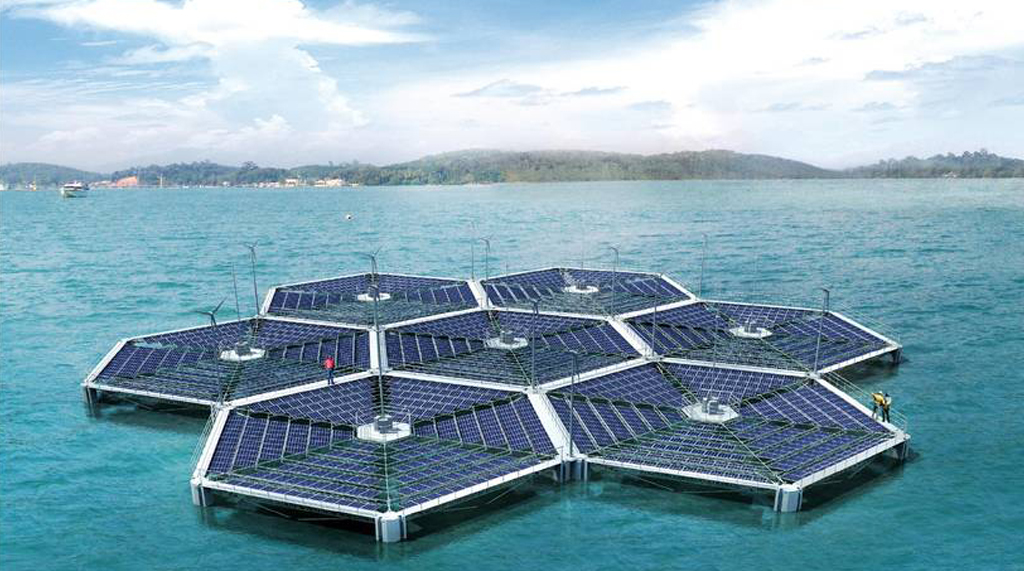
Floating solar power plant in India

The National hydroelectric power company in India announced that they are going to construct a great solar power plant that will sail on top of a lake.

India has previously announced their strategy to build a 10 megawatt solar situated on some of the its canals, the Asian country took their idea to another level and want to construct a floating power station that will be situated on one of the large stretches of water in Kerala, India.

This particular floating solar power plant machinery was expanded by India’s Renewable Energy College and it is going to be implemented by the National Hydro Power Corporation, India’s national energy company. The very first of its plants will be authorized this fall.

“NHPC had contacted us for offering technical know-how and installation assistance for their proposed 50-mw plant,” reports the chairman of the Renewable Energy College, Gon Choudhury. “Each station would require around 3000 square feet of space to generate 20 kilowatt of power. There are many water bodies that could be used for this,” he added.

The project is also said to be eco-friendly and it will have a small impact on the surroundings, as Choudhury illustrates:

“The ecology of the water body is not likely to be affected much and it will also reduce evaporation, thus helping preserve water levels during extreme summer. Solar panels installed on land face reduction of yield as the ground heats up. When such panels are installed on a floating platform, the heating problem is solved to a great extent. This isn’t an ideal solution, it’s not as though we can go and cover the world’s oceans with photovoltaic cells, but it’s certainly a solid intermediary step until we get those space-based solar farms up and running.”

This project looks a lot like one of Japan’s offshore solar power plants built in 2013. The 70MW Kagoshima Nanatsujima Mega Solar Power Plant was conceived as part of the move towards a more green energy area as a follow-up of the 2011 Fukushima meltdown and is located in Japan’s Kagoshima Prefecture.

A huge floating solar power plant to be built in India

solar technology

Floating solar power plant in India

The National hydroelectric power company in India announced that they are going to construct a great solar power plant that will sail on top of a lake.

India has previously announced their strategy to build a 10 megawatt solar situated on some of the its canals, the Asian country took their idea to another level and want to construct a floating power station that will be situated on one of the large stretches of water in Kerala, India.

This particular floating solar power plant machinery was expanded by India’s Renewable Energy College and it is going to be implemented by the National Hydro Power Corporation, India’s national energy company. The very first of its plants will be authorized this fall.

“NHPC had contacted us for offering technical know-how and installation assistance for their proposed 50-mw plant,” reports the chairman of the Renewable Energy College, Gon Choudhury. “Each station would require around 3000 square feet of space to generate 20 kilowatt of power. There are many water bodies that could be used for this,” he added.

The project is also said to be eco-friendly and it will have a small impact on the surroundings, as Choudhury illustrates:

“The ecology of the water body is not likely to be affected much and it will also reduce evaporation, thus helping preserve water levels during extreme summer. Solar panels installed on land face reduction of yield as the ground heats up. When such panels are installed on a floating platform, the heating problem is solved to a great extent. This isn’t an ideal solution, it’s not as though we can go and cover the world’s oceans with photovoltaic cells, but it’s certainly a solid intermediary step until we get those space-based solar farms up and running.”

This project looks a lot like one of Japan’s offshore solar power plants built in 2013. The 70MW Kagoshima Nanatsujima Mega Solar Power Plant was conceived as part of the move towards a more green energy area as a follow-up of the 2011 Fukushima meltdown and is located in Japan’s Kagoshima Prefecture.

A huge floating solar power plant to be built in India

solar technology

Floating solar power plant in India

The National hydroelectric power company in India announced that they are going to construct a great solar power plant that will sail on top of a lake.

India has previously announced their strategy to build a 10 megawatt solar situated on some of the its canals, the Asian country took their idea to another level and want to construct a floating power station that will be situated on one of the large stretches of water in Kerala, India.

This particular floating solar power plant machinery was expanded by India’s Renewable Energy College and it is going to be implemented by the National Hydro Power Corporation, India’s national energy company. The very first of its plants will be authorized this fall.

“NHPC had contacted us for offering technical know-how and installation assistance for their proposed 50-mw plant,” reports the chairman of the Renewable Energy College, Gon Choudhury. “Each station would require around 3000 square feet of space to generate 20 kilowatt of power. There are many water bodies that could be used for this,” he added.

The project is also said to be eco-friendly and it will have a small impact on the surroundings, as Choudhury illustrates:

“The ecology of the water body is not likely to be affected much and it will also reduce evaporation, thus helping preserve water levels during extreme summer. Solar panels installed on land face reduction of yield as the ground heats up. When such panels are installed on a floating platform, the heating problem is solved to a great extent. This isn’t an ideal solution, it’s not as though we can go and cover the world’s oceans with photovoltaic cells, but it’s certainly a solid intermediary step until we get those space-based solar farms up and running.”

This project looks a lot like one of Japan’s offshore solar power plants built in 2013. The 70MW Kagoshima Nanatsujima Mega Solar Power Plant was conceived as part of the move towards a more green energy area as a follow-up of the 2011 Fukushima meltdown and is located in Japan’s Kagoshima Prefecture.