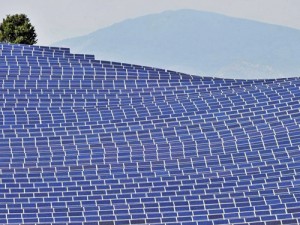
Australian-first floating solar plant under construction in South

 floating solar farm

PHOTO: Solar panels will be floated at the wastewater facility at Jamestown similar to a current project in France.

An Australian-first floating solar power plant it may be operational in South Australia by early April, with construction about to begin.

According to ABC News, the plant will float on a wastewater treatment facility in Jamestown in the state’s mid north.

Felicia Whiting of Infratech Industries said the plant was designed so that much of the construction could be carried out offsite and slotted together at the facility.

“We should see some plant on the site within about two weeks,” Ms Whiting said.

She also explained that as the solar panels were floating they would be kept cool by the water mass, making them about 57 per cent more efficient than land-based solar panels.

“It prevents water evaporation up to 90 per cent of the surface area covered, and for dry states and dry climates that’s a big water saving measure,” Ms Whiting said.

“It prevents the outbreak of blue-green algae by keeping the surface water cool, which is for treated wastewater an issue in water quality.

“By preventing photosynthesis, the energy from the sun goes into the panel rather than into the water.”

Jamestown solar farm to showcase technology

Infratech has developed floating solar power plants in countries such as France and South Korea, but the company had seen them as test sites for the new and improved model planned for South Australia.

“The plants that we had operating overseas were really behind the meter and not at the utility level and certainly didn’t have some of the sophistication,” Ms Whiting said.

The South Australian plant was expected to produce not only enough energy to power its co-located wastewater treatment facility, but have excess power flow-on to the township of Jamestown.

“The water treatment plants are heavy uses of power for the actual water treatments and pumping,” Ms Whiting said.

“Quite sustainably, with no additional use of land, we can use the water surface to power the water treatment facility.

“In addition to that, because we’re so efficient, we’re able to export power to the township.”

Ms Whiting said that once operational, the plant would become Infratech’s showpiece for export around the world.

“We’ve invested our whole research and development program in this technology over the past two years in South Australia,” she said.

“We have other councils waiting to have a look at this and see how it might be adapted to a water basin or a community wastewater management scheme.

“We are using Australian engineering and it’s an Australian supply chain – that will be taken internationally.”

Google aims to change mobile business with solar-powered internet drones

Google solar-powered drone

Google is preparing to conduct test flights of its solar-powered internet drones in the next few months

Google is working on Project Titan programme, which aims to provide internet services with solar-powered drones to four billion people in rural and remote areas who have no internet access.

Speaking at the Mobile World Congress in Barcelona, Spain, Google senior vice-president Sundar Pichai said the lightweight drones will hover over certain areas, and serve as remote satellites to provide web connectivity.

While Project Titan is designed to focus on specific, narrower areas, Google’s Project Loon covers greater regions using balloons, which will act as floating cell towers.

“Google is working on Project Titan programme, which aims to provide internet services to four billion people in rural and remote areas who have no internet access.”

According to Aerospace Technology, Google has been seeking to strengthen its capabilities in the aerospace segment, and leverage the expertise to expand web access to isolated parts of the world.

In line with these plans, the company acquired Skybox Imaging and Titan Aerospace in 2014.

Titan Aerospace is working on solar-powered internet drones, which can fly at an altitude of 65,000ft for up to five years, and offer data speeds of up to one gigabit a second.

Google is also working on Project Wing to develop drones that could be used for goods deliveries.

Earlier this year, the company participated in SpaceX’s $1bn financing round and acquired a stake of less than 10% with Fidelity Investments.

Solar energy powers innovation at Cook Medical

one of the largest PERC solar installations

Cook Medical to build one of the largest PERC solar installations

Cook Medical partnered with Positronic Solar and WINAICO to build one of the largest PERC solar installations in Asia Pacific – 99.90kW

According to a press release, world leading medical device manufacturer, Cook Medical, has taken one giant leap to reduce its carbon footprint and power bill, by installing a 706 square metre field of solar panels on its roof in Brisbane. The installation is the largest of its kind in Asia Pacific, utilising advanced solar panel technology called PERC (passivated emitter- rear contact).

“We have a roof and lots of sun, so harnessing solar power was an obvious solution to reduce costs for us and the environment. The investment was significant, but even so we expect our solar panels will pay for themselves within 15 years,” Barry Thomas, Cook Medical Vice President and Managing Director of Cook Medical Australia said. “Using alternative energy to power manufacturing still isn’t mainstream, but given the benefits it’s completely logical. We’ve chosen an extremely efficient technology, and the panels are now offsetting on average 30 per cent of the power we use each day.”

The installation of the panels was finished in January, and was carried out by local company, Positronic Solar, who recommended and installed the custom-design. John Inglis, Director of Positronic Solar was impressed by Cook Medical’s commitment to alternative energy. “When we put in our proposal we were very honest about what was achievable and the best technology for Cook Medical’s solar panels. They appreciated our straightforward approach, and chose an effective solution to offset a significant majority of their power use,” said Mr Inglis. “The design utilises Schneider-Electric inverters and WINAICO high efficiency PERC 280 W monocrystalline modules – some of the most advanced technology available. The panels are not only efficient even in low light, but also perform very well at high temperatures – which is of course very important here in Queensland.”

Cook Medical

Cook Medical Australia was established in 1979 and has grown to a headcount of over 500 people at their headquarters in Eight Mile Plains where its headquarters are based.

Founded in 1963, Cook Medical pioneered many of the medical devices now commonly used to perform minimally invasive medical procedures throughout the body. Today, the company integrates medical devices, drugs and biologic grafts to enhance patient safety and improve clinical outcomes. Since its inception, Cook has operated as a family-held private corporation.

WINAICO – Manufacturer and system supplier

As a global PV brand based in Taiwan, WINAICO manufactures and distributes crystalline high performance modules worldwide. Furthermore, as a systems house for photovoltaic, WINAICO delivers complete PV system packages.

Target customers include solar specialists, solar technologists, installation specialists and project developers. Installation specialists profit here from the superior product quality of products manufactured in Taiwan in accordance with the highest quality standards, as well as from the comprehensive consultation, planning and maintenance services from WINAICO. Generous stock levels ensure the rapid availability of WINAICO products.

SunEdison to build 15 GW renewable energy capacity addition in India

SunEdisin plant in India

New energy capacity addition for SunEdison in India

SunEdison has announced that it will set up 15.2 GW of solar and wind energy capacity in India over the next 5 years. The company is expected to develop solar as well as wind energy projects.

This would be SunEdison’s contribution to India’s ambitious target to add 100 GW renewable capacity by 2022. India’s installed renewable energy capacity currently stands at just above 32 GW.

According to Clean Technica, SunEdison had recently signed agreements with the state governments of Rajasthan and Karnataka to set up large-scale renewable energy projects. In Rajasthan, the company will add 5 GW solar power capacity while in Karnataka the company will add an equal capacity but through solar and wind power technologies.

SunEdison has been taking part in solar power project auctions conducted in the past by several state governments and the central government.

In addition to utility-scale power projects the company will also set up significant distributed renewable energy capacity. The company recently announced an agreement with a local firm to set up 250 MW distributed solar photovoltaic power projects in around 5,000 villages.

SunEdison also commissioned India’s first canal-top solar PV project in Gujarat.

Last month SunEdison signed an agreement with Adani Enterprises to set up India’s largest solar PV modules manufacturing unit in Gujarat. The project is expected to require a total investment of $4 billion.

SunEdison made this ambitious commitment at RE-INVEST, an investor summit organised by the Indian government. First Solar committed to set up 5 GW solar power capacity at the same summit. This brings to total commitment to over 20 GW over the next 5 years from these 2 American companies.

In comparison, when the Indian government launched the National Solar Mission in 2010 it had set a target to add 22 GW of solar power capacity by 2022.

Recent developments in European solar energy sector

European solar market

What’s new on European solar sector

Many EU member states have passed laws in recent years to encourage solar energy investment. However, solar energy may have become a victim of its own success. According to industry experts, certain subsidies and tariffs may have been overly generous, particularly given the decrease over the past few years in the cost of producing photovoltaic panels. As a result, several European countries – including Bulgaria, the Czech Republic, Greece, Italy, Romania and Spain – are backtracking and modifying their solar energy laws. On the other hand, these changes may contravene applicable bilateral investment treaties or the Energy Charter Treaty, giving rise to claims by investors.

In 2009 the European Union issued a directive setting the goal that by 2020, at least 20% of energy consumed in the European Union shall be from renewable sources.

In conjunction with this directive and the drive towards renewable energy, many EU member states have passed laws to encourage sector investment, including in the solar energy sector.

In particular, many countries offered subsidies or proposed a feed-in tariff system, whereby solar energy investors could sign long-term contracts under which the market operator would commit to purchasing all of the energy that the investor produced at an above-market rate.

As a result of such measures, investment flowed in and many countries witnessed a significant increase in their photovoltaic capacity. For instance, Greece’s photovoltaic capacity increased from 620 megawatts (MW) in 2011 to 2,600MW in September 2013.

According to Intenational Law Office, Italy’s solar energy regulations resulted in an increase in subsidies from €750 million in 2010 to €6.7 billion in 2013. Conversely, investors have invested over €50 billion in the Italian renewable energy sector in the past five years.

Solar energy – a victim of its own success

According to some industry experts, certain subsidies and tariffs may have been overly generous, particularly given the recent decrease in production costs of photovoltaic panels.

In early October 2014 the European Commission noted that certain countries faced high electricity tariff deficits. As a result, several European countries have modified or are modifying their solar energy laws. According to one press report, the Italian government indicated that the changes were “necessary to combat the ‘excessive investments’ into the solar and wind energy sectors”.

Recent changes

The recent changes to solar energy laws have often involved fiscal changes and tariff and subsidy cuts. Often, the only alternative to such cuts is to drastically increase the electricity end price for consumers, which governments are reluctant or unable to do.

In Italy, under Law 116 (which came into effect in August 2014), owners of photovoltaic plants with a capacity of over 200 kilowatt-peak were required by November 2014 to choose between partial deferral of the payment of subsidies or a cut in subsidies (the amount of which would depend in part on the capacity of the plant), with a possible extension of their subsidies from 20 to 24 years.
Plant owners will also be required to pay a 5% general system charge to cover the administrative costs of the solar energy measures. The cuts and additional charges took effect in January 2015.

Bulgaria amended its Renewable Energy Act in December 2013 by imposing a 20% fee on income from wind and solar power installations, effective as of January 2014. It also limited the volume of electricity purchased at feed-in tariff rates. Whereas the national electricity company was previously required to purchase the entire volume of electricity produced via renewable energy technology at applicable feed-in tariff rates, it is now required to purchase only an amount specified by the State Energy and Water Regulatory Commission.

Any additional renewable energy produced must be purchased at the price at which the national electric company sells electricity to end suppliers or distribution companies. These measures led to a decrease in investment in the solar energy sector in 2014.

While Bulgaria’s Constitutional Court invalidated the 20% fee in August 2014, the ruling has not had retroactive effect and solar (and wind) energy producers will not be reimbursed payments made since January 2014. The other part of the law that limits the volume that the national electricity company is required to purchase at feed-in tariff rates, remains in force.

On March 30 2014 Greece enacted a law that retroactively cut solar feed-in tariffs by approximately 30%. Under the new measures, solar energy producers were required to contribute approximately 35% of their 2013 income (by issuing a credit invoice) to the market operator within two months of the law’s entry into force. Unless and until the solar energy producer does so, the market operator is not required to compensate that producer for energy produced following the entry into force of the new law.

Further, under the new law renewable energy providers are required to pay a solidarity tax on their now reduced 2013 income. After the expiration of the extended term of the power purchase agreements, any energy will be sold at market conditions and prices.

Finally, Romania enacted a measure in December 2013 which reduced the number of green certificates awarded to renewable energy producers for projects completed after January 1 2014.

In Romania, renewable energy providers traditionally receive a certain number of green certificates per MW of energy produced for a 15-year period following the commissioning of the plant. Under the amended system, photovoltaic projects completed after January 1 2014 will receive only three green certificates per MW, instead of six.

These recent legislative changes come on the heels of earlier significant changes to the solar energy laws in other European countries (eg, Spain and the Czech Republic). Since 2008, Spain has passed a series of measures resulting primarily in tariff and subsidy cuts and a 7% tax on the sale of electricity, applying to both existing and future projects. Similarly, in 2011 the Czech Republic imposed a levy on electricity generated from solar power plants.

Legal repercussions

Changes to the legal and regulatory frameworks of certain states may not only discourage future investment, but also give rise to legal proceedings by foreign investors. These changes could contravene domestic law, EU law (including EU Directive 2009/28/EC), any applicable bilateral investment treaties (BITs) and the Energy Charter Treaty. Investors may have BIT or Energy Charter Treaty claims for, for instance: expropriation; breach of contract and failure to grant their investments fair and equitable treatment.

They may thus be able to claim specific performance of original contractual agreements or obtain monetary damages.

Certain states are already facing legal action by foreign investors as a result of changes to their solar energy laws. In 2013 foreign investors from Cyprus, Germany, the Netherlands and the United Kingdom initiated at least seven arbitration proceedings against the Czech Republic. The cuts in tariffs and subsidies and the imposition of a 7% tax also led to the initiation of a litany of arbitration proceedings against Spain in 2013 and 2014. It has also been reported that arbitration proceedings were initiated in 2014 against Romania and Italy in connection with the changes to their solar energy laws.

International arbitration proceedings

The European Commission has sought leave to intervene as amicus curiae (an interested party) in arbitrations relating to the renewable energy sector. In July 2014 the commission sought leave to intervene in six of the arbitrations against the Czech Republic. The commission also sought, but was denied, leave to intervene in two of the arbitrations against Spain.

In one such recent amicus curiae submission, the commission contended that the exemptions from the payment of certain charges on the consumption of electricity that were in turn used to support the production of renewable energy amounted to a form of state aid that violated Article 107(1) of the Treaty on the Functioning of the European Union. It has also been reported that the commission has argued in at least two arbitrators that EU investors cannot rely on the Energy Charter Treaty to bring claims against EU member states, one of which has nevertheless resulted in an award in favour of the claimant.

Investors in EU countries suffering from the effects of these recent legislative changes should consider carefully whether they have recourse under the relevant legislative framework.

Parties seeking to invest in European solar energy should equally study the legal and regulatory framework of the country in question, including whether the Energy Charter Treaty or any BIT would govern their envisaged investment project and what protections it would afford.

Given the commission’s efforts to discourage reliance on intra-EU BITs (and possibly the Energy Charter Treaty, as applied to an investment by an EU investor in a different member state), potential EU investors wishing to invest in other EU countries should consider investing through a non-EU structure.

Conversely, states envisaging changes to their solar energy laws should study carefully the possible legal repercussions, including the risk of violating international treaty obligations and of thereby triggering legal proceedings as a result of such changes.

Apple is building a $2 Billion solar-powered data command center

solar-powered data

Apple to build a solar-powered data in Arizona

Apple’s power plant project in Arizona didn’t work out, so now Apple is investing another $2 billion to convert the facility into a massive data center.

According to Quartz, the company will employ 150 full-time Apple staff at the Mesa, Arizona facility, which will serve as a command center for its global network of data centers. In addition to the investment for the data center, Apple plans to build a solar farm capable of producing 70-megawatts of energy to power the facility.

The facility with some 120,000 square meters (1.3 million square feet) had been the planned site of a plant to produce sapphire glass screens in a collaboration with GT Advance Technologies.

Sapphire touch screens are a very tough synthetic replacement for the glass currently used on many Apple mobile devices, and are already used in a limited way for particularly sensitive parts of devices, The Sun Daily writes.

The synthetic screens were also expected to be used in the Apple Watch set to hit the market in April.

The collaboration came apart late last year after GTAT filed for bankruptcy and accused Apple of saddling the company with onerous terms in the deal.

State officials said the investment is a good deal for Arizona.

“Apple is a company that we wanted to come to Arizona, previously with a third party,” state Governor Doug Ducey said during a press conference.

“Now, we have Apple itself investing in our state. This is a one-of-a-kind company, they just had a world record quarterly earnings, and they are coming to Arizona.”

Ducey said Apple has made a 30-year commitment with the data center, and that it will sign on about 150 employees along with creating hundreds of construction jobs during the building phases.

Greenpeace senior IT sector analyst Gary Cook lauded Apple’s decision to build an Arizona data center powered by renewable energy.

“Apple remains the most aggressive among major IT companies in delivering on its commitments to be 100% renewable, and has shown the business community that solar is ready, here and now, to power our economy,” Cook said.

He call on other technology industry titans, particularly Amazon and its massive cloud services operation, follow suit.

The web portal that provides insight into renewable energy sources

web portal clean energy

The web portal is available for viewing on a variety of devices.

Researchers from the University of Arizona and their partners have built a new web portal that will help utility companies better understand the long-term impact of clean energy on the power grid and provide insight on how to integrate these resources in the future in the most cost-efficient and reliable way for consumers.

The tool — a web portal— analyzes, gathers and displays real-time data from eight Southwestern utility companies, painting a broad picture of energy sources and use across the region. The information is crucial, because it will help companies determine what actions to take for backup power planning over the next several years as the percentage of renewable energy usage grows.

According to psys.org, by 2025, Arizona utility companies are required to generate 15 percent of their energy from the sun, wind, biogas, biomass, geothermal and other green resources. But the power generated by some of these renewable resources is variable. For instance, a cloudy day will change the amount of power generated by a solar array, a stormy day could generate more wind power, and solar generation drops completely at night —right about the time when customers turn on their lights, increasing energy demand.

By using this tool to obtain a deeper understanding of these opportunities and challenges, utility companies will be able to provide customers with a more reliable and efficient power grid, even as variable resources become a larger percentage of the overall power generated.

“Integrating solar and wind resources onto the grid while maintaining the total load and resource balance is the challenge for balancing authorities such as TEP,” said Sam Rugel, Tucson Electric Power’s director of systems control and reliability. “This tool will help quantify and communicate that challenge in a more efficient and effective way for us and our customers as we move forward.”

Part of the portal is accessible to the general public, marking the first time in the Southwest that so many utility companies have coordinated their efforts to allow this amount of near real-time data to be publicly available.

“The data are available for anyone to download and analyze, and people from all over the world have accessed the site,” said Will Holmgren, the UA physics post-doctoral researcher who led the development of the website. “We’re using the data to understand the challenges and opportunities inherent in expanding renewable energy usage in the existing power grid in the Southwest.”

The project began in 2012, when the UA Renewable Energy Network, or UAREN, a University-wide initiative designed to support the expanded use of abundant, clean and economical renewable energy, brought together UA researchers and regional utility companies to provide a more complete picture of the challenges that affect energy production and demand.

The companies—Arizona Public Service, Arizona’s Generation & Transmission Cooperatives, El Paso Electric, Imperial Irrigation District, Power New Mexico, Salt River Project, Tucson Electric Power and Western Area Power Administration—are part of the Southwest Variable Energy Resource Initiative, or SVERI, which was formed in 2012 to study the impact of variable energy resources on the grid in the Southwest.

The SVERI Public Access Data Portal displays a variety of graphs designed to provide a better understanding of the mix of renewable and traditional energy generation in the Southwest: how much energy is being generated overall, how much of that energy generation is from renewable or variable resources, such as solar and wind, and what the total load, or energy demand, is for the utility companies. The data are gathered from more than 150 power facilities across the region, including 75 variable energy resources.

The website offers a date range selection and an interactive map of renewable energy power stations across the region, as well as an option to download the data. It also includes a glossary to help visitors understand technical or scientific terminology.

Energy-Saving Light Invention received Nobel Prize in Physics

blue LED

The invention of the blue LED

Isamu Akasaki, Hiroshi Amano and Shuji Nakamura got the Nobel Prize in Physics conception of the blue light-emitting diode, the Royal Swedish Academy of Sciences reports.

The invention is a revolutionary way of producing light. In order to produce white light, you need red, green and blue. When the red and green light-emitting diodes (LEDs) are known for half a century, researchers say in invention of blue light-emitting diodes is challenging. Then in the 1990s, in parallel, the trio invented blue light beams from semiconductor materials.

Different types of light sources need a wire filament that the current needs to glow. On the other hand, in the case of LEDs, the power is converted instantly into light. So, this kind of technology is much more efficient.

“The invention of the blue LED is just twenty years old, but it has already contributed to create white light in an entirely new manner to the benefit of us all,” according to a statement by the Royal Swedish Academy of Sciences.

Staffan Normark, permanent secretary of the Royal Swedish Academy of Sciences, says about the winners: “Of course they are thrilled of getting this prize, and I think actually they were not prepared for it. They had not been waiting all day and all night for this call. It’s a fantastic experience for us to be the first to wake them up or call them in the evening and congratulate them for achieving the Nobel Prize in Physics.”

Nakamura talked to the press audience today over the phone, and says the award is was “unbelievable” and “amazing.”

Akasaki is now at Meijo University, Nagoya, Japan and Nagoya University in Japan; Amano is at Nagoya University; and Nakamura is at the University of California, Santa Barbara. The three researchers will be awarded million Swedish Krona ($1.1 million).

One man’s pollution, another man’s green energy

energy storage

Cigarettes butts could be a part of the solutions for clean energy storage

It’s about the cigarettes butts that could be a part of the solutions for renewable energy storage enigma. Researchers believe that cigarettes filters could be useful in computer energy saving.

You may never heard of a good news about smoking, but the first one comes from South Korea where researchers have found a big advantage for cigarettes as used filters can be transformed into green energy batteries.

It’s rare that smoking receives some good press, but South Korean scientists say they have found an unlikely benefit to cigarettes: used butts can be converted into powerful batteries for storing renewable energy.

As an article published in the journal Nanotechnology says, cigars can be converted into a high-performance carbon-based material that is very good for energy storage.

The storage has always been one of the green energy’s problem, since, as opposed to fossil fuels, wind and solar can provide electricity in an intermittent way.

Reusing old cigar filters can offer two advantages: recycling cigarettes while offering a storage solution.

“Our study has shown that used-cigarette filters can be transformed into a high-performing carbon-based material using a simple one step process, which simultaneously offers a green solution to meeting the energy demands of society,” are Professor’s Jongheop Yi words, from Seoul National University, and co-author of the study.

“Numerous countries are developing strict regulations to avoid the trillions of toxic and non-biodegradable used-cigarette filters that are disposed of into the environment each year—our method is just one way of achieving this”, he added.

About 5.6 trillion used cigarettes are thrown into the environment every year. They have cancers related chemicals, pesticides and nicotine.

After being smoked, the cigars convert into a material made of tiny pores that makes a high surface area which can store big amounts of power.

This is useful for coating the electrodes of supercapacitors – electrochemical parts used in storing big energy amounts and create a super-efficient battery useful for computers, phones and hybrid cars. This could also impact production costs and could also be more efficient than current alternatives.

Researchers from Sheffield took another step forward as they developed spray-on, highly efficient solar cells with the help of perovskite, a new type of cheap efficient solar technology.

“There is a lot of excitement around perovskite based photovoltaics. Perovskite cells now have efficiencies of up to 19 per cent. This is not so far behind that of silicon at 25 per cent – the material that dominates the world-wide solar market,” says lead researcher Professor David Lidzey.

Shipping green energy has improved with the latest project

solar boat

The Blue Star Delos Renewable Energy Innovation Project

Eco Marine Power proudly reports to collaborate with Blue Star Ferries of Greece in order to develop some green energy related technologies for shipping, for example: the Aquarius Management and Automation System (MAS) with an integrated marine solar power system.

The Blue Star Delos Renewable Energy Innovation Project is big improvement and transforms shipping into a sustainable using renewable energy and fuel reduction solutions on-board ships.

The new strategy will study a multitude of inventive solutions made by Eco Marine Power (EMP) and some of its collaborators from “Blue Star Delos” – a contemporary high speed passenger and car ferry owned and operated by the multi-award winning Greek shipping company – Blue Star Ferries of Athens, Greece – a member of Attica Group.

Blue Star Delos and sister vessel Patmos incorporated cutting edge sustainable vessel technology as a premiere for vessels in the Mediterranean region. With a hybrid shaft generator system (HSG) – an innovative sophisticated active front end frequency converter system enabling the shaft generators to be constantly connected to the ships’ grid, the have a bigger power factor and release less Nox emissions.

Moreover, HVAC and engine room ventilation enjoy a frequency converted load dependent management system that can reduce fuel dependency and reduce Nox emissions.

In the project’s first steps, a marine solar power system based on flexible lightweight marine grade panels from Solbian Energie Alternative is going to be a part of the Aquarius MAS and it will all be observed for best performance. Furthermore, fuel oil consumption will be calculated with the Aquarius MAS, an alarm device foe green energy projects.

Greg Atkinson, Director and Chief Technology Officer at EMP says that: “This project with Blue Star Ferries is very exciting for Eco Marine Power and for our strategic partners as it will be the first deployment on a ship of some of the technologies and solutions we have been developing over the last few years including our integrated renewable energy systems.”

It is said that the Blue Star Delos Renewable Energy Innovation Project will lead the way to a bigger and stronger development of EMP’s renewable energy proposals in the domain.