Scientific breakthrough that will increase the conversion efficiency of solar photons into electricity

Researchers from the U.S. Department of Energy’s National Renewable Energy Laboratory (NREL) and the University of Colorado, Boulder (UCB), have reported the first designed molecular system that produces two triplet states from an excited singlet state of a molecule, with essentially perfect efficiency. The breakthrough could lead to a 35 percent increase in light-harvesting yield in cells for photovoltaics and solar fuels. The experiments, using a process called singlet fission, demonstrated a 200 percent quantum yield for the creation of two triplets of the molecule 1,3-diphenylisobenzofuran (DPIBF) at low temperatures. In singlet fission, a light-absorbing molecular chromophore shares its energy with a nearby non-excited neighreackthroghboring molecule to yield a triplet excited state of each. If the two triplets behave independently, two electron-hole pairs can be generated for each photon absorbed in a solar cell. This process could subsequently increase by one third the conversion efficiency of solar photons into electricity or solar fuels.
The researchers identified DPIBF as a promising candidate while searching for molecular chromophores that have the required ratio of singlet and triplet energy states.
Earlier, NREL and Los Alamos National Laboaratory had demonstrated an analgous two-electrons-from-one photon bonus using semiconductor quantum dots in a process NREL termed Multiple Exciton Generation. The latest advance is the first to demonstrate the electron multiplication phenomenon via the singlet-fission process in molecules.
Until this most recent advance, singlet fission had been known as a somewhat obscure phenomenon occurring at low efficiency in a small number of molecular systems. In 2004, NREL and UCB revisited singlet fission as a potential way to maximize solar photon conversion efficiency. In 2006, NREL’s Arthur J. Nozik and Mark C. Hanna calculated the gains in thermodynamic efficiencies that were possible with solar cells based on singlet fission. These activities led to a much more extensive search for the best candidate molecules in a collaboration between NREL and the research group at the UCB led by Josef Mic

Source: http://energyportal.eu/latest-solar-energy-news/9640-scientists-generate-two-energetic-electronic-states-from-one-photon.html

Thin film solar technology promises charging phones without need of wires

Electronics users may soon never have to plug their cellphone or e-book reader into a wall again thanks to the latest innovations in thin film solar technology. French company Wysips is planning to launch a transparent solar film that will fit over a device’s screen, charging it without the need for wires.
The company, which has won first place in CTIA’s 2011 Emerging Technology competition, says that the material will be available in flexible or rigid formats, with thicknesses of between 0.1mm and 0.5mm.
The film has an efficiency of 10 per cent, but can scales easily in size, so that it can be used for relatively large areas, the company says.
It also claims that it can be built into screens, fabrics, plastics, and other materials, without affecting their appearance, making it ideal for mobile electronic devices.
The material could be particularly useful for the growing e-book reader category, most of which rely on electronic paper that carries an image with power. These books, which draw power only to change the image on the page, are likely candidates for the material, because their power draw is already so low.
However, Wysips is setting its sights on a wide range of potential markets, envisaging tents with built-in light sources, or garden furniture that can similarly power electrical devices.
Source: www.businessgreen.com/bg/news/2038960/french-solar-innovation-promises-wireless-phone-charging

Vestas has plans for building a giant turbine in UK

Vestas has hinted it is considering building a new manufacturing facility in the UK, after unveiling the long-awaited design for its first wind turbine designed specifically for the next generation of offshore North Sea projects.
The world’s largest wind turbine manufacturer today launched the new V164-7.0MW turbine, which is 1MW larger than anticipated – and 1MW larger than the offshore turbines planned by rivals Siemens and General Electric.
Speaking at the launch of the turbine design in London today, Vestas chief executive Ditlev Engel said the company will require a new production facility for the 7MW machine at an undecided coastal location if it secures enough orders.
“This is an investment we are ready to make, but only if we see firm commitment from our customers,” he said. “A commitment that is backed by the political framework.”
Vestas Offshore president Anders Søe-Jensen confirmed the company’s Isle of Wight research and development centre will produce the V164’s 80 metre blades, each weighing 35 tonnes.
He also hinted the UK would be a strong contender for any new manufacturing site for the remaining components.
“[In order to lower costs] we need to build offshore where the wind resources are best, and that happens to be right here at our doorstep in the North Sea,” he said. “The ambitions and the volume definitely seem to be in the UK, but it is vital for the UK not to lose the first-mover momentum. Not least to address the energy gap at the end of the decade, but also to maximise possible job creation benefits.”
Weighing about 800 tonnes and standing at 187 metres high, the giant turbine constitutes Vestas’ largest ever research and development investment. It is expected to be able to produce enough electricity in one hour to supply one and a half households for a year.
The first prototypes are slated for construction in the fourth quarter of 2012, with serial production expected to start during the first quarter of 2015.
Source: www.businessgreen.com/bg/news/2038728/vestas-manufacture-giant-7mw-wind-turbine-uk

Eco-friendly seagull

This Eco Solar-Powered Flapping Seagull Kit is a great way to teach children about the abilities of the eco-friendly energy source of solar power. The flapping seagull comes in kit form, once assembled the kit is a plastic seagull that flaps its wings in the sunlight.
The Solar Powered Flapping Seagull Kit is perfect for children who have little experience in creating toys from kit form. The kit includes an illustrated instruction guide and only has 12 parts to assemble but does require you to have diagonal cutters and a pair of scissors. The flapping seagull is created from high density plastic parts, coloured to look like a seagull. The solar panel on the seagull’s back is used to provide power to flap the wings, allowing the seagull to appear to be in flight on a sunny day.
The Flapping Seagull Kit can be used as an educational aid to help teach children about solar power. Due to the model being supplied in kit form the child can get full involved with it, learning how the parts go together and visually experiencing how effectively light energy is converted into electrical power that causes the wings to flap.
The Flapping Seagull Kit is supplied with a suction cup that allows you to secure the seagull to a sunny spot. It is best to place the seagull in direct sunlight to allow it to work in optimum conditions and to help demonstrate the abilities of solar power. The kit is a great way to get a child involved with science and to help them learn about solar energy while providing them with an entertaining toy that will never require batteries.
Source: www.ecosystemdiscovery.com/2011/02/eco-solar-powered-flapping-seagull.html

Energy provided by passing trains

Rail travel is one of the greenest means of traveling across the country, but it could be even more efficient if the infrastructure itself produced electricity. Companies have already come up with plans to harness energy from passing trains using piezoelectric pads, and now two designers have developed a device that could harness the wind energy produced by speeding trains.
Ale Leonetti Luparinia and Qian Jiang’s T-Box is a power generator that captures wind energy from passing trains. It is designed to be installed into the spaces between existing rail tracks – around 150 T-Boxes could hypothetically be installed over 1km of track.
A passing train travelling at 200 kph would produce a wind speed equivalent to 15 m/sec. The T-Box would be able to catch this wind and produce about 3,500 W of power. If the train was 200m long, going at a speed of 300 kph and travelled 1km in 18 seconds, the T-Boxes would be able to produce about 2.6 KWh. This energy could then be utilized to power remote areas that don’t have electricity or rail sub-systems.
Source:inhabitat.com/t-box-harnesses-wind-energy-from-speeding-trains/

First floating solar power plant in India

Tata Power is joining hands with the Sunengy Pty Ltd, an Australian solar power company to set up India’s first floating solar plant. It would be a low cost plant as the economic floating solar technology invented by Sunengy is going to be used. According to Mr.Banmali Agrawala, the executive director of Tata Power, India’s private electrical utility provider, Tata Power plans to set this floating solar unit on water that in the company’s quest for providing sustainable energy that is also eco-friendly. As this would be set on water surface land competition can be reduced considerably and it can be used for other purposes.
According to Mr.Phil Connor, executive director and chief technology officer of Sunengy, this plant would be built using their patented Liquid Solar Array (LSA) technology. LSA technology works by converting a large water source like a dam into a battery that can store solar energy. Such a setup would be a better method of water management and does not require acquisition of vast land.
Basically concentrated photovoltaic (CPV) technology will be used to make the solar cells floating on water. This floating reduces the cost of mounting solar cells on costly and strong supporting structures. This also makes the structure cyclone proof. Thus a lens and an array of solar cells would track sunlight throughout the day. In bad weather conditions the lens and cells would get submerged under water. However, this cooling would increase the life and efficiency of the cells and the lens.
The pilot plant in India would be commenced only in August 2011. Meanwhile, Sunengy would establish a larger LSA in the NSW Hunter Valley by mid 2012. Tests for the Indian units would be done at the CSIRO Energy Center in New Castle, New South Wales, Australia.
Thus by setting such a low cost solar plant, Tata Power can make a breakthrough by providing power at a reduced cost. The success of this plant can certainly be an eye-opener for using solar power extensively.
Source: www.ecofriend.com/entry/india-s-first-floating-solar-plant-by-tata-power-and-sunengy/

Green house built by The Fab Academy

Built by the Institute for Advanced Architecture of Catalonia (IAAC), Fab Lab House is a fully constructed project to provide energy efficiency and sustainability.
One of the features that impressed with this project is that the house is capable of generating up  to three times more energy due to rooftop solar panels. A detail of the construction are the plywood panels that are standardized (1220 x 1440mm) and used throughout the project in this dimension.
The Institute for Advanced Architecture of Catalonia is one of the leading educational and research center dedicated to the development of an architecture to address the global challenges in building comfort in the 21 century. Based on the 22 @ district of Barcelona, one of the main cities in the world of architecture and urban planning, IAAC is a platform for sharing knowledge with teachers and students from over 25 countries including USA, China. India, Poland, Italy, Mexico and Sudan. The students work on multiple scales
(urban, design, production) and in various fields (ecology, energy, digital manufacturing, new technologies), to pursue their  own research to develop an integrated skills to effectively in their home country or the world.
IAAC organizes the Master in Advanced Architecture of Vicente Guallart, Willy Müller and Marta Malé Alemany, in collaboration with the Polytechnic University of the UPC. Open-process inventory is open to students of the Master of Architecture PhD worldwide. The Fab Academy is part of the worldwide network of Fab Labs with the MIT Center for Bits and Atoms connected.
Source:www.ecosystemdiscovery.com/2011/02/eco-fab-lab-house.html

In five years iPods will be powered by our heartbeat

According to the American Chemistry Society, researchers including lead scientist Zhong Lin Wang, Ph.D. of Georgia Institute of Technology, have spent the last six years working on a commercially viable nanogenerator that uses the body’s movements to generate electricity. And they’ve finally hit a breakthrough. They’ve created a flexible chip that currently generates electricity when it is squeezed between two fingers (but will eventually use our very pulse) to create a charge.
“This development represents a milestone toward producing portable electronics that can be powered by body movements without the use of batteries or electrical outlets,” said lead scientist Zhong Lin Wang, Ph.D. “Our nanogenerators are poised to change lives in the future. Their potential is only limited by one’s imagination.”
Their latest iteration of the nanogenerator stores generated electricity in a capacitor, and was efficient enough to run LCDs, LEDs and laser diodes. The team is working on ramping up the voltage by 150 times so that it can be functional in daily life, charging MP3 players and other small handheld devices, environmental sensors powered by wind, and even devices in the medical industry like insulin pumps powered by heartbeats.
Source:www.treehugger.com/files/2011/03/ipods-powered-with-our-heartbeat-within-5-years-scientists-say-yes.php?campaign=th_rss_science

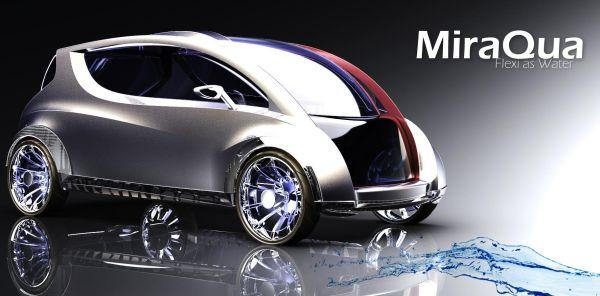
MiraQua: the green car without carbon footprint

Today there seems to be more and more and yet more vehicles on the road than ever. Everybody wants to have their own transport and a smaller car with least carbon emission seems to be an ideal solution for this inexhaustible number of cars that seem to be coming up. Tiny cars electrically driven but looking unique in design and performance may be the ideal solution, according to Chaoyi Li, designer of the MiraQua car. Though he designed this as a solution for Australia and China’s excessive traffic congestion, this car can become popular all over.
MiraQua designer, Chaoyi Li, has done a thorough job of designing this unique-designed small green concept car tailor-made for improving urban life quality. He had carried out through sketching, body storming practices, mock-up modeling in various media include styling foam, crafting clay and metal wire etc., and digital model making in Autodesk Studiotools. The name also refers to the smooth flow of the vehicle-traffic like that of a water stream.
With MiraQua being a totally electrical car, there are no carbon emissions. The very driving force behind the development of this car was the desire of its designer to reduce fossil fuel dependency and using optimally minimal road space for commuting and parking. This he has achieved with the creation of MiraQua.
It is heartening to see more and more efforts focused to contain the carbon print on our universe and reduce fossil fuel dependency. When individual transportation becoming a way of life, it is good to have a small car that will not hog road space. It is all the more better in having a green sensitive vehicle that will be eco-friendly and leave no carbon footprint.
Source: www.alternative-energy-news.info/miraqua-electric-car/

Today there seems to be more and more and yet more vehicles on the road than ever. Everybody wants to have their own transport and a smaller car with least carbon emission seems to be an ideal solution for this inexhaustible number of cars that seem to be coming up. Tiny cars electrically driven but looking unique in design and performance may be the ideal solution, according to Chaoyi Li, designer of the MiraQua car. Though he designed this as a solution for Australia and China’s excessive traffic congestion, this car can become popular all over.MiraQua designer, Chaoyi Li, has done a thorough job of designing this unique-designed small green concept car tailor-made for improving urban life quality. He had carried out through sketching, body storming practices, mock-up modeling in various media include styling foam, crafting clay and metal wire etc., and digital model making in Autodesk Studiotools. The name also refers to the smooth flow of the vehicle-traffic like that of a water stream.With MiraQua being a totally electrical car, there are no carbon emissions. The very driving force behind the development of this car was the desire of its designer to reduce fossil fuel dependency and using optimally minimal road space for commuting and parking. This he has achieved with the creation of MiraQua.It is heartening to see more and more efforts focused to contain the carbon print on our universe and reduce fossil fuel dependency. When individual transportation becoming a way of life, it is good to have a small car that will not hog road space. It is all the more better in having a green sensitive vehicle that will be eco-friendly and leave no carbon footprint.
Source: www.alternative-energy-news.info/miraqua-electric-car/

UK needs to recycle its stockpile of waste plutonium into fuel

Former chief scientific adviser to the government Sir David King has today urged the government to recycle its giant stockpile of waste plutonium into fuel for new-build nuclear reactors, as part of a major new report calling for an overhaul of the UK’s nuclear energy sector.
The report from the Smith School of Enterprise and the Environment at Oxford University investigates how the UK should manage its huge stocks of separated plutonium, reprocessed uranium and spent fuel.
It examines the costs, risks and environmental impacts of four possible scenarios, three of which analyse different options for recycling spent fuel into new fuel, and one that considers what would happen if the UK continued to treat spent fuel as waste for disposal.
Speaking at the launch of the report this morning, King insisted that there is no need for the UK to delay or scrap the new nuclear build programme in light of the crisis in Japan, arguing that there is “a massive economic economic opportunity for converting plutonium, which is a potential danger, into fuel”.
The report warns that all four scenarios would be expensive, but maintains that there is no cheaper “do nothing” option because the UK must deal with its stocks of nuclear materials and spent fuel.
Significantly, the report suggests that the cost of recycling waste materials could be paid for by the private sector and offset by the value of the new fuel produced. In contrast, treating spent fuel as waste would not generate any income and the cost would almost inevitably fall to taxpayers.
However, the report also warns that the government must adapt its nuclear policy and establish incentives to encourage investment in order to start recycling fuel.
Source: www.businessgreen.com/bg/news/2038151/uk-urged-recycle-spent-plutonium-power-nuclear-reactors