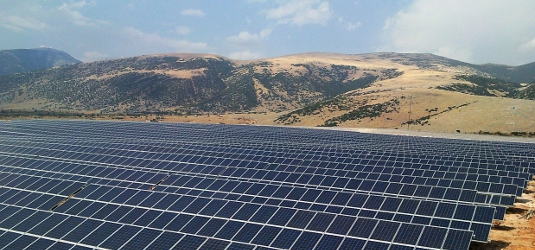
New photovoltaic plants are going to give energy in Romania

The Colibasi plant brings up PV energy in Romania

Romania solar potential is building up

The energy supplier, Enel Green Power has connected to the  PV plant situated in Colibaşi, located south-eastern Romanian county of Giurgiu, to the grid.

More capacity was accepted to the grid by Romania during this week when Rome-based Enel Green Power wired its 6.5 MW Colibasi PV plant.

This plant is situated in the south-east of the country, in Giurgiu county to be precise, and it is said to be responsible for generating nearly eight million kWh of power per year. This supply is said to be able to provide green energy for 7,000 Romanian households and minimize carbon emissions in the region by as much as 4,000 tones each and every year.

The plant from Colibaşi is the third solar installation in Romania from Enel Green Power, an institution that now has have 26 MW of solar PV capacity in the country. The other two Photovoltaic plants owned by them are Berceni 1 and Berceni 2.

Still, the company manages to go all the way until its solar output matches the 498 MW wind capacity they currently boast in the country.

As a recent IHS reports shows, Romania is said to be situated within the fastest-growing solar markets in Europe, considering the 175.5 of solar power available since the first half of 2013 and the 2.7 GW about to be installed in the next couple of years.

The biggest Airport in North America based on a solar power system is about to open

The biigest Airport with a PV system to open this month

Indianapolis International Airport will have PV system

Indianapolis International Airport from the U.S.A is to have a 12.5 MW PV plant, meaning 41,000 solar panels. This puts it on the first place as the largest solar power system on any airport in the North of the continent.

Totaling a number of Comprising 41,000 solar panels, the biggest solar power plant on airport real estate in the U.S. is going to be put in use later in October. Totaling 41,000 solar panels, Indianapolis International’s 12.5 MW PV farm will be situated on 75 acres of land that has not been used before. The array will be providing power for the airport’s terminal.

The PV system is said to help the environment by bringing the airport’s carbon emissions down by 10,700 tons a year. In translation, this is going to be like getting rid of 2, 000 cars from the road. The produced energy is sufficient for about 1, 200 normal American homes per year. The system was built managed via a partnership between Telamon and Johnson Melloh Solutions, and will be wired to 20 Solectrica Renewables SGI 500XT inverters.

A 15-year old power purchase arrangement was made for the regional service company IPL over the plant, which will be connected to the airport terminal.

A raise in the collaboration between airports and solar plants has been noticed over the recent years. The pessimistic outlook about the bad influence induced by glare from the panels on the pilots has created general worry in regard with the combination of the two. Gradually this worry reduced. By 2012, an 8000-panel PV plant was completed within the security zone of the Dusseldorf airport.

The retailer IKEA will sell solar panels in all UK stores


Ikea is going to sell Pv systems

Ikea will sell solar panels

The Swedish furniture retailer is going to sell solar panels in all 17 of it’s U.K. chain store in the up coming 10 months pursuing a succesful pilot within 10 months following a successful pilot business in one Essex store.

IKEA is responsible for a big amount of potency for the solar industry by deciding to sell solar panels into 17 British stores over the next ten moths.

This sale is going to be a premiere as it is the first time the world’s biggest furniture retailer is selling solar panels on a wide scale. This comes after the store tried a pilot scheme at the IKEA store at Lakeside, Essex (just east of London) that sold a PV system almost daily.

Customers have to give from thei pockets at least €6,800 for 18 panels, the cost of a thin-film PV panels made by China’s Hanergy Holding Group Ltd. An IKEA case study shows that homeowners that put money in this investment will recover the expenses in seven years.

“We know that our customers want to live more sustainably and we hope working with Hanergy to make solar panels affordable and easily available helps them do just that,” reported Joanna Yarrow , IKEA’s head of sustainability in the U.K. and Ireland,.
Like an in-store consultation sugests, customers will also beneft of installation and maintenance of the German-made panels.

This sale is part of IKE’s plan to gain a greener image. The sweedish retailer has a plan to gain a clean energy target and to recieve 70% of the energy the stores need fronm solar and wind power until 2015 it self.

The move is a further step by IKEA towards a greener image. The Swedish company has set its own ambitious clean energy target – to source at least 70% of the energy it needs from solar and wind power by 2015, and all of it by 2020.

The company already has solar panels on its factories, warehouses and stores, and owns some wind farm in Europe.

Greek municipalities decided to go solar

Greeks to install PV in municipalities

Greek Pv will be installed in municipalities

A program of which purpose is to bring up to date the local governments’ infrastructure and also the installation of solar photovoltaic systems in building throughout municipalities in Greece was approved by the Greek Ministry of the Interior

This ministry will take use of European Union funds for the upgrade of the local government infrastructure and management practices. The purpose of the project is to help local governments to have better services but also to reduce their cost and boost their income.

The ministry also chose the areas of action in need of reform. Throughout these areas are is renewable energy and environmental protection also. With the project of installation of PV in municipalities the governments intends to minimize reduce the environmental impact of the local government and provide income by selling the extra generated power.

When funding the project the ministry announced that €6 million and will come specifically through the National Strategic Reference Framework (NSRF), the reference document used for the security of European Union funds at the national level.

In the meantime, the capital of Elis in western Peloponnese, the Pyrgos municipality, said that solar PV systems are to be installed on over 200 bus stops.

The project is estimated at €301,305, a sum which includes the supply and the installation of solar systems, and is going to be auctioned in the next weeks. At the funding will also participate NSRF funds via the Environment and Sustainable Development Program, managed by the Greek Ministry of Energy. The cumulated capacity will be 6 KW. Another purpose of the project is to increase public awareness.

A new record was set by a cell structure

The four-junction solar cell set a new record

New efficiency record was set by a solar cell

A solar cell structure with four sub-cells has set a new world record efficiency regarding solar sunlight conversion. The cell succeeded to set a new record efficiency hitting 44.7% and it is the creation of researchers from the Fraunhofer Institute for Solar Energy Systems ISE, Soitec, CEA-Leti and the Helmholtz Center Berlin.

The German-French team from the mentioned associations made the announce of a a 43.6% efficiency for the german-french solar cell in this year’s May. But they managed to develop that groundwork and succeeded to expand the efficiency of the solar cell to 44.7%. This efficiency was measured at a concentration of 297 suns. This means that 44.7% of the solar spectrum’s energy, from ultraviolet through to the infrared, is transformed into electricity.

This four-junction solar cells have a utility in concentrated PV or CPV and are formed by several cells made out of different III-V semiconductor materials(composed of elements from III-V groups of the periodic table) one on top the other. The single sub-cells attract absorb different wavelength ranges of the solar spectrum.

“This four-junction solar cell contains our collected expertise in this area over many years. Besides improved materials and optimization of the structure, a new procedure called wafer bonding plays a central role. With this technology, we are able to connect two semiconductor crystals, which otherwise cannot be grown on top of each other with high crystal quality. In this way we can produce the optimal semiconductor combination to create the highest efficiency solar cells,” as Frank Dimroth, Department Head and Project Leader in charge of the development work at Fraunhofer ISE describes the success.

Soitec’s CEO and Chairman André-Jacques Auberton-Hervé thinks that with the accomplishment of this record this four-junction solar cell design based on Soitec’s bonding techniques and expertise can actually be a part of the competitiveness of Soitec’s own CPV systems.

The Indian government plans to build the biggest power plant in the world

4 gw of solar to be buit in India

India to built the biggest power plant in the world

4 GW of solar capacity is to be built as part of the world’s biggest power plant in the world. The plant will be situated in India, in the Rajasthan province to be precise. This announcement was made by the Indian government and the project has a long timeline.

This should be taken as a sign that the Indian government wants solar to be the source of energy needed for generating the electricity that the population needs. The initial plans for a 4 GW project were announced on Friday.

Still during the time the the staggering scale of the project will attract the attention of the Indian PV industry, its achievement is going to be a long term deal. Only the first stage of the project will be finished in 2016, as it is reported by the Indian government’s press information bureau.

The Rajasthan province, is the one in which the project will be situated. Ths means the construction will be located at , approximately 75 km away from the city of Jaipur. The minister of heavy industries and public enterprises, Praful Patel was the one who initiated the process to develop the vast project and has pointed to a 23,000 acre piece of land in the region. The project is named Sambhar Ultra-Mega Green Solar Power Project.

A joint venture company wil be the one who will proceed with the development of the phase of the project, having the equity from various partners as well as the Solar Energy Corporation of India and Power Grid Corporation of India.

The government statement suggests that India is willing to set a global example with the great project. “Being the first project of this scale anywhere in the world this project is expected to set a trend for large scale solar power development in the world,” today’s statement reports.

EIB will help Indian renewable energy project by loaning EUR 80 million


EIB loans India  €80 milion for renewable pojects

India gets a €80 milion loan for renewable energy

The European Investment Bank (EIB), helped Italian export credit agency SACE S.p.A, signs EUR 40 million loans as first instalment to SREI Infrastructure Finance Limited (SREI) for financing green energy programs in India.

The EIB and Italy’s SACE S.p.A signed a €40 million long-term loan agreement with India’s SREI for helping with the finance of some investments which have the role of mitigating climate changes in the country.

This triplet cooperation is the first movement within an €80 million pledge and it was created to promote Italian exports, help with India’s renewable energy objectives and benefit economies in the European Union.

Some parts of the loan is dedicated to renewable energy projects in India, that are mostly under the wing of private sector companies. To be precise, the loan will help electricity and heat generation schemes, meaning photovoltaic energy and wind power.

The loan is a bid made by all the parts to help India with it’s struggle for environmentally sustainable power. Moreover, it will help stimulate portions of the Indian economy although there is a development of domestic energy resources, improved energy efficiency and a reduction in airborne pollutants and carbon emissions.

This loan is a part of the EIB’s largest nergy Sustainability and Security of Supply Facility (ESF) fund, that has, until now contributed with more that €4.9 billion regarding a long term investments programs in the Asian continent, and €2.2 billion of that has been ploughed into the energy sector.


Sol Voltaics will get $9.4 million funding for developing nanotech

A sweden company will recieve 10 milions for nanotech development

A sweden company will recieve 10 milions for nanotech development

Norwegian investor Umoe and others investors were convinced to put their money, almost $10 million, to help the Sweden company work on nanotechnology which can be used for 25% more efficient solar cells.

A solar technology startup based in Lund, Sweden named Sol Voltaics made a deal to get more funding, over $9.4 million, because the initial sum of 6.2 million from a Swedish government agency is for the pilot production.

The company’s Solink nanomaterial may increase the energy output of the solar cells by 25%. The company got finanacial backing of a Norwegian investment company Umoe AS and other investor like including Industrifonden, Nano Future Invest, and Foundation Asset Management. Besides, a former chief technology officer at REC Solar named Erik Sauer has also invested.

The company managed to get the biggest loan in the history of Sweden offered by a government agency. The agency hopes that Sol Voltaics’ technology can provide green energy in a more affordable and efficient way.

“The combination of shortage of energy in the world and global warming trends presents a unique long-term opportunity of capitalizing on a trend towards alternative energy,” announced Jens Ullveit-Moe, Umoe’s CEO and former chairman of REC Solar. “The technology that Sol Voltaics is developing promises to be disruptive in the solar market.”

David Epstein, CEO of Sol Voltaics, says: “With this closing we now have the resources to take the company to pilot production. Together with strategic partners, we plan to demonstrate Wave Concentrated Photovoltaics using large quantities of nanowires on commercially viable solar cells.We are tremendously gratified to add the support oft he Swedish Energy Agency and Erik Sauer”

“We have two goals: to make solar more profitable for solar manufacturers and developers, and to lower the price of solar energy for consumers, utilities, and businesses. We look forward to demonstrating our technology later this year,” continued Epstein.

The Japanese market is overflow by foreign-made cells and module

japanese_solar_market
Domestic-made product levels in Japan are dominated by a huge amount of foreign-made imports in a time when Japanese solar cells and module manufacturers are willing to export globally.

Although Japan is considered to be a solid market for foreign solar developers to turn down, statistics from the country’s solar industry say that show cells and modules made outside Japan are enjoying a great success since onset of the world’s most generous FiT regime.

Since prime minister Shinzo Abe launched a JPY42/kWh (US$0.42/kWh) FiT payment in July 2012, the Japanese solar market has become one of the biggest global draws, a fact reflected in figures released by the Japan Photovoltaic Energy Association (JPEA) that show the amount of cells and modules shipped in Japan has trebled year on year.

After that, in the first part of the financial year total shipments went from 613.5 MW to 1.7 GW in the year’s first quarter, although FiT payment was being reduced to JPY37.8/kWh since April 1st.

On the other hand, shipment to Japan to Japan quadrupled from 445 MW to 1.65 GW the expense of cell and modules exports to the rest of the world that went down from 168 MW in April-to-July 2012 to 35.2 MW in this fiscal quarter.

As a matter of fact, -made cells and modules rose 313 MW to 521 MW is being shared as good news for Japanese solar manufacturers. Manufactured cells and modules outside Japan, that gathered 132 MW in the first quarter, went up to 1.13 GW this year.

French Pv industry is in need of a growth in the solar sector

fench_PV_in_need_to_grow

The French PV system is in need of a boost

The French union of solar energy professionals named Enerplan demands the French government to come up with new measures to increase the solar sector as a result of the latest publication of disappointing results.

The redesign of the solar PV support system, new tariffs for photovoltaic installations in buildings, or allowing for net metering were part of the list of proposals made to the French government by Enerplan. Moreover, Enerplan also asked for a new tender to be introduced to the public until the end of 2013, as the goal is to reach 1000 MW of installations per year.

A recent report was revealed to the public opinion by the French general office for sustainable development (CGDD) announcing that only 207 MW of solar PV capacity was installed during the first half of the year, which means a 73% decline from the former year. This means that France has a total of 4.26 GW of installed solar PV power.

Enersplan warns the public opinion about the so-called “emergency” measures announced by Delphine Batho, previous Energy Minister, in last year’s fall the were proven to be inadequate to rise up the sector, the necessity for new Energy Minister Philippe Martin to undertake new measures.