Inventors say they’ve created a solar panel like no other

new type of solar panel

Researchers testing claims for light, heat capturing panels.Photo by Mallika Viegas

Crystal Green Energy Corporation is a small company of three men, producing extraordinary things.

Lead technical and engineering expert Gilles Leduc, along with partners James Delsaut, a pharmacist, and Malik Amjad, an optical design enginer, say they have found a way of building highly efficient solar panels like no other.

According to northernlife.ca, while typical solar panels only gather light, Crystal Green’s high-concentration photovoltaic thermal (HCPVT) systems not only concentrate sunlight on a compact panel for conversion to high-amperage electricity, but also extracts and stores heat — something no other solar panel on the planet can do, they say.

“When you play with magnifying glasses you have heat — you can burn things. I started there,” Leduc said. “There’s a lot of energy that no one’s using right now.”

Other solar panels have to dissipate heat because it can damage the solar cells, Leduc said. But Crystal Green Energy has found away around that.

“With our heat exchanger, we also capture the thermal energy and store it,” said Delsault. “It can then be used in your home for hot water, heating and, (if we) reverse that process, cooling.

The panels themselves are something like lightweight, mirrored bowls that are mounted on a sun-tracking system, allowing the panels to follow the sun across the sky from sunrise to sunset, which maximizes the amount of energy generated.

Crystal Green told NorthernLife.ca the thermal mirroring on their optics is 98-per-cent efficient, calling it a huge leap over the 80-per-cent efficiency of previous systems.

The designers say their “triple junction photovoltaic cell” is another innovation over the competition. They use fibre optics to channel the sun’s rays through a reflective Winston cone onto the photovoltaic cell, which converts light energy into electricity. Generated energy is stored using lithium ion batteries.

“We’re trying to gather all that energy as fast as we can, and pouring it into a backup system, so on the days the sun does not shine, you have those backup systems,” Leduc said.

Their design is so effective and efficient, Crystal Green said, a 1500-square-foot home can get all the power and heat it needs from only six of their 1.1-x-1.1-square-metre panels. The company said it’s panels are are not only more compact that traditional solar panels, but are also 40-per-cent efficient compared to 15-per-cent for standard panels.

“Solar panels are a 30-year-old technology that can’t be adapted,” Delsaut said. “We’re not comparing apples to apples anymore — this technology is way beyond (that).”

Leduc, Delsaut and Amjad spent the past four years perfecting the product in their small Sudbury office, self-funding the prototype design.

“We do this on the side,” Delsaut said. “We still have our full time jobs. We just want to see the product succeed.”

So what’s next? The men behind Crystal Green Energy said they have partnered with researchers at the University of Sherbrooke, Ottawa University and Cambrian College for pre-testing certification and advanced development of the cells.

Japan anticipates clean energy will edge out nuclear power

solar energy Japan

Clean energy in Japan. Photo via inventorspot.com

Japan anticipates that by 2030 clean energy such as solar and hydro will generate slightly more of the nation’s electricity than nuclear power plants.

According to renewableenergyworld.com, clean energy sources will supply as much as 24 percent of Japan’s electricity in 15 years, while atomic power will account for as much as 22 percent, according to a draft report from the Ministry of Economy, Trade and Industry on what Japan’s electricity mix should look like by 2030.

Though the eagerly-awaited report — the result of months of study by a ministry panel debating the electricity mix — continues to see a need for nuclear, the draft proposes a diminished role compared with before the Fukushima disaster of March 2011. Nuclear power accounted for more than a quarter of Japan’s electricity generation before the meltdowns at the Fukushima Dai-Ichi reactors.

Even the 22 percent level is doubtful for a nation with one of the world’s oldest nuclear fleets and where the majority of the public has opposed atomic generation since Fukushima, environmental group Greenpeace, which campaigns against nuclear power, said in a statement.

Nuclear’s role has been the central focus of the panel’s discussions. The 2011 disaster triggered strong opposition to atomic power among the public, while the subsequent spike in electricity prices has seen business groups lobby intensively for the nation’s nuclear reactors to resume operations.

Operable Reactors

Nuclear provided about 29 percent of Japan’s electricity in fiscal 2010, while clean energy sources supplied 9.6 percent with most of that coming from hydro. None of Japan’s commercially operable nuclear reactors are working at the moment.

If all 24 nuclear reactors currently under review for a restart by the country’s nuclear watchdog are allowed to switch back on, they would still not be able to generate more than 16 percent of Japan’s power, Greenpeace estimates. At least 10 more reactor units need to resume operations to reach the government’s target for nuclear, the group said.

Such a mass-scale restart is unlikely, according to Shaun Burnie, a nuclear specialist at Greenpeace Germany.

“The scale of the challenges facing the nuclear industry are such that generation from reactors is likely to collapse during the coming decade,” Burnie said in the statement. “Many reactors will never restart, and most reactors over the coming years will be too old to operate.”

Latest Proposal

The latest proposal signals less reliance on nuclear than a previous plan released in 2010. Japan had been envisioning nuclear and renewable sources supplying 53 percent and 21 percent of power, respectively, by 2030, under the government led by the Democratic Party of Japan.

The DPJ’s stance shifted following the Fukushima disaster, with the party eventually calling for all nuclear to be phased out. The DPJ was replaced by a coalition led by the Liberal Democratic Party in December 2012.

The draft foresees hydro power accounting for as much as 9.2 percent of Japan’s total power generation, with solar at 7 percent, wind at 1.7 percent, biomass coming in at as much as 4.6 percent and geothermal as much as 1.1 percent, according to the release.

By 2030, gas will supply 27 percent while coal and oil will provide 26 percent and 3 percent, respectively.

The release came a day after the trade ministry issued draft estimates of power generation costs. Nuclear is estimated to be the cheapest source, as low as 10.1 yen per kilowatt hour, by 2030.

Large-scale solar was estimated to cost 12.7 yen to 15.5 yen, while onshore wind was projected to cost 13.9 yen to 21.9 yen, according to the ministry.

MIT research team is turning salt water into drinking water using solar panels

Solar-powered desalination

Solar-powered desalination. Image via sciencealert.com

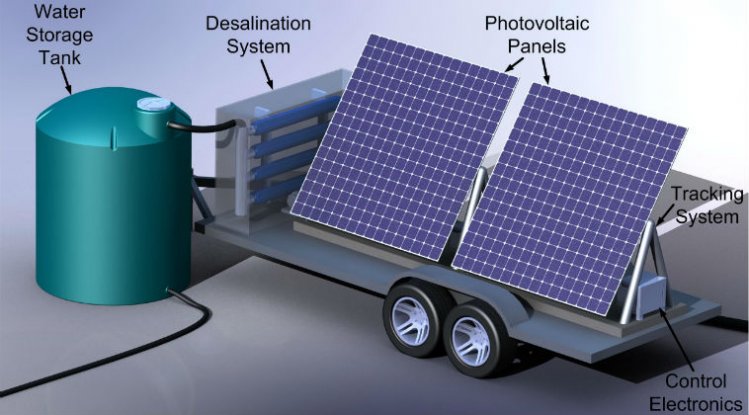
By inexpensively turning salt water into drinking water using sustainable solar power, a team from MIT in the US has not only come up with a portable desalination system for use anywhere in the world that needs it, but it’s just won the 2015 Desal Prize – a competition run by USAID to encourage better solutions to water shortages in developing countries.

In order to win the $140,000 prize, entries had to demonstrate how their invention not only works well, but is cost-effective, environmentally sustainable, and energy efficient. And the MIT researchers teamed up with US-based manufacturing company, Jain Irrigation Systems, to do just that.

According to Science Alert, the team’s invention works by using solar panels to charge a cache of batteries that power an electrodialysis machine that removes salt from the water and makes it perfectly drinkable. David L. Chandler explains for MIT News:

“Electrodialysis works by passing a stream of water between two electrodes with opposite charges. Because the salt dissolved in water consists of positive and negative ions, the electrodes pull the ions out of the water, Winter says, leaving fresher water at the centre of the flow. A series of membranes separate the freshwater stream from increasingly salty ones.”

Solar-powered desalination plants are nothing new, and officials are investigating potential in water-poor areas such as Chile and California right now, but the technology has so far been extremely expensive to both piece together and run. And this obviously makes it difficult for developing countries to adopt. The key to the MIT plant is the electrodialysis process, says Chandler, talking to one of the team, mechanical engineer Amos Winter:

“Both electrodialysis and reverse osmosis require the use of membranes, but those in an electrodialysis system are exposed to lower pressures and can be cleared of salt buildup simply by reversing the electrical polarity. That means the expensive membranes should last much longer and require less maintenance, Winter says.”

Chandler reports that the MIT system can turn 90 percent of the salt water that’s fed into it into drinking water, which is huge, compared to the 40 to 60 percent from reverse-osmosis systems.

The team has been testing their system out in several villages across India since 2014, and have been using the Brackish Groundwater National Desalination Research Facility in the US to run 24-hour tests to analyse its efficiency and cost of maintenance. According to Mary Beth Griggs at Popular Science, in just 24 hours, their system can remove the salt from 2,100 gallons (7,950 litres).

They’re now hoping to expand their field tests to rural communities in developing countries, in the hopes that they can set them up as irrigation systems in small farms. “A solution with the potential to double recoverable water in an environment where water is becoming more precious by the day could have a huge impact,” environmental and civil engineer Susan Amrose from the University of California at Berkeley, who was not involved in the research, told MIT News.

Trina Solar sets new world record for high efficiency solar panels

Trina Solar world record

Trina Solar sets new solar panel efficiency world record. Image via pv-tech.org

Trina Solar’s State Key Laboratory of PV Science and Technology of China has set a new world record for high efficiency p-type multi-crystalline silicon solar panels.

According to Energy Matters, Trina says its test Honey Plus multi-crystalline silicon module attained a new module efficiency record of 19.14% with an aperture area of 1.515 m2.

The results were confirmed by the National Center of Supervision and Inspection on Solar Photovoltaic Product Quality (CPVT) in Wuxi, China.

The 60-cell panel features advanced technologies including back surface passivation, local back surface field and half-cell module technologies. Trina says the half-cell module technology is not currently part of the Honey Plus products, but will be incorporated at a later date.

“To the best of our knowledge, this is the first time that a multi-crystalline Silicon PV module reaches an efficiency higher than 19%. It demonstrates that multi-crystalline Silicon PV modules can reach an efficiency level that was reserved to the most efficient solar cells before, such as mono-crystalline IBC or heterojunction cells,” said Dr. Pierre Verlinden, Vice-President and Chief Scientist of Trina Solar.

”This milestone achievement is the result of a very close collaboration among our silicon crystallization, solar cell and module scientists. We believe that innovation is playing the very essential role to Trina’s sustainable growth and long-term success. Our focus remains on developing innovative and cutting-edge solar power products and technologies to strengthen our leadership in the PV industry.”

In other recent news, the company announced the signing of an agreement with Toyo Engineering Corporation to supply approximately 116 MW of Trina Solar panels for use in Japan’s largest solar power project – a 231-megawatt facility to be built in Setouchi City, Okayama Prefecture.

Approximately 446,000 Trina Solar TSM-260PC05A modules will be used in the project, which will be situated on 1,210 acres of city land on the former Kinkai salt field.

The project is expected to commence commercial operations in the second quarter of 2019.

Trina Solar says Japan is a key market for the company and that solar will play a crucial role in the growing diversification of the country’s energy mix.

Trina Solar panels are also popular choice in Australia, where they are often used in residential solar power system installations.

Tesla’s new home battery to solve one of solar power’s biggest problems

Tesla's new home battery

Tesla’s home battery to be unveiled this month. Photo via gizmodo.com

So far, specific details are thin on the new battery designed for home use that Tesla will unveil this month. But just based on what we do know, it’s a pretty big deal. The quest for a good battery that can store home-generated power is kind of like the holy grail for a renewable energy future. This one product might change everything.

A New York Times article published earlier this week essentially sets up the problem that Tesla’s battery will solve. In Hawaii, 12 percent of homes have some kind of solar energy, by far the highest rate for any place in the US at the moment. In fact, that rate is growing too quickly—solar customers are dumping so much energy back onto the grid that they’re taxing the delicate and often aging infrastructure that was only designed to deliver power to homes. What’s happening in Hawaii is actually indicative of what’s going to be an issue everywhere as many cities start to see an increase in large-scale solar implementation: There’s going to be too much energy generated, and nowhere to put it.

According to Gizmodo, utility companies might spend the money to upgrade the grid, but even then it’s difficult for them to predict how much more capacity they’ll need (and of course those costs will certainly be passed down to consumers). The absolute best idea is for homeowners to start installing batteries that can store the power for later use instead of giving the power back to the utilities, something called peak load shaving. It’s not just solar power that can be stored, of course—it can also come from wind turbines or hydroelectricity or the treadmill you rigged together to juice up your house with kinetic energy.

Enter Tesla. In its quest to design the perfect electric car, Tesla has pretty much engineered the best battery on the market. Now, basically, the company is manufacturing an electric car battery for home use. They’re already out there: Tesla’s installed batteries in about 400 locations, including businesses like Walmart. Supposedly this new battery concept will improve upon what’s available now. But the real game changer here—like almost everything about energy—is price.

Thanks to companies like Tesla, the cost per kilowatt-hour of these batteries is coming down much faster than once predicted. Right now, Tesla’s batteries are about about $300 per kWh, which is comparable to the market rate the industry expected for 2020. This cost is intertwined with the proliferation of renewable energy because cheaper batteries mean that the price of entry for something like solar energy is essentially cheaper. Which means more people will be able to get into the solar game.

The biggest news here—and why utility companies are likely worried—is that with a cheaper, more accessible battery, homeowners will now very easily be able to achieve complete energy independence. You could store your power for off-peak usage, and you might be able to sell your excess energy to a neighbor. In the near future, cord-cutting may mean severing one’s self from the electrical grid.

Now here’s the very interesting twist: Tesla is also announcing a “utility-scale” battery, something we don’t know anything about at all. If this is something that the utility companies can use to help shoulder some of that grid burden, then this, too, will be a game changer for utilities. That’s a win-win for both energy customers and energy companies.

Breakthrough technology generate clean power

Enclosed wind turbine

Enclosed wind turbine

AirClear Energy has announced they have discovered an efficient solution that will generate renewable electrical energy without using fuel. The innovative system has two models that both use clean air and wind to create energy that can keep households, businesses, and private entities operating.

To build the first plant in Washington, D.C., the company has launched an IndieGoGo campaign to raise $500,000.

According to pressreleaserocket.net, as a subsidiary of Tajintech, Inc., which was founded in 2013, AirClear Energy is excited to bring to the world a solution to global warming. As the world relies heavily on non-sustainable energy sources, the damage done to the world everyone lives in is irreversible. However, there is a way to stop further harm to the earth with AirClear Energy.

The company created two models: plant model and portable model. Both use clean air compression methods. In the plant model, an enclosed wind turbine will be used to generate renewable energy. The method is efficient, reliable, and dependable by generating pressure that is compressed in the enclosed structure to turn the turbines.

As the turbines move, natural air is converted into mechanical energy, the mechanical energy is then converted into electrical energy that can be used anywhere. Wind plants that exist today usually have to wait for wind, but in this model there is no need to wait and it will operate longer than current air systems.

AirClear Energy also developed the portable model, which is great to use in living rooms, bedrooms, or any enclosed area. The system extracts proportionate amounts of outside pressure and compresses it. This pressure is used to operate the wind turbines while circulating cool air into the environment, which is perfect to control thermal conditions.

Both models are a cheaper energy source that will also support humanitarian needs. It is a reliable source of energy that is also perfect to be used in times of emergencies during natural disasters, refugee camps, or in the remote military locations.

Solar soda bottles to light our streets

Solar soda bottle street lights

Solar soda bottle street lights

The streets of San Luis, Bogota, Colombia are now a little safer thanks to low cost solar-powered soda bottles.

Costing just USD $70 to construct, the street lights use a 3 watt LED lamp, controller and battery pack powered by a couple of small solar panels. The protective casing used for the lamp is just a plastic soda bottle – pretty much unbreakable under most conditions.

According to Energy Matters, 14 locations in Colombia have already been illuminated with these solar street lights and there are plans to install another 2,000 across the country in this year.

Quartz reports the super-cheap solar streetlights are a project of Liter Of Light; an organisation that rose to prominence with its promotion of Moser lamps. A Moser lamp is a plastic bottle filled with water inserted into a roof to refract sunlight into the room below; with a with a brightness equivalent to a 55w electric bulb.

Tens of thousands of households in the Philippines capital Manila alone have so far benefited from Liter Of Light’s Moser lamp inspired revolution, which has now also spread across the world.

2015 is International Year of Light and Light-based Technologies (IYL 2015). IYL 2015 isn’t just about increasing access to light, but the right sort of light. Lighting represents almost 20% of global electricity consumption (International Energy Agency). While this has a significant impact on the environment in relation to coal fired power generation, worse still is lighting fueled by kerosene.

“In developing and third-world countries without access to electricity, 1.3 billion people depend on kerosene for light. The burning of kerosene lamps leads to the death of 1.5 million people every year. Inhaling kerosene smoke is the equivalent of smoking 4 packs of cigarettes a day, and commonly induces respiratory illnesses such as asthma, bronchitis, pneumonia, and cancer in tens of millions of people,” states the IYL 2015 web site.

It’s also very expensive, with some families spend up to half of their income on kerosene.

An important aim of the International Year of Light will be to promote the use of portable solar-powered LED lanterns in regions where there is little or no reliable source of light. Solar lighting is literally changing lives – enabling extended productivity, enhanced security and without the negative health impacts.

Other low-cost solar powered LED lighting designed specifically for developing nations that we’ve covered in the past include LUCI, Luminaid, Solar Pebble, the Solar Schoolbag and the Australian-designed Mandarin Solar Light and Sunking.

Study says abandoned coal mines can produce clean energy

clean energy from abandonated mines

Abandoned coal mines to produce renewable energy. Image via abandonedplaces.livejournal.com

New technology could heat 45,000 homes in the UK, says team at Nottingham Trent University. In a novel example of the transition from high to low carbon infrastructure, researchers in Nottingham have discovered how abandoned coal mines could produce renewable heating for tens of thousands of homes and offices in the UK.

According to Business Green, as part of a two-year project, researchers at Nottingham Trent University worked with renewable energy firm Alkane Energy to explore how water at the former Markham Colliery in NortEast Derbyshire could be condensed in a heat pump and fed through a district heating network.

The team took naturally lukewarm water from the mineshaft and pumped it to the surface, where a heat exchanger extracted its thermal energy. The energy was then condensed through a heat pump to increase the temperature further while the water was returned to the mine where it becomes lukewarm again.

The team explored a series of old mines in the UK, which they estimate could provide enough heat for around 45,000 homes.

Professor Amin Al-Habaibeh of Nottingham Trent’s School of Architecture, Design and the Built Environment, who led the study, said he hoped the breakthrough would provide a new lease of life to abandoned mines.

“In a way we may never have previously envisaged, coalmines could once again be used to provide warmth to thousands of homes across the UK,” he said in a statement.

“But the key difference between yesteryear and tomorrow is that we now have the ability to harness their energy potential in a completely sustainable way.”

Alkane says it hopes to use the research findings to support a new business venture. The company already uses gas from disused mines to produce electricity, and it reckons harnessing heat from old mines could provide an additional source of clean energy.

Post-Fukushima Japan turns to wind as solution for energy crisis

wind energy Japan

Japan turns to wind energy to solve energy crisis

The kamikaze pilots that flew bombing raids and suicide missions against the Allies in World War Two were inspired by a “divine wind” that they believed was keeping their planes aloft in the service of the Japanese Empire. Legend has it that the divine wind from which the word “kamikaze” is translated, referred to a typhoon that saved the Japanese islands from invasion by a Mongol fleet in 1281.

Seventy years after the end of the Second World War, nature continues to exert a powerful influence on the Japanese nation, and we only have to look back four years to see the devastation caused by the Great East Japan Earthquake, as it is known there.

Now, the threat to Japan comes not from outside enemies, but from her own internal weaknesses, particularly the lack of natural resources requiring Japan to either import coal and liquefied natural gas in large quantities, or maintain aging nuclear power plants that remain vulnerable to earthquakes and tsunamis.

According to oilprice.com, in 2015, the wind that once inspired kamikaze pilots is once again being pressed into service, only now the goal is not a wartime victory, but to move Japan a step closer to energy independence.

As a far-flung island nation, Japan appears to be ideally suited to capturing power from the wind. The country has the sixth largest sea surface in the world, including economic zones allowing resource exploitation, and in Japan the wind blows strong especially during typhoon season.

However, up to now, wind power in Japan has been underutilized, particularly compared to solar. While the Japanese photovoltaic market has risen 7-fold, from 1GW in 2010 to almost 7GW in 2013, growth in wind power has underwhelmed.

The country produces less than one percent of its power from wind turbines, and in 2013 Japan installed 100 times more solar power than wind. According to Wind Power Monthly, Japan has just 2.6GW of installed wind capacity, virtually all of it onshore.

The publication notes that Japan’s reluctance to develop offshore wind is down to three factors:

“First, 80% of its offshore resources are in depths greater than 100 meters, far beyond the reach of the conventional fixed-bottom foundations that support the offshore projects on northern Europe’s continental shelf. Second, the climate and conditions – typhoons and tsunamis – present formidable challenges to installation and upkeep of wind turbines. Third, Japan’s powerful maritime logistics and fishing industries have strongly opposed sharing ocean space with wind developers.”

Another factor is Japan’s feed-in tariff requiring electrical utilities to buy renewable energy at set rates. While the tariff has resulted in a big increase in solar panel investment, largely because photovoltaics are relatively easy to install, for wind producers the tariff is less attractive, because high installation costs make small-scale generators unprofitable, according to manufacturers of small wind farms – those whose windmill diameter is less than 7 meters and with generation capacity of 20 kW or lower.

There are encouraging signs however, that Japan’s wind-power industry is starting to blow a lot stronger. Following the Fukushima disaster in 2011, the Japanese government approved a budget of 12.5 billion yen (US$12.2 million) to encourage wind power development, and shortly thereafter, a consortium of 10 companies led by Marubeni Corp began building a floating wind farm offshore of the Fukushima prefecture. The farm, powered by a 2MW turbine, has been generating power since November 2013. A second phase is currently under development to install an additional two 7MW turbines.

Marubeni notes the Fukushima Recovery/Floating Offshore Wind Farm Experimental Project has three themes: “By a team comprising only Japanese members,” “to pioneer Japan’s new international business,” and “to contribute to the recovery of Fukushima.”

Marubeni was also recently selected to construct 145MW of offshore wind capacity in northern Japan by 2021. The project is divided into two wind parks. The first park off the northwestern coast of Honshu will have 13 5MW turbines. A second park, located near Noshiro port, will have 16 turbines also providing 5MW each.

If the planned wind farms off Honshu go ahead as planned, they will mean a huge expansion in wind power for a nation that has until very recently shown little interest in the renewable energy form.

According to the World Nuclear Association Japan’s electricity utilization rate at the end of 2012 was 295GWe for nuclear, compared to 2.5 GWe for wind, 6.6GWe for solar and 0.5GWe geothermal. The rest of Japan’s energy requirements were met from hydro, at 45 GWe, 36 GWe from coal and 47 GWe from natural gas.

The Japan Wind Power Association estimates the country has the potential for 622GW of offshore wind, and 168GW onshore (the association has a goal of 50MW by 2050), however, one must ask to what degree the Japanese citizenry would tolerate such a massive expansion of wind power.

Marubeni’s Fukushima offshore wind project was lauded for its ability to produce utility-scale power with equivalent output to a nuclear reactor, but the project also drew criticism from Japanese fisheries unions who opposed it for its potential to destroy fishing grounds and prevent trawler fishing.

Wind skeptics in Japan also point to delays in setting up an offshore wind tariff, and local opposition to onshore wind – proving that the Japanese are no different from other countries in their NIMBYist attitude to wind farms near homes, schools and businesses.

The Japanese government solved the first problem a year ago with the introduction of a 36-yen-a-kilowatt-hour subsidy for offshore wind, but the NIMBY issue is obviously more intractable and presents a challenge to the further expansion of wind power in Japan, even in rural areas.

A 2013 study by Ryukoku University in Kyoto showed that while over 80 percent of respondents approved of large-scale wind power projects, 69 percent worried about such projects in their neighborhoods.

NIMBYism was likely a key factor in why Japan has moved its wind farms offshore, so it will be interesting to see whether more ocean wind power proceeds unobstructed, or whether industry lobby groups, like the Fukushima fishermen, will lobby to prevent further incursions into traditional Japanese industrial activities.

Turkish farms will use solar power to cover their own electrical demand

solar farm

Solar power for Turkish agricultural sector

Solar energy is about to power Turkish agricultural sector, which is among the most significant market sectors in the country. In the upcoming period, the most important innovation for the sector will be clean energy produced by solar panels.

According to Daily Sabah Business, the aim is to use solar energy to cover all energy expenses of agricultural lands that are large enough to support it. The devised system is especially advantageous for farmers using well water, since they have to pay high bills for using electrical engines to pump water from the ground.

The cost of this process decreases nearly one-10th and the system also recoups its costs within two years by operating drip irrigation systems.

The Ministry of Energy and Natural Resources, the Ministry of Economy, Ministry of Food, Agriculture and Livestock and the Ministry of Finance are carrying out collaborative work to establish an effective incentive policy on this issue. The fact that the energy surplus obtained from the energy plants will be transferred to the government increases the attractiveness of the project, and the number of Turkish companies specializing in the field is increasing daily.