MIT scientists show us the future of solar energy

the future of solar energy

MIT releases report on the future of solar energy

Solar energy holds the best potential for meeting humanity’s future long-term energy needs while cutting greenhouse gas emissions — but to realize this potential will require increased emphasis on developing lower-cost technologies and more effective deployment policy, says a comprehensive new study, titled “The Future of Solar Energy,” released by the MIT Energy Initiative (MITEI).

“Our objective has been to assess solar energy’s current and potential competitive position and to identify changes in U.S. government policies that could more efficiently and effectively support its massive deployment over the long term, which we view as necessary,” says MITEI Director Robert Armstrong, the Chevron Professor in Chemical Engineering at MIT.

According to MIT’s website, the study’s chair, Richard Schmalensee, the Howard W. Johnson Professor Emeritus of Economics and Management at the MIT Sloan School of Management, adds, “What the study shows is that our focus needs to shift toward new technologies and policies that have the potential to make solar a compelling economic option.”

The study group is presenting its findings to lawmakers and senior administration officials this week in Washington.

“The Future of Solar Energy” reflects on the technical, commercial, and policy dimensions of solar energy today and makes recommendations to policymakers regarding more effective federal and state support for research and development, technology demonstration, and solar deployment.

Among its major themes is the need to prepare our electricity systems, both technically and from a regulatory standpoint, for very large-scale deployment of solar generation — which tends to vary unpredictably throughout the day. To this end, the study emphasizes the need for federal research and development support to advance low-cost, large-scale electricity storage technologies.

The analysis finds that today’s federal and state subsidy programs designed to encourage investment in solar systems should be reconsidered, to increase their cost-effectiveness, with greater emphasis on rewarding production of solar energy.

The group also recommends that state renewable portfolio standards, which are designed to increase generation of electricity from renewable resources, be brought under a unified national program that would reduce the cost of meeting set mandates by allowing unrestricted interstate trading of credits.

The study concludes by pointing to the urgent need for an ambitious and innovative approach to technology development, with federal research and development investment focused on new technologies and systems with the potential to deliver transformative system cost reductions.

The MIT “Future of …” studies are a series of multidisciplinary reports that examine the role various energy sources could play in meeting future energy demand under carbon dioxide emissions constraints. These comprehensive reports are written by multidisciplinary teams of MIT researchers. The research is informed by an external advisory committee.

Sunny Scotland to embrace solar energy

solar panels in Scotland

More solar panels for Scottish homes

Figures showing last month’s sunshine could have powered all the homes in Scotland have sparked calls for more properties to install rooftop panels.

According to Business Green, Scottish homes with solar panels saw more than 100 per cent of their energy needs met by the sun during April, according to data collated by WeatherEnergy, the UK arm of a Europe-wide network of analysts.

The country received enough sunlight to generate 113 per cent of the electricity needs of an average home in Edinburgh, 111 per cent in Aberdeen, 106 per cent in Glasgow, and 104 per cent in Inverness.

Meanwhile, for those homes fitted with solar hot water panels, there was enough sunshine in Edinburgh, Glasgow and Inverness to generate an estimated 100 per cent of an average household’s hot water needs – and 99 per cent for homes in Aberdeen.

“Scotland has long been leading the charge when it comes to wind power,” said Karen Robinson of WeatherEnergy. “However, despite misconceptions, Scotland also has potential for sun-loving renewables too.”

While over 35,000 Scottish homes and 600 business premises currently have solar PV arrays fitted, wind power remains the country’s major renewable electricity source. During April, wind turbines in Scotland generated enough electricity on average to supply the electrical needs of 69 per cent of Scottish households, equivalent to 1.66 million homes.

Prices of solar panels have plunged in the last two years, while efficiency has increased. Tesla’s announcement last week of $3,000 battery to store solar energy could also ensure green electricity on demand for the first time.

“With these sorts of figures, every home or business with a south-facing roof should seriously consider switching on to the full potential of solar power,” said Lang Banks, director of WWF Scotland. “Similarly, there is no reason why Scotland should not be home to commercial-scale solar farms.”

If Tesla’s new solar power batteries are as good as its cars, they could change the way we store energy

Tesla home battery

Tesla’s new solar power battery. Photo credits Patrick T. Fallon/Reuters

Tesla debuted an array of solar power storage systems on Thursday, intended for both homes and businesses. The Powerwall and larger Power Pack systems will allow users to store most of the electricity from their solar panels and use it as needed — at night, on cloudy days, even when the grid goes down.

According to pri.org, the systems will be based on the same lithium-ion battery technology Tesla uses in its cars, packaged in a sleek design with new controls designed specifically for homes and businesses.

It’s not a new idea, or even revolutionary technology, but Musk and Tesla’s investors are making a multi-billion dollar bet that their move into the stationary electricity storage market will be a game changer. The company is building a giant $5 billion battery factory in Nevada, and expects its vast production capacity will bring costs down by 30 percent.

With a well-recognized and well-respected brand, Tesla likely has an edge in the market and a big opportunity to cash in on the growth of solar power, improvements in battery technology and the fact that few competitors have paid much attention to design and usability.

But Musk has made it clear that his ambitions go beyond the success of his businesses. In announcing the Powerwall and Power Pack systems, Tesla’s CEO said his company’s goal is to “fundamentally change the way the world uses energy on an extreme scale,” away from fossil fuels and to cleaner renewables like wind and solar.

Whether the company’s ambitions will be met, of course, remains to be seen. But some observers also have high hopes.

“When I read about it, I thought, ‘OK, let’s put one in my house,’” says Richard Hirsh, who teaches the history of science and technology at Virginia Tech. “I currently have a gasoline powered generator as a back-up unit because, where I live, we have had some power problems. But that’s always a pain. … I’d love to have a battery that will provide power when we don’t have it.”

Hirsh says physicists and battery makers have made incremental improvements in battery technology since the early 1800s, when Allesandro Volta of Italty first figured out how to make what we would today consider a battery. “A good, cheap, economical and efficient battery has been the Holy Grail for battery makers,” Hirsh says.

As to whether the company can deliver a commercially viable system for storing green power, Hirsch says he’s “hopeful that Tesla has come up with this — but only time will tell.”

Inventors say they’ve created a solar panel like no other

new type of solar panel

Researchers testing claims for light, heat capturing panels.Photo by Mallika Viegas

Crystal Green Energy Corporation is a small company of three men, producing extraordinary things.

Lead technical and engineering expert Gilles Leduc, along with partners James Delsaut, a pharmacist, and Malik Amjad, an optical design enginer, say they have found a way of building highly efficient solar panels like no other.

According to northernlife.ca, while typical solar panels only gather light, Crystal Green’s high-concentration photovoltaic thermal (HCPVT) systems not only concentrate sunlight on a compact panel for conversion to high-amperage electricity, but also extracts and stores heat — something no other solar panel on the planet can do, they say.

“When you play with magnifying glasses you have heat — you can burn things. I started there,” Leduc said. “There’s a lot of energy that no one’s using right now.”

Other solar panels have to dissipate heat because it can damage the solar cells, Leduc said. But Crystal Green Energy has found away around that.

“With our heat exchanger, we also capture the thermal energy and store it,” said Delsault. “It can then be used in your home for hot water, heating and, (if we) reverse that process, cooling.

The panels themselves are something like lightweight, mirrored bowls that are mounted on a sun-tracking system, allowing the panels to follow the sun across the sky from sunrise to sunset, which maximizes the amount of energy generated.

Crystal Green told NorthernLife.ca the thermal mirroring on their optics is 98-per-cent efficient, calling it a huge leap over the 80-per-cent efficiency of previous systems.

The designers say their “triple junction photovoltaic cell” is another innovation over the competition. They use fibre optics to channel the sun’s rays through a reflective Winston cone onto the photovoltaic cell, which converts light energy into electricity. Generated energy is stored using lithium ion batteries.

“We’re trying to gather all that energy as fast as we can, and pouring it into a backup system, so on the days the sun does not shine, you have those backup systems,” Leduc said.

Their design is so effective and efficient, Crystal Green said, a 1500-square-foot home can get all the power and heat it needs from only six of their 1.1-x-1.1-square-metre panels. The company said it’s panels are are not only more compact that traditional solar panels, but are also 40-per-cent efficient compared to 15-per-cent for standard panels.

“Solar panels are a 30-year-old technology that can’t be adapted,” Delsaut said. “We’re not comparing apples to apples anymore — this technology is way beyond (that).”

Leduc, Delsaut and Amjad spent the past four years perfecting the product in their small Sudbury office, self-funding the prototype design.

“We do this on the side,” Delsaut said. “We still have our full time jobs. We just want to see the product succeed.”

So what’s next? The men behind Crystal Green Energy said they have partnered with researchers at the University of Sherbrooke, Ottawa University and Cambrian College for pre-testing certification and advanced development of the cells.

Japan anticipates clean energy will edge out nuclear power

solar energy Japan

Clean energy in Japan. Photo via inventorspot.com

Japan anticipates that by 2030 clean energy such as solar and hydro will generate slightly more of the nation’s electricity than nuclear power plants.

According to renewableenergyworld.com, clean energy sources will supply as much as 24 percent of Japan’s electricity in 15 years, while atomic power will account for as much as 22 percent, according to a draft report from the Ministry of Economy, Trade and Industry on what Japan’s electricity mix should look like by 2030.

Though the eagerly-awaited report — the result of months of study by a ministry panel debating the electricity mix — continues to see a need for nuclear, the draft proposes a diminished role compared with before the Fukushima disaster of March 2011. Nuclear power accounted for more than a quarter of Japan’s electricity generation before the meltdowns at the Fukushima Dai-Ichi reactors.

Even the 22 percent level is doubtful for a nation with one of the world’s oldest nuclear fleets and where the majority of the public has opposed atomic generation since Fukushima, environmental group Greenpeace, which campaigns against nuclear power, said in a statement.

Nuclear’s role has been the central focus of the panel’s discussions. The 2011 disaster triggered strong opposition to atomic power among the public, while the subsequent spike in electricity prices has seen business groups lobby intensively for the nation’s nuclear reactors to resume operations.

Operable Reactors

Nuclear provided about 29 percent of Japan’s electricity in fiscal 2010, while clean energy sources supplied 9.6 percent with most of that coming from hydro. None of Japan’s commercially operable nuclear reactors are working at the moment.

If all 24 nuclear reactors currently under review for a restart by the country’s nuclear watchdog are allowed to switch back on, they would still not be able to generate more than 16 percent of Japan’s power, Greenpeace estimates. At least 10 more reactor units need to resume operations to reach the government’s target for nuclear, the group said.

Such a mass-scale restart is unlikely, according to Shaun Burnie, a nuclear specialist at Greenpeace Germany.

“The scale of the challenges facing the nuclear industry are such that generation from reactors is likely to collapse during the coming decade,” Burnie said in the statement. “Many reactors will never restart, and most reactors over the coming years will be too old to operate.”

Latest Proposal

The latest proposal signals less reliance on nuclear than a previous plan released in 2010. Japan had been envisioning nuclear and renewable sources supplying 53 percent and 21 percent of power, respectively, by 2030, under the government led by the Democratic Party of Japan.

The DPJ’s stance shifted following the Fukushima disaster, with the party eventually calling for all nuclear to be phased out. The DPJ was replaced by a coalition led by the Liberal Democratic Party in December 2012.

The draft foresees hydro power accounting for as much as 9.2 percent of Japan’s total power generation, with solar at 7 percent, wind at 1.7 percent, biomass coming in at as much as 4.6 percent and geothermal as much as 1.1 percent, according to the release.

By 2030, gas will supply 27 percent while coal and oil will provide 26 percent and 3 percent, respectively.

The release came a day after the trade ministry issued draft estimates of power generation costs. Nuclear is estimated to be the cheapest source, as low as 10.1 yen per kilowatt hour, by 2030.

Large-scale solar was estimated to cost 12.7 yen to 15.5 yen, while onshore wind was projected to cost 13.9 yen to 21.9 yen, according to the ministry.

MIT research team is turning salt water into drinking water using solar panels

Solar-powered desalination

Solar-powered desalination. Image via sciencealert.com

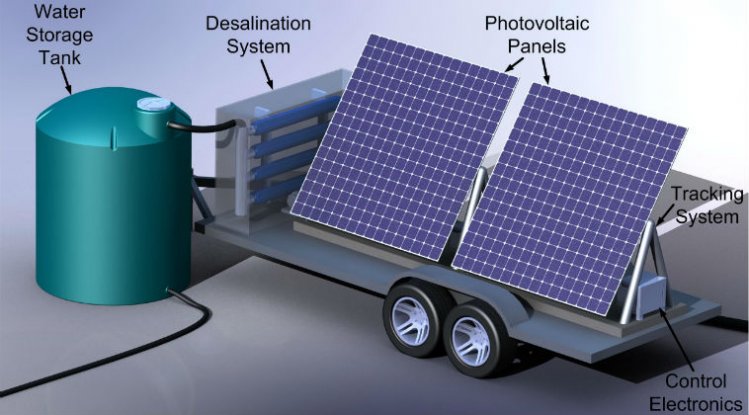
By inexpensively turning salt water into drinking water using sustainable solar power, a team from MIT in the US has not only come up with a portable desalination system for use anywhere in the world that needs it, but it’s just won the 2015 Desal Prize – a competition run by USAID to encourage better solutions to water shortages in developing countries.

In order to win the $140,000 prize, entries had to demonstrate how their invention not only works well, but is cost-effective, environmentally sustainable, and energy efficient. And the MIT researchers teamed up with US-based manufacturing company, Jain Irrigation Systems, to do just that.

According to Science Alert, the team’s invention works by using solar panels to charge a cache of batteries that power an electrodialysis machine that removes salt from the water and makes it perfectly drinkable. David L. Chandler explains for MIT News:

“Electrodialysis works by passing a stream of water between two electrodes with opposite charges. Because the salt dissolved in water consists of positive and negative ions, the electrodes pull the ions out of the water, Winter says, leaving fresher water at the centre of the flow. A series of membranes separate the freshwater stream from increasingly salty ones.”

Solar-powered desalination plants are nothing new, and officials are investigating potential in water-poor areas such as Chile and California right now, but the technology has so far been extremely expensive to both piece together and run. And this obviously makes it difficult for developing countries to adopt. The key to the MIT plant is the electrodialysis process, says Chandler, talking to one of the team, mechanical engineer Amos Winter:

“Both electrodialysis and reverse osmosis require the use of membranes, but those in an electrodialysis system are exposed to lower pressures and can be cleared of salt buildup simply by reversing the electrical polarity. That means the expensive membranes should last much longer and require less maintenance, Winter says.”

Chandler reports that the MIT system can turn 90 percent of the salt water that’s fed into it into drinking water, which is huge, compared to the 40 to 60 percent from reverse-osmosis systems.

The team has been testing their system out in several villages across India since 2014, and have been using the Brackish Groundwater National Desalination Research Facility in the US to run 24-hour tests to analyse its efficiency and cost of maintenance. According to Mary Beth Griggs at Popular Science, in just 24 hours, their system can remove the salt from 2,100 gallons (7,950 litres).

They’re now hoping to expand their field tests to rural communities in developing countries, in the hopes that they can set them up as irrigation systems in small farms. “A solution with the potential to double recoverable water in an environment where water is becoming more precious by the day could have a huge impact,” environmental and civil engineer Susan Amrose from the University of California at Berkeley, who was not involved in the research, told MIT News.

Trina Solar sets new world record for high efficiency solar panels

Trina Solar world record

Trina Solar sets new solar panel efficiency world record. Image via pv-tech.org

Trina Solar’s State Key Laboratory of PV Science and Technology of China has set a new world record for high efficiency p-type multi-crystalline silicon solar panels.

According to Energy Matters, Trina says its test Honey Plus multi-crystalline silicon module attained a new module efficiency record of 19.14% with an aperture area of 1.515 m2.

The results were confirmed by the National Center of Supervision and Inspection on Solar Photovoltaic Product Quality (CPVT) in Wuxi, China.

The 60-cell panel features advanced technologies including back surface passivation, local back surface field and half-cell module technologies. Trina says the half-cell module technology is not currently part of the Honey Plus products, but will be incorporated at a later date.

“To the best of our knowledge, this is the first time that a multi-crystalline Silicon PV module reaches an efficiency higher than 19%. It demonstrates that multi-crystalline Silicon PV modules can reach an efficiency level that was reserved to the most efficient solar cells before, such as mono-crystalline IBC or heterojunction cells,” said Dr. Pierre Verlinden, Vice-President and Chief Scientist of Trina Solar.

”This milestone achievement is the result of a very close collaboration among our silicon crystallization, solar cell and module scientists. We believe that innovation is playing the very essential role to Trina’s sustainable growth and long-term success. Our focus remains on developing innovative and cutting-edge solar power products and technologies to strengthen our leadership in the PV industry.”

In other recent news, the company announced the signing of an agreement with Toyo Engineering Corporation to supply approximately 116 MW of Trina Solar panels for use in Japan’s largest solar power project – a 231-megawatt facility to be built in Setouchi City, Okayama Prefecture.

Approximately 446,000 Trina Solar TSM-260PC05A modules will be used in the project, which will be situated on 1,210 acres of city land on the former Kinkai salt field.

The project is expected to commence commercial operations in the second quarter of 2019.

Trina Solar says Japan is a key market for the company and that solar will play a crucial role in the growing diversification of the country’s energy mix.

Trina Solar panels are also popular choice in Australia, where they are often used in residential solar power system installations.

Tesla’s new home battery to solve one of solar power’s biggest problems

Tesla's new home battery

Tesla’s home battery to be unveiled this month. Photo via gizmodo.com

So far, specific details are thin on the new battery designed for home use that Tesla will unveil this month. But just based on what we do know, it’s a pretty big deal. The quest for a good battery that can store home-generated power is kind of like the holy grail for a renewable energy future. This one product might change everything.

A New York Times article published earlier this week essentially sets up the problem that Tesla’s battery will solve. In Hawaii, 12 percent of homes have some kind of solar energy, by far the highest rate for any place in the US at the moment. In fact, that rate is growing too quickly—solar customers are dumping so much energy back onto the grid that they’re taxing the delicate and often aging infrastructure that was only designed to deliver power to homes. What’s happening in Hawaii is actually indicative of what’s going to be an issue everywhere as many cities start to see an increase in large-scale solar implementation: There’s going to be too much energy generated, and nowhere to put it.

According to Gizmodo, utility companies might spend the money to upgrade the grid, but even then it’s difficult for them to predict how much more capacity they’ll need (and of course those costs will certainly be passed down to consumers). The absolute best idea is for homeowners to start installing batteries that can store the power for later use instead of giving the power back to the utilities, something called peak load shaving. It’s not just solar power that can be stored, of course—it can also come from wind turbines or hydroelectricity or the treadmill you rigged together to juice up your house with kinetic energy.

Enter Tesla. In its quest to design the perfect electric car, Tesla has pretty much engineered the best battery on the market. Now, basically, the company is manufacturing an electric car battery for home use. They’re already out there: Tesla’s installed batteries in about 400 locations, including businesses like Walmart. Supposedly this new battery concept will improve upon what’s available now. But the real game changer here—like almost everything about energy—is price.

Thanks to companies like Tesla, the cost per kilowatt-hour of these batteries is coming down much faster than once predicted. Right now, Tesla’s batteries are about about $300 per kWh, which is comparable to the market rate the industry expected for 2020. This cost is intertwined with the proliferation of renewable energy because cheaper batteries mean that the price of entry for something like solar energy is essentially cheaper. Which means more people will be able to get into the solar game.

The biggest news here—and why utility companies are likely worried—is that with a cheaper, more accessible battery, homeowners will now very easily be able to achieve complete energy independence. You could store your power for off-peak usage, and you might be able to sell your excess energy to a neighbor. In the near future, cord-cutting may mean severing one’s self from the electrical grid.

Now here’s the very interesting twist: Tesla is also announcing a “utility-scale” battery, something we don’t know anything about at all. If this is something that the utility companies can use to help shoulder some of that grid burden, then this, too, will be a game changer for utilities. That’s a win-win for both energy customers and energy companies.

Taking care of your garden with this unique solar-powered soil sensor

Solar-powered soil sensor

A Solar-Powered soil sensor for serious gardeners

The Edyn Wi-Fi garden sensor will monitor soil and weather, alert your iPhone and trigger a wireless water valve for irrigation.

Accordng to The Next Web, Edyn’s creator, Jason Aramburu, worked as a soil scientist prior to inventing the company’s devices. The product is designed to help both expert and novice gardeners. Fuse Project contributed to the hardware.

The Edyn sensor runs off solar power and connects to your WiFi network. It uses electrical impulses to monitor the state of your soil and then combines that info with other sensors (temperature, light, humidity) and online weather data to come up with recommendations for your garden. If you need advice on what to plant, it can suggest pairings of different crops.

The hose attachment serves as the other piece of the Edyn system. You connect it between your garden hose and a drip irrigation system to automate your watering. The Edyn sensor can adjust the amount of water your plants get if the day is rainy or especially humid.

The Edyn mobile app will act as your garden’s dashboard, serving up data on the state of your plants. You’ll get push notifications when your garden is watered, as well as alerts when you need to add fertilizer to your soil.

The compant’s sensor will cost $99 for backers, though an early-bird tier can get the device for $79. The combo pack of the sensor and the hose attachment will set you back $159. The first shipments are expected to go out in December, with the bulk of campaign rewards arriving in time for Spring 2015 planting. Edyn will also run a Toms-style buy-one-give-one tier that lets you purchase a set and donate one to growers in developing areas, such as Africa.

Breakthrough technology generate clean power

Enclosed wind turbine

Enclosed wind turbine

AirClear Energy has announced they have discovered an efficient solution that will generate renewable electrical energy without using fuel. The innovative system has two models that both use clean air and wind to create energy that can keep households, businesses, and private entities operating.

To build the first plant in Washington, D.C., the company has launched an IndieGoGo campaign to raise $500,000.

According to pressreleaserocket.net, as a subsidiary of Tajintech, Inc., which was founded in 2013, AirClear Energy is excited to bring to the world a solution to global warming. As the world relies heavily on non-sustainable energy sources, the damage done to the world everyone lives in is irreversible. However, there is a way to stop further harm to the earth with AirClear Energy.

The company created two models: plant model and portable model. Both use clean air compression methods. In the plant model, an enclosed wind turbine will be used to generate renewable energy. The method is efficient, reliable, and dependable by generating pressure that is compressed in the enclosed structure to turn the turbines.

As the turbines move, natural air is converted into mechanical energy, the mechanical energy is then converted into electrical energy that can be used anywhere. Wind plants that exist today usually have to wait for wind, but in this model there is no need to wait and it will operate longer than current air systems.

AirClear Energy also developed the portable model, which is great to use in living rooms, bedrooms, or any enclosed area. The system extracts proportionate amounts of outside pressure and compresses it. This pressure is used to operate the wind turbines while circulating cool air into the environment, which is perfect to control thermal conditions.

Both models are a cheaper energy source that will also support humanitarian needs. It is a reliable source of energy that is also perfect to be used in times of emergencies during natural disasters, refugee camps, or in the remote military locations.