Swedish solar energy plants suffering from heatstroke

MVN Luftaufnahme solar plant

MVN Luftaufnahme, the largest swiss solar power plant. Image via tritec-energy.com

Switzerland’s solar energy farms are paradoxically suffering from the recent sunny weather, with the heat affecting photovoltaic plants. As a result, power generation has decreased slightly.

Although photovoltaic plants depend on a lot of sun, heat can impair energy production, according to Patrick Schaub, an energy analyst from SIG, a utility provider for canton Geneva.

“The cells’ efficiency depends on the temperature,” he explained. “The higher this climbs, the lower the efficiency. With temperatures in recent days seven or eight degrees above the seasonal average, the production of solar energy in canton Geneva has dropped by about 8%.”

The heatwave, which has so far lasted ten days, could reduce SIG’s annual energy production of 27 gigawatt hours by around 0.4%, Schaub said.

According to swissinfo.cf, Geneva saw the mercury rise to 37.1 degrees Celsius on Saturday and temperatures are set to exceed 30 degrees in many parts of the country this week. People in the capital Bern are bracing themselves for 37 degrees Celsius on Tuesday.

Schaub added that in addition to overheated photovoltaic cells, mist in the atmosphere was also causing problems. While the air gets dry at the beginning of a heatwave, evaporation tends to increase in the days that follow, reducing solar radiation. The ideal weather conditions for solar energy are therefore a sunny spring or autumn.

The same problem affects solar panels, which unlike photovoltaics are used not to generate energy but to heat water. These panels also overheat during hot periods.

Solar power provides 1% of Switzerland’s electricity needs. The country was a pioneer in photovoltaic technology 30 years ago, but it has since been overtaken by a number of other European countries in terms of production of solar power. In Germany, per capita production is more than 15 times the Swiss figure, and in the Czech Republic it is four times more.
Iconic London double-deckers go electric

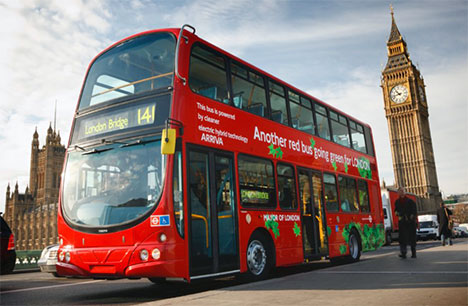
hybrid double decker bus

Hybrid double decker bus in London. Image via sciencehistorylover.files.wordpress.com

China-based manufacturer BYD will supply battery-powered buses to Transport for London from October. The number 16 route will be the first to go emission-free.

According to PV Magazine, passengers travelling from the Edgware Road to Victoria bus station in London will be using zero-emission transport from October onwards, announced Mayor of London Boris Johnson this week.

The Mayor, widely tipped as a future Conservative Party leader, announced at this week’s C40: Clean Bus Summit, Transport for London (TfL) has signed a deal with Chinese electric vehicle (EV) giant BYD Company Ltd to supply battery-powered buses, starting with the number 16 route.

BYD says its double-decker buses can drive for 155 miles, even in thick city traffic, on a single charge and their iron-phosphate batteries come with a 12-year warranty.

The news follows a report last week that the Delhi Metro system is considering switching to 100% solar power as public transport organisations the world over begin the migration to clean power sources.

Bus operator First West started running its biomethane-powered ‘poo bus’ between Bristol and Bath, in the west of England at the end of March. The Bio-Bus runs on human and household waste from 32,000 households.

New discovery to make cheaper solar energy storage

new solar discovery

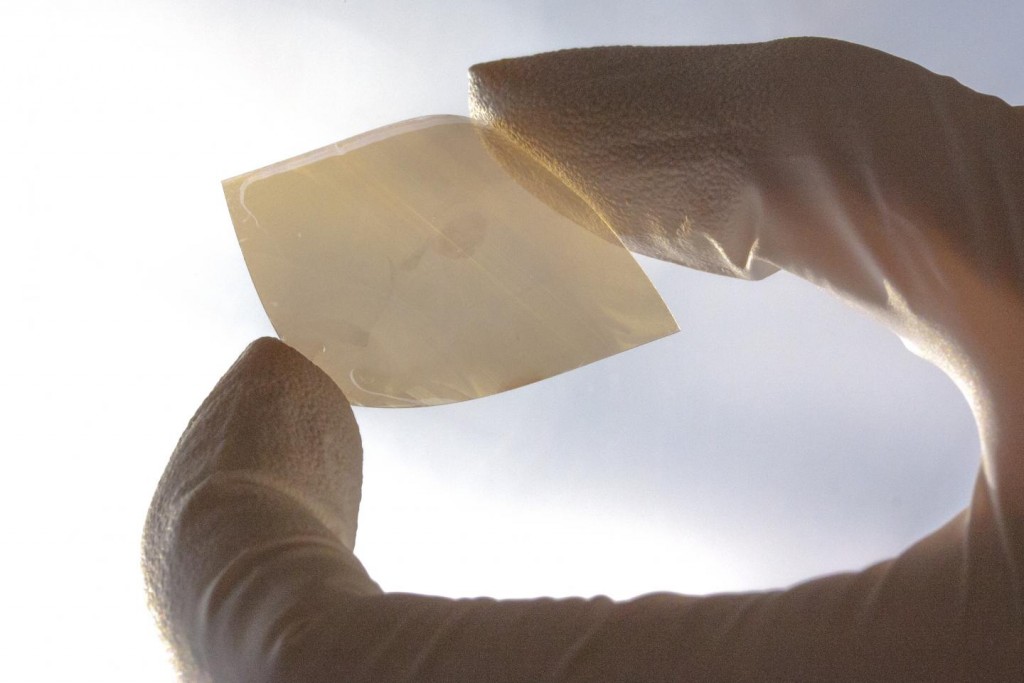
This is a photograph of a single-flake-layer WSe2 thin film deposited on flexible Sn:In2O3 (ITO)-coated PET plastic. Credit: Kevin Sivula (EPFL)

Scientists in Switzerland announced a clean-energy breakthrough on Wednesday; a cheaper solar technology that splits water molecules to create clean-burning hydrogen fuel.

According to The Japan Times, the solar panel design will make it cheaper to produce hydrogen, but a simple version won’t be available for average citizens for at least 10 years, scientists said.

Splitting water molecules to create hydrogen allows the sun’s energy to be more easily stored to generate electricity or power clean cars.

The discovery has major implications for climate change, as improved solar energy would reduce fossil fuel dependence.

Previous solar hydrogen technologies are too expensive to commercialize, scientists from the Ecole Polytechnique Federale de Lausanne said in their article appearing in the journal Nature Communications.

“We want to convert solar energy into hydrogen in an economically competitive way,” Kevin Sivula, one of the report’s authors, said.

The technology is “a huge increase (in efficiency) on what’s been done before . . . and it opens new pathways for solar development,” he said.

The new solar panel looks similar to the traditional version mounted on rooftops, except sunlight first passes through a thin layer of water contained inside the device.

Tungsten diselenide, a non-toxic chemical, acts as a photocatalyst and is critical for using the sun’s energy to split water into oxygen and hydrogen.

Currently, about 1 percent of the energy from the sunlight passing through a panel can be converted into hydrogen energy; efficiency must increase to about 10 percent for the discovery to have mass commercial appeal, Sivula said.

He estimated that when scientists are able to obtain “the same efficiency as traditional solar-to-hydrogen conversion, our cheap device production method would reasonably lead to a price for hydrogen that is five to 10 times less expensive.”

Sivula and his colleagues believe it is only a matter of time and research before the new technology’s efficiency is improved.

The new discovery is part of a larger international push towards improving solar power.

The global solar index tracked by investors has risen 40 percent this year, and investments in solar power are outperforming struggling fossil fuel commodities, such as natural gas or coal.

Oil giant Exxon Mobil expects solar capacity to grow by more than 20-fold between 2010 and 2040.

“At the rate we are using fossil fuels, a solar to hydrogen conversion technology will eventually become economically viable no matter what,” Sivula said.

South Korea ingeniously uses solar panels to cover bike lane and shade bikers

Solar-Powered-Bike-Lane

Solar-powered bike lane. Photo via inquisitr.com

Over the past five years, the solar energy community has seen major innovation in solar panels. First, the new solar panels are efficiently made to look like windows. As a result of the new design, there’s been a dramatic decrease in solar panel sludge, a waste pollutant left behind from solar panel creation that solar panel companies had issues with. Also, solar panels are becoming more versatile. This can be seen by having them incorporated into everyday items, like bicycles and water distillers, to improve efficiency.

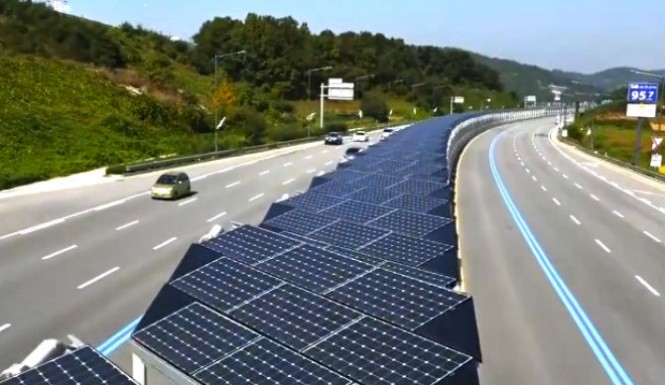
Now there are reports of solar panels actually providing something else most people wouldn’t think about: shade. That is the case for a bike lane in South Korea which is topped with solar panels.

According to Inquisitr, a stretch of highway in South Korea features a solar-powered bike lane running down the median. It is offset from traffic, protected by barriers, and sheltered by solar panels. The bike lane is about a few hours’ drive away from Seoul and runs 20 miles from Daejeon to Sejong. All 20 miles of it is solar panel covered.

Just to give an idea how efficiently innovative this idea is, we’ll provide the scenario: the solar panels are five feet by two feet, short side aligned with the length of the bike lane, and are offset by one foot each.

That means over 13 miles of the bike lane is covered by solar panels totaling 35,200 panels. Now let’s assume the solar panels are set at producing 250 kW per year without fluctuation. That is exactly 8,800,000 kW of electricity, which is about 80 percent of the power used in New York City annually.

That’s a lot of electricity.

If you want to see what the solar-powered bike lane looks like, Inhabitat provided a video by a drone displaying it from above in their follow-up. It is attached below for viewing.