Solar energy at night. Harvard physicists believe it’s possible

sollar cells to wrok at night

Harvard physicists found a way to make solar work at night

Federico Capasso and Steven Byrnes, Harvard physicists, believe a new type of renewable energy can be a solar cell-like device that could collect energy during the night. The idea that could change the solar industry is based on a principle: clean energy can be collected anytime a body transfers its hot energy to a cool body.

So, heated by the sun, our planet emits infrared radiations into the cool space. The solar cells we all know and appreciate can capture the energy from the sun during the day, but if connected to a emissive energy harvester, they could also do this at night.

“It’s not at all obvious, at first, how you would generate DC power by emitting infrared light in free space toward the cold. To generate power by emitting, not by absorbing light, that’s weird. It makes sense physically once you think about it, but it’s highly counter-intuitive,” as Capasso reports.

The two physicists discovered two types of models suitable. One could use modified cells to catch the infrared radiation. The process is named thermal EEH and it means the Earth would be a hot plate, and a cooler one would be above the ground. The accumulated energy would rapidly go into the air.

The idea is just in the concept phase tough. The scientist still don’t know if enough energy could be gathered from the process.

“It is possible to harvest energy from Earth’s thermal infrared emission into outer space. We calculate the thermodynamic limit for the amount of power available, and as a case study, we plot how this limit varies daily and seasonally in a location in Oklahoma,” said the team.
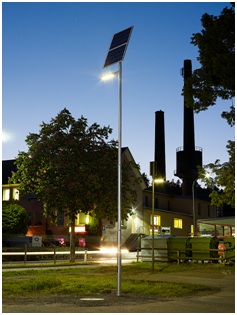
Expensive public illumination was put to an end on a street in Nepal’s capital city, Kathmandu

Nepal's capital city has solar street lamps

Nepal has solar street lamps

A central street from the Nepal’s capital city, Kathmandu, has a new way of facing the dark: solar powered street lamps.

This big step for the Asian solar industry couldn’t have been possible without the collaboration between Kathmandu Metropolitan City and Durbarmarg Development Board (DDB). The chief of the Urban Development Committee from KMC announced that most of the construction is finished, meaning that poles with twin lights have already been installed.

KMC gave permission to DDB to put into action the project that will bring to the street of Durbarmarg not less than 30 solar street lamps, installed on both sides of the street.

 “Right now we have planted the lamps just as dividers. We will also equip the foot lanes with additional lamps,” announced Rijal, chief at KMC.

To project is predicted to reach Rs 11.79 million and is possible due to a public-private partnership of KMC and the DDB. If this project reaches its goals, KMC is willing to bring a clean light to all main roads in the city.

 “This is just a pilot project, and we are sure it will attract more local communities to solar powered lamps, considering the growing power crunch. This will be proposed in most of the four lanes within the Capital,” said Rijal.

The project was no easy to implement as in 2013 KMC asked for help from public and consumers committees for about 30% of the installation price but they got no support at all. Still,  KMC got Rs 380 million from the Asian Development Bank (ADB).

The bank is going to supply with 600 light, and half of them will be under the jurisdiction of KMC.

 Roxana Moraru