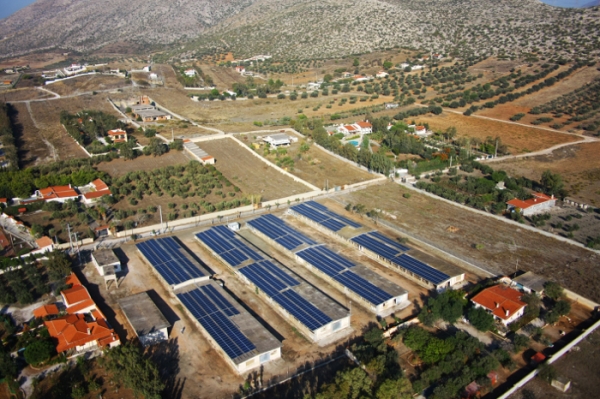
Greek PV, war against job losses

Greek PV falling

Greek PV industry asks The Prime Minister for help in the war against job losses

The Hellenic Association of Photovoltaic Companies (HELAPCO) wrote yesterday an open letter to the Greek Prime Minister Antonis Samaras reporting that three quarters of the solar sector jobs were lost this year only. HELAPCO also asked the Prime Minister to provide means of restarting the Greek solar PV market.

The words addressed to the Greek Prime Minister have a powerful tone reporting that besides the three quarters of the solar sector jobs lost so far, another one could by lost by the next year if no one tales any measures to prevent this

The solar PV industry also announced Samaras, with the help of HELAPCO that the solar sector has provided thousand of working places in the whole country. Moreover, they claim to have attracted significant investment from domestic and foreign sources in moments when the country was facing a big economic crisis and had the biggest unemployment rate on the continent.
HELAPCO is proud to announce that this year only, the PV sector supplied Greece with €1.5 billion, and over the past five years the association invested €4.5 billion.

Samaras is also reminded that the greek solar PV industry supplied 20,000 direct and 30,000 indirect jobs, benefiting about 100,000 Greek households. In specific terms, HELAPCO claims that 38,000 residential consumers and 14,000 companies have invested in the domestic solar market for the past years.

So, as HELAPCO reports, there are at least 40 % of the services, materials and components used in PV arrays that are manufactured domestically by Greece’s tax payers which are hired on 60 different job positions.

Roxana MORARU


The biggest rooftop system will be built in by Solon

The largest rooftop system in Bucharest will stand on top a a logistics centre

15% of the energy will go into the Romanian grid

A 2.2 MW grid tied system made comprised of nearly 9,000 Solon 220/16 modules that is set to be planted in only seven week on top of a Bucharest logistics center.

Berlin-based solar module producer Solon Energy is on the way to plant Bucharest’s biggest system in a seven week’s period.

Solon announced to finish installing the system of 8,000 if its 220/16 modules on top of the logistics center until the end of the month.

The 2.2 MW system is going to produce 2.8 MWh per year and about 15% of that generated energy will be spend by the firms in the building, and the rest of the green energy will go into the Romanian grid company, Transelectrica, fact that will guarantee green certificates for the company.

The logistics center is owned by Romanian PV installer SC Atwar & TH Services, a company that was founded by logistics company Elcyrom Realty & Development.

Roxana MORARU

The solar development in Japan may be limited by the gird capacity

Japan lacks grid capacity

Japan could have problems with the grid capacity

The southern Japanese may have less than 1 GW of grid capacity left for upcoming solar and wind projects. This statement results from the new analysis from Bloomberg New Energy Finance (BNEF).

“Grid congestion” appears to be an important layoff in going on with the renewable energy market, in Japan’s blooming solar industry. Still, in the north of the country, on the island of Hokkaido, there is a well know shortage of grid capacity, and now the new BNEF report says that related issues may appear in the south of the country also.

Although a 22.4 GW of new green energy capacity have been accepted as part of the FIT program that emerged in last year’s July, BNEF analysis reports that the Chugoku Electric Power Co. and Kyushu Electric Power Co. posses a little under of 1 GW of accessible grid capacity in the south of the country.

BNEF also shows that the report reveals an estimated grid capacity of 34 GW as being usable for upcoming wind projects all over the country.

The rehabilitation of Japan’s energy market are on going at this moment and Bloomberg is announcing that a bill is said to be introduced into Japan’s parliament in the fall. BNEF believes that a free trade could bring grid development.

Japan’s utility market continues to be partially closed having regional monopolies as a feature. These monopolies have been under pressure since the Fukushima Daiichi nuclear power plant disaster in 2011.

Telecommunications entrepreneur Masayoshi Son, the billionaire Chairman and CEO of Softbank Corp., has been involved in marching for increased electricity market reregulation. Softbank is already known as being active in expanding photovoltaic projects in the country.

Roxana MORARU